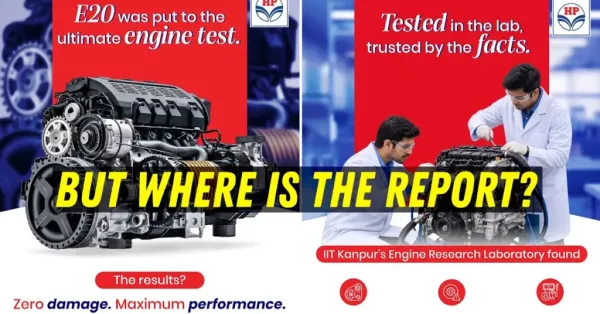
HPCL has stepped into the E20 petrol debate with a strong claim: extensive testing by IIT Kanpur found no engine damage, corrosion or technical faults attributable to E20 in newer or older vehicles, while the observed fuel-economy reduction stayed below 5 percent.
The issue is how little supporting test data is publicly visible alongside such a broad claim. HPCL’s post names IIT Kanpur’s Engine Research Laboratory and says vehicles underwent extensive testing.
But it does not identify which vehicles were tested, their model years, whether they were certified for E20, how many kilometres they covered, the exact fuel used, or the detailed test methodology. Those are important questions when the claim covers both “newer and older vehicles”.
The underlying statements are not new. In July, Dhruv Raj Karana, Project Scientist at IIT Kanpur’s Engine Research Laboratory, said the institute’s work found no evidence of engine damage, corrosion or other technical problems from E20 in newer or older vehicles.
He also said the fuel-efficiency reduction observed was below 5 percent and argued that a variation of that size cannot automatically be attributed to ethanol because repeated tests with the same fuel can also produce differences.
Reporting from IIT Kanpur showed a BS6 car engine tested for knocking and performance, while a motorcycle was tested under varying speeds, acceleration and loads. That establishes that testing has taken place. It does not answer every question raised by HPCL’s much broader social-media claim.
Public reports do not provide a full vehicle and vintage list or a detailed durability dataset owners can independently examine.
There is another reason transparency matters. The government’s own 2021 Roadmap for Ethanol Blending estimated a 6 to 7 percent fuel-economy reduction for four-wheelers designed for E0 and calibrated for E10 when running E20. It estimated 3 to 4 percent for comparable two-wheelers and 1 to 2 percent for cars designed for E10 and calibrated for E20.
The same report discussed material compatibility. It said tests found inferior performance with E20 for certain elastomers and a drop in tensile strength for PA66 plastic. It also said the move to E20 would require changes to components such as O-rings, seals and fuel pumps.
Most importantly, the roadmap recommended continued availability of E10 as a “protection grade” fuel for existing vehicles during the transition. That does not prove E20 will damage an older car. The 2021 trials also found no abnormal engine wear or severe malfunction.
But it shows why a simple statement that E20 has been tested on “older vehicles” needs detail. A 2022 BS6 car, a 2015 car designed around E10 and a much older petrol vehicle are not automatically the same compatibility case.
HPCL is entitled to point motorists towards scientific testing rather than anecdotes on social media. The same standard should apply in the other direction. If the argument is that confidence should come from evidence, the strongest response would be to make that evidence easy to inspect.
Publish the vehicle list, manufacturing years, E20 compatibility status, baseline fuel, kilometres accumulated, test cycles, temperature and load conditions, fuel source, ethanol percentage, corrosion measurements, elastomer and plastic assessments, fuel-economy results for each vehicle and the statistical variation between repeated runs.
That would allow motorists, engineers and vehicle manufacturers to understand exactly what “extensive testing” means. It would help separate genuine E20 problems from un failures, bad fuel, poor maintenance or normal ageing.
The IIT Kanpur findings may ultimately prove reassuring. The available information certainly does not establish that E20 is routinely destroying engines. But HPCL has chosen to make a very broad claim covering old and new vehicles while asking consumers to trust rigorous testing.
-
Nalli Nihari To Lotus-Inspired Mithais, This Is What BRICS Delegates Will Eat In Delhi
-
Pre-booking of iPhone 18 Pro and Pro Max will start from today, know the price offers and how to buy

-
Will Vaibhav Suryavanshi storm in Duleep Trophy final? East Zone batting first
-
Chelsea vs Hull City player ratings — Belloumi brace helps Tigers hold Blues

-
India Blocks Pakistan's Entry in BRICS