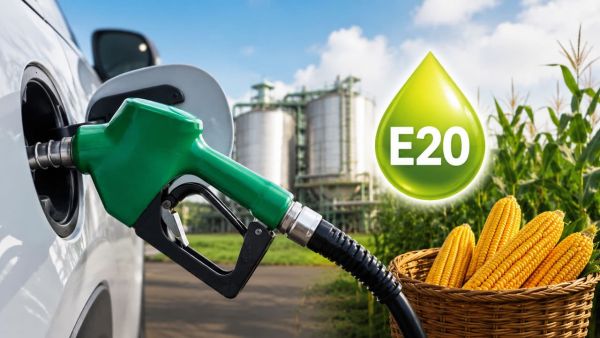
From 1 April 2026, E20 petrol is India’s base fuel. F1 never ran on E20 and now uses 100% synthetic fuel. Expect lower mileage (3-7%), moisture-driven phase separation risks, and unanswered questions on >90,000 pumps, even as the government cites about ₹2 lakh crore in savings.
India’s shift to ethanol-blended petrol has accelerated and stirred a nationwide debate. Policymakers and parts of the auto industry defend E20 by pointing to racing series, arguing that ethanol can boost performance. But the comparison between an everyday hatchback and a car lapping a circuit at 300 km/h is proving far from straightforward.
The original plan targeted 2030 for E20 at retail pumps. That deadline was pulled forward by five years to 2025–26, and from 1 April 2026 E20 became the base fuel across ordinary petrol pumps. Neat petrol without ethanol now survives only as a limited, pricier “premium” option.
Policy Shift And Consumer Choice
This has left owners of millions of older vehicles, designed for E0 or lower blends, without a real choice. Critics also flag the pace of rollout, the lack of clear pump labeling, and no price relief despite expected efficiency losses.
The government’s racing analogy is incomplete. Formula 1 cars never ran on 20% ethanol; they spent years on E10, which India has now phased out, and F1 has since moved to 100% synthetic fuel.
Engine life is incomparable: a racing engine (such as in NASCAR) is torn down after roughly 800 to 1500 kilometers, while consumer cars are expected to run 200,000 to 300,000 kilometers without opening the engine.
Racing Fuel Isn’t Real-World Motoring
Fuel handling is different, too. On a racetrack, fuel is blended fresh and burned within hours. In daily use and at retail stations, fuel can sit for weeks. Ethanol is hygroscopic, pulling moisture from humid air.
In monsoon or coastal conditions, excess water can trigger phase separation, the petrol layer floats up while a heavier ethanol, water layer sinks. Dispensers draw from the bottom, raising the risk of stalling and corrosion when that mixture reaches the vehicle.
Officials reject social-media claims of a 30% mileage crash, and the data supports that rebuttal. Still, mileage declines do occur because ethanol has lower calorific value. A 2021 NITI Aayog report notes that legacy E0-designed vehicles can see 6% to 7% lower fuel efficiency on E20. Maruti Suzuki has indicated a 3% to 3.5% hit with E20.
Mileage, Data And International Practice
Brazil shows a different path: about 80% of new cars are flex fuel, subsidies help offset efficiency losses, and consumers choose what to buy at the pump. In India, speed trumped choice. More than 90,000 pumps need proper cleaning and relining to store E20 safely, yet no independent public audit shows how many are truly upgraded.
The government says ethanol blending has delivered major gains, about ₹2 lakh crore saved on crude imports, some environmental benefit, and money flowing to farmers via sugar mills. But citing racing cars does not settle concerns over engine life, real-world mileage, and the effective loss of fuel choice for many drivers.
-
Anxiety Relief: How Sujok Therapy Can Help Calm The Mind

-
'Get Him In Test Team': Netizens Demand Team India Call-Up For Vaibhav Sooryavanshi After Stunning 92-Run Knock In Duleep Trophy

-
iPhone 18 Pro, iPhone 18 Pro Max Pre-Orders May Be Pushed To September 12: All You Need To Know

-
'A Small Gift Of Love And Hope': Ex-Venezuelan President Nicolas Maduro Shares Photos From New York Prison

-
Who Is Runa Khan? Bangladesh’s ‘Friendship’ NGO Founder Wins 2026 Ramon Magsaysay Award