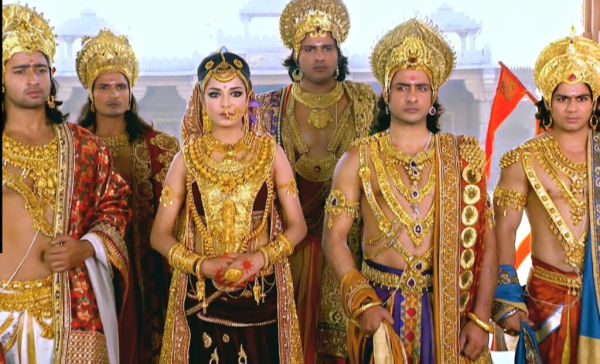
Whenever the Mahabharata is discussed, several questions surrounding Draupadi continue to fascinate readers. Her marriage to the five Pandavas, the infamous dice-hall episode, her relationship with Lord Krishna and, most importantly, the question of why she did not marry Karna have remained subjects of debate for centuries.
Karna and Arjuna were both extraordinary warriors. So why did Draupadi’s story ultimately become connected with Arjuna rather than Karna?
The answer is more complicated than the popular story of Draupadi simply rejecting Karna at her swayamvara. Different versions of the Mahabharata tradition tell the episode differently. While popular retellings often say that Draupadi refused to allow Karna to participate because he was a “Suta-putra,” this episode does not appear in exactly the same form in the Critical Edition of the Mahabharata.
Several factors — including Draupadi’s unusual birth, King Drupada’s intentions, the swayamvara challenge, Karna’s social identity and later traditions about Draupadi’s previous birth — are connected to the story.
1. Draupadi Was Born With a Special Purpose
Draupadi was not born through an ordinary birth, according to the Mahabharata.
King Drupada had developed deep hostility toward Dronacharya after being humiliated by him. Seeking revenge, Drupada performed a sacrificial ritual. From the sacrificial fire emerged Dhrishtadyumna and Draupadi.
Dhrishtadyumna’s destiny was explicitly associated with the killing of Dronacharya. Draupadi’s appearance from the same sacrificial ritual also made her birth part of a larger chain of events that shaped the Mahabharata.
Drupada therefore sought a highly accomplished warrior as a suitable husband for his daughter. The extraordinary archery challenge arranged at Draupadi’s swayamvara was part of this larger setting.
2. Arjuna Won the Swayamvara Challenge
The swayamvara presented an extremely difficult test of archery.
According to the Mahabharata narrative, the contestant had to string a powerful bow and hit a rotating target while aiming through its reflection.
Several kings and warriors attempted the challenge but failed.
Arjuna, who was disguised as a Brahmin at the time, eventually succeeded in hitting the target. Draupadi then chose him by placing the garland around his neck.
Therefore, one of the clearest explanations in the main narrative is simple: Arjuna successfully completed the challenge and became the winner of Draupadi’s swayamvara.
3. Did Draupadi Really Reject Karna as a “Suta-Putra”?
This is perhaps the most controversial part of the story.
In many popular retellings, Karna is said to have stepped forward to participate in the swayamvara. Draupadi supposedly stopped him by identifying him as a “Suta-putra,” or the son of a charioteer, and refused to marry him because of his social status.
This version became particularly influential in later interpretations of the relationship between Karna and Draupadi.
However, the story is more complicated when the Critical Edition of the Mahabharata is considered. The episode does not contain the same explicit scene in which Draupadi publicly rejects Karna by saying that she will not accept a “Suta-putra.”
In the Critical Edition’s account, Karna is associated with the competition but does not successfully complete the archery challenge.
This distinction is important because many details familiar from popular Mahabharata retellings are not necessarily found in the same form in the oldest recoverable textual tradition.
4. Draupadi’s Previous-Birth Story
Another important explanation comes from the Mahabharata’s account of Draupadi’s previous birth.
In the Adi Parva, a story is associated with a woman who performed intense penance to Lord Shiva and repeatedly expressed her desire for a husband possessing several desirable qualities.
According to the narrative, Shiva granted her a boon that she would have five husbands in her next birth.
This story is later connected with Draupadi’s marriage to the five Pandavas.
From this perspective, Draupadi’s relationship with the Pandavas was not presented merely as the result of an ordinary marriage arrangement. It formed part of a larger destiny within the Mahabharata narrative.
5. What About Karna’s Relationship With Duryodhana?
Karna’s close relationship with Duryodhana is another important part of the broader story.
Karna became one of Duryodhana’s closest allies and remained firmly aligned with the Kaurava side. His loyalty to Duryodhana ultimately placed him in direct opposition to the Pandavas.
This later relationship makes the possibility of a Karna-Draupadi marriage difficult to fit into the larger political and narrative structure of the epic.
However, it would be misleading to claim that the original Mahabharata explicitly says that Draupadi did not marry Karna because of his friendship with Duryodhana. That is better understood as an interpretation of the broader circumstances rather than a clearly stated reason in the text.
Was a Karna-Draupadi Marriage Ever Possible?
If we rely on the main narrative of the Mahabharata, there is no straightforward statement saying that Draupadi could have married Karna but deliberately rejected him for a particular reason.
The decisive event is that Arjuna completed the swayamvara challenge and Draupadi garlanded him.
The popular story that Draupadi rejected Karna specifically by calling him a “Suta-putra” has become deeply embedded in later retellings, television adaptations and popular culture. However, the Critical Edition does not preserve that episode in precisely that form.
Similarly, explanations involving Karna’s relationship with Duryodhana, Draupadi’s predetermined destiny and social identity can provide context, but they should not all be presented as explicit statements from the original text.
The Bigger Picture
The question of why Draupadi did not marry Karna becomes particularly interesting because the Mahabharata exists in a long and complex textual tradition. Stories have been transmitted, interpreted and retold in different forms over centuries.
The most reliable conclusion is that Arjuna won Draupadi’s swayamvara by successfully completing the prescribed challenge. The popular account of Draupadi rejecting Karna because he was a “Suta-putra” is a later and widely circulated version, but it is not presented in the same way in the Critical Edition.
Thus, the Karna-Draupadi question cannot be answered with a single simple reason. It sits at the intersection of the epic’s original narrative, later traditions, social interpretations and the Mahabharata’s larger ideas of destiny and duty.
In the end, Draupadi’s marriage to the Pandavas was not merely the outcome of a single archery contest. Within the epic’s larger framework, it was part of a chain of events involving destiny, political alliances, divine boons and the unfolding conflict between the Pandavas and Kauravas.
-
Miss Teen International 2026: Cuba's Jhoanna Uranga Wins Crown In Jaipur
-
Daayra Trailer: Kareena Kapoor, Prithviraj Sukumaran Face Off In Meghna Gulzar's Crime Thriller
-
Hyderabad couple under digital arrest for 4 months, lose Rs 64L

-
WATCH | Moment Glacier Collapsed Before Nepal Flash Floods Accidentally Captured On Drone

-
IAS Officer Divya Mittal's Resignation: List Of 13 Officers Who Have Left Service Since 2017