8
Sajjan Kumar’s death reminds us that 1984 was undoubtedly a one-sided organized massacre of a specific community, instigated orchestrated and sustained by the establishment.
A few days ago, on August 20, a man named Sajjan Kumar died in Safdarjung Hospital while serving a life sentence. Who was Sajjan Kumar, and what was his role in one of the most horrific public atrocities to occur in post-Independence India?
Public memory is fickle and transient and needs to be constantly reminded of past evil so that we do not repeat the same mistake or forget the true character of the people or party responsible for these crimes. Moreover, the current generation of Indians (many of whom were not even born when such incidents occurred) may be totally unaware of these happenings.
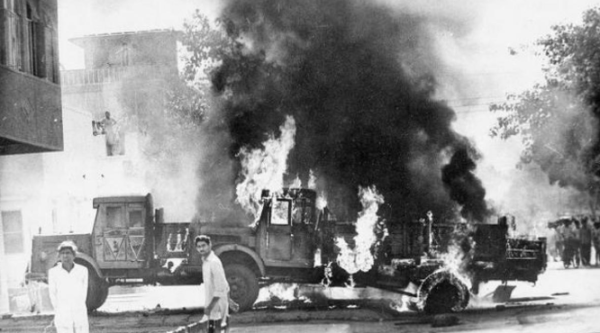
Sajjan Kumar was a three-time MP of the Indian National Congress. He was the alleged mastermind and the face of what is arguably the worst communal atrocity of post-Independence India: the anti-Sikh riots of 1984, a bloody pogrom—which killed at least 3,000 Sikhs—carried out by Congress workers in the wake of PM Indira Gandhi’s assassination in October 1984.
You Might Be Interested In
It was undoubtedly a one-sided organized massacre of a specific community, instigated orchestrated and sustained by the establishment. The figures tell the whole story: 3,000 Sikhs killed with zero corresponding casualties on the other side. That it was manufactured is obvious for until then anti Sikh riots (unlike Hindu-Muslim) were unknown in Indian history.
At the outset, therefore it is important to make one distinction for the sake of clarity. This was not Hindu-Sikh violence. This was a Congress instigated pogrom against the Sikhs.
The Nanavati Commission unequivocally detailed the role of the Congress: “Large number of affidavits indicate that local Congress(I) leaders and workers had either incited or helped the mobs in attacking the Sikhs. But for the backing and help of influential and resourceful persons, killing of Sikhs so swiftly and in large numbers could not have happened… The systematic manner in which the Sikhs were thus killed indicate that the attacks on them were organized. In many places the riotous mobs consisted of outsiders… Outsiders in large numbers could not have been brought by ordinary persons from the public. Bringing them from outside required an organized effort. Supplying them with weapons and inflammable material also required an organized effort.”
There were glaring lapses in governance in the critical three-day period after the assassination when most of the killings occurred. At the top of this list were police inaction and an inordinate delay in deploying the Army, which was not called in until the third day. These actions appeared to be almost deliberate. Bluntly speaking, the top Congress hierarchy all fiddled when Delhi burnt.
Making matters worse was Rajiv Gandhi’s remarks made a few days later on November 19 at the Boat Club in New Delhi: “When Indira’s assassination happened, there were riots in the country. We know that the hearts of the Indian people were full of anger and that for a few days people felt India was shaking. When a big tree falls, the earth shakes.”
This amounts to a virtual justification of the killings; a callously insensitive statement that not only lacked remorse but seemed to ignore the larger question of his accountability as the PM of the nation.
After the riots the Congress indulged in a series of inquiry commissions (Marwah, Misra, Kapur Mittal, Jain Banerjee etc), some of which were headed by eminent jurists. These were not sincere attempts to unearth the truth or to bring the guilty to book. They were eyewashes to exonerate the Congress establishment of wrongdoing. How else can you explain the conclusion of the Justice Ranganath Mishra Commission which admitted that although local Congress leaders and workers were complicit in the killings the party itself was not responsible?
The Nanavati commission headed by Justice G.T. Nanavati, a retired judge of the Supreme Court of India, appointed by the BJP government in May 2000 was the only one which carried out a systematic and honest inquiry into the anti-Sikh violence. The report clearly pointed a finger at top leaders of the Congress: Sajjan Kumar, Jagdish Tytler and H.K.L. Bhagat.
But after the BJP was voted out of power in 2004 and the UPA returned. The report was placed in cold storage and cases against the accused were closed.
In 2015, the BJP government under Narendra Modi instituted a SIT to reopen and scrutinize hundreds of riot cases that had been closed ostensibly due to lack of evidence during the Congress-led UPA rule. As a result, in December 2018, in one of the first high-profile convictions, Sajjan Kumar was sentenced to life imprisonment by the Delhi High Cour
The Delhi High Court, delivering its verdict on a riot- case in 2009, aptly remarked: “Though we boast of being the world’s largest democracy and the Delhi being its national capital, the sheer mention of the incidents of 1984 anti-Sikh riots in general and the role played by Delhi Police and state machinery in particular makes our heads hang in shame in the eyes of the world polity.”
The Congress party was responsible for what is singularly the deadliest act of communal violence in post-Independence India. By skilful skullduggery and labelling itself as a secular party, the Congress has evaded all responsibility, accountability and punishment for this ghastly communal massacre Therefore it is imperative that we remind all Indians of the Janus-face of the Congress and call out its duplicity.
-
Mohammad Rizwan And Imam-ul-Haq 'Dropped' From Pakistan Test Squad, Likely To Return Home Ahead Of ENG Vs PAK 3rd Test
-
BCB Chief Tamim Iqbal Calls For Separating Sports From Politics After Bangladesh's World Cup Withdrawal
-
'Cast Of Race 4 Has Not Yet Been Finalized': Ramesh Taurani Shares Statement Amid Reports Of Aamir Khan Starring In The Film

-
No Survivors Found in Nepal Hydropower Tunnel; 93 Workers Still Untraceable After Floods

-
‘Run, Water!’: Stranger's Shout Saves 370 Students, Teachers From Deadly Nepal Flash Flood