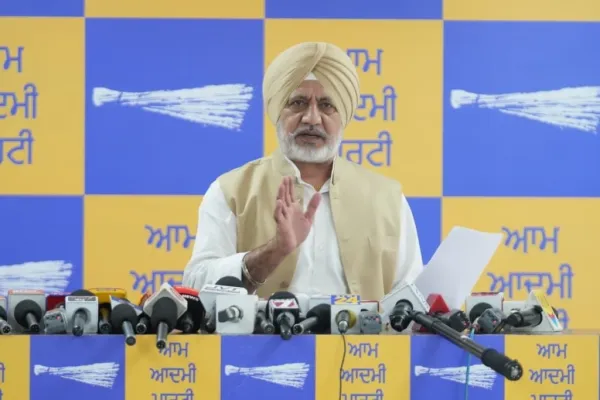
Punjab groundwater: Aam Aadmi Party (AAP) Punjab media in-charge Baltej Pannu on Monday said the latest groundwater assessment has given a big ray of hope to Punjab as government data shows that the state has started fixing a crisis that previous governments allowed to fester for decades. He said that this improvement is the result of continuous efforts made by the Bhagwant Singh Mann government to increase the use of canal water, strengthen the canal infrastructure and reduce Punjab’s dependence on groundwater.
Questions on previous governments regarding water crisis
Addressing a press conference, AAP Punjab state media in-charge Baltej Pannu said, “For decades, we have been hearing about the need to save Punjab’s water. We have seen leaders calling themselves custodians of Punjab’s water, carrying symbolic tools and giving emotional speeches. But the question is simple: what have they actually done? The answer is now in front of Punjab in the form of government data.”
Government’s focus on use of canal water
Baltej Pannu said that the Bhagwant Mann government chose a different path by focusing on planning, infrastructure and implementation instead of slogans. He said the AAP government worked to ensure that Punjab fully utilizes its share of canal water, thereby reducing the burden on groundwater.
Utilization of canal water reached 80 to 82 percent
He said that the utilization of canal water has now reached about 80% to 82%, which was only around 21% in 2022. He further said, “The government has commissioned 14,100 canals, repaired over 400 km of closed canals and paved over 1,000 km of canals. Along with repairing the canal structures, recharge points have also been created to help recharge the groundwater.”
11.58 percentage point reduction in groundwater exploitation in four years
Baltej Pannu said that the effect of these measures is now clearly visible in the latest groundwater assessment. Baltej Pannu said, “The level of groundwater withdrawal in Punjab has declined from 163.80% in 2021-22 to 156.36% in 2025 and 152.22% in 2025-26, which shows an improvement of 11.58 percentage points in four years. The level of annual groundwater withdrawal has also decreased from about 28.01 billion cubic meters. Has decreased to 26.32 billion cubic meters.” “11.58 percentage points may seem like just a number on paper, but for Punjab it means that after decades of decline, we are finally moving in the right direction.”
Improvement in 95 blocks, four reached safe category
He said that the most encouraging aspect of the latest assessment is the improvement recorded in the groundwater assessment blocks. “There has been improvement in 95 of Punjab’s 153 dark-zone blocks, while the number of critical blocks has reduced from 10 to 6. Four blocks have moved into the safe category, including Arniwala in Fazilka, Makhu in Ferozepur, Hajipur in Hoshiarpur and Narot Jaimal Singh in Pathankot. Another 14 blocks have recorded significant improvement,” he said.
Groundwater recharge increased by canal water
Baltej Pannu said that groundwater recharge has also increased, the total annual recharge is 19.14 billion cubic meters. “This includes 5.53 billion cubic meters from rain and 5.5 billion cubic meters from canal water. The recharge of canal water has increased from 4.5 billion cubic meters last year to 5.5 billion cubic meters this year,” he said.
Need to reduce dependence on tube wells in farming
He said these figures show why it is important for Punjab to reduce its dependence on tube wells for agriculture. He further said, “Out of the 26.32 billion cubic meters of groundwater withdrawn, about 24.95 billion cubic meters is used for agriculture, while about 1.38 billion cubic meters is used for domestic and industrial purposes.”
Punjab is still facing serious water crisis: Pannu
Baltej Pannu acknowledged that Punjab is still facing a serious challenge of groundwater. However, he said a change of direction was necessary as the new assessment showed reductions in groundwater withdrawals and improvements in many assessment blocks. He said, “This is the difference between governments that just talk about Punjab’s water crisis and a government that decides to solve it. The Bhagwant Mann government did not reduce Punjab’s share in water going to any other state, but increased the use of Punjab’s own canal water. The opposition should answer this question: Where was this water going when they were in power?”
Water conservation is important for future generations
Baltej Pannu said this development is especially important for the next generation of Punjab, as the state’s water crisis is ultimately a question of what future generations will inherit. “When history is written, our children should not ask us why we left the desert for them. They should be able to say that their parents’ generation finally took timely action. The latest groundwater data gives this hope to Punjab,” he said.
Government work should be counted in other areas also
He said that the same style of governance, going beyond slogans and delivering concrete results, is being seen in other areas as well, which include road safety forces, infrastructure of government schools and strengthening the public healthcare system. Baltej Pannu said, “The message from these figures is clear: If the government has the political will, Punjab’s problems can be solved. The Bhagwant Mann government has shown that commitment; now the results are beginning to speak for themselves.”
-
‘They turned a wedding into a funeral’: Iran after US strike

-
Telangana man dies in Russian strikes on Ukraine
-
Ganga river crosses warning mark in Varanasi
-
Stock markets tumble in early trade on escalating tensions

-
Bombay HC Orders CBI Probe In Disha Salian Death Case, Directs FIR Against 'Unknown Persons'