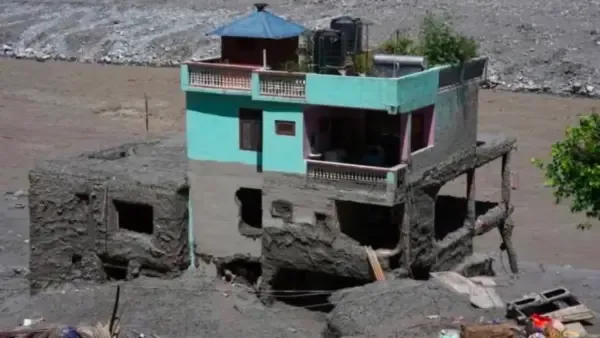
Ablue home standing tall as floodwaters, mud and boulders swept away everything around it in Nepal has left people amazed, with videos of the seemingly unshaken structure going viral on social media.
Even more shocking was that residents were still inside the house and could be seen huddled together on the balcony.
Flash floods struck Nepal early on Wednesday, August 26, sending huge volumes of water, rocks and debris through villages and towns. The scale of the destruction has raised questions about how some structures managed to withstand the force while others around them were swept away.
Among them is the blue house seen in the viral videos, leaving many to wonder: How did it survive?
What made the blue house stronger?
An architecture enthusiast on X shared a video of the structure and offered a possible explanation based on its design and the way the floodwater moved around it.
The account described the blue home as a rare structure still standing in what it called Nepal's "disaster zone", while several buildings around it appeared to have been destroyed.
"This lone structure took a direct hit from a massive debris flow, a dense slurry of mud and car-sized boulders moving at highway speeds, and refused to fall," the user said.
According to the explanation, one of the key differences could be the building's structural system.
Many houses in Himalayan valleys are built using unreinforced stone masonry. Such construction can support the weight of the building vertically, but it is considerably more vulnerable to strong sideways or lateral forces.
The blue house, however, appears to have a reinforced concrete frame, the architecture enthusiast said.
Such a frame consists of interconnected concrete columns and beams reinforced with steel bars. Concrete is particularly good at handling compression, while steel provides strength against tension. Together, they create a much more robust structural framework.
The user explained that continuous steel reinforcement connected the columns, beams and foundation, effectively tying the structure into a single rigid frame.
When the debris flow struck, the frame would therefore have been able to absorb and distribute much of the sideways force through the building and into the ground, rather than allowing individual walls to take the full impact.
Its location may have helped too
The building's construction may not have been the only factor that helped the blue home survive.
The architecture enthusiast pointed out that debris flows tend to carry their largest and heaviest boulders through the deepest part of the channel. The house, they suggested, appeared to be positioned slightly away from this main path and on somewhat higher ground.
That could have significantly reduced the direct force hitting the structure.
The compact shape of the building may also have helped divert the flow. As the mud and debris reached the house, the mass split and moved around either side instead of striking the entire structure head-on.
Mud deposited around the building then appears to have formed a natural ramp. According to the explanation, that raised section may have helped deflect subsequent surges away from the house.
In other words, the blue house may have survived because of a combination of stronger structural design, its position relative to the main debris channel and the way the floodwater and debris moved around it.
However, a definitive assessment would require an on-site structural inspection. Viral footage alone cannot establish exactly how much force the building endured or whether its foundation and structural members suffered hidden damage.
-
Indian expats in UAE warned of fraud linked to biometric scans

-
Delhi: 3-year-old tied up, beaten in playschool; case booked

-
Deputy CM holds review meeting for Invest Telangana Summit prep

-
Netizens draw comparisons between Gandhari and Toxic’s portrayal of women

-
Fernandes brilliant, but Rooney says one Manchester United star was ‘head and shoulders above everyone’ against Ipswich