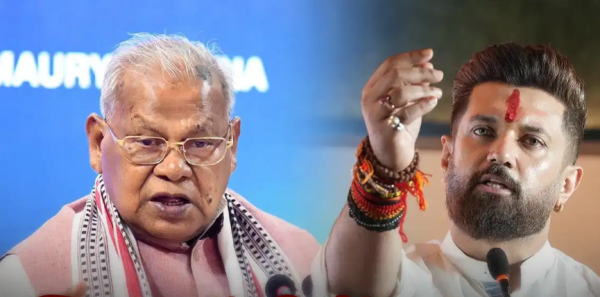
Chirag Paswan vs Jitan Ram Manjhi: Differences between Union Ministers Chirag Paswan and Jitan Ram Manjhi regarding sub-category and creamy layer within the Scheduled Caste (SC) reservation in Bihar have come to the fore. The dispute has increased so much that both the leaders are even demanding resignation from each other. Along with the reservation debate, the caste equation of Bihar is also playing a big role behind this.
Tezzbuzz Desk- These days, ministers Chirag Paswan and Jitan Ram Manjhi in Modi government are face to face on the issue of reservation. The views of both the leaders are different regarding sub-category and creamy layer in SC reservation. While Jitan Ram Manjhi is advocating review of the existing system of SC-ST reservation, Chirag Paswan is opposing it.
Chirag says that creating separate categories within the SC community can increase division in the Dalit society. Manjhi argues that some Scheduled Castes are still extremely backward and they are not getting adequate benefits of reservation. In such a situation, a change in the system is necessary to extend the benefits of reservation to the most deprived communities.
Why do the two leaders have different thinking regarding reservation?
Amidst the debate on implementing sub-quota in SC reservation, Chirag Paswan believes that it would not be right to divide the Dalit society into different parts. He has also raised questions on the concept of creamy layer and objected to the stance of those supporting such a proposal.
On the other hand, Jitan Ram Manjhi says that not all Dalit communities have got the benefit of reservation equally. His emphasis is on giving more opportunities to those castes which are most backward socially and economically.
The basis of Manjhi's stance is the caste survey and data to government jobs revealed in Bihar.
How much share of which Dalit community?
According to the data to caste survey in Bihar, about 2.91 lakh Scheduled Caste people have government jobs in the state. Of these, about 99,230 people from Dusadh community and about 82,290 people from Ram community are reported to be in government jobs.
In comparison, the number of government employees of Musahar community is said to be around 10,615. About 3,274 people of Dom community are in government jobs.
It is clear from these figures that the representation in government jobs among different SC castes is quite unequal. This difference strengthens Manjhi's argument that the benefits of reservation should effectively reach even the most backward Dalit communities.
Statistics of major SC communities of Bihar
| SC community | people in government jobs | share in total population |
|---|---|---|
| Dusadh | 99,230 | 5.31% |
| Ram | 82,290 | 5.25% |
| Washerman | 34,372 | 1.15% |
| Pasi | 25,754 | 0.98% |
| Musahar | 10,615 | 3.08% |
| dome | 3,274 | 0.20% |
According to the caste survey of Bihar, the share of Scheduled Castes in the total population of the state is about 19.65 percent. Among these, the population of Ram/Mochi/Ravidas community is said to be about 5.25 percent, that of Dusadh community is about 5.31 percent and that of Musahar community is about 3.08 percent.
Who leads in job statistics?
If we look at the number of government jobs, the Dusadh community is at the forefront. After this comes Ram, Dhobi and Pasi communities. The numbers of Musahar and Dom communities are much less in comparison.
If we look at the figure of government jobs in proportion to the population, then according to the given data, the Dhobi community is at the top with about 3.14 percent. After this, Pasi is at around 2 percent, Dusadh at 1.44 percent, Dom at 1.24 percent, Ram at 1.20 percent and Musahar at around 0.26 percent.
Chirag and Manjhi's political interests are also different
The differences between the two leaders regarding reservation are not only policy but also to their politics. Chirag Paswan's strong political base is considered to be in the Dusadh/Paswan community. His father Ram Vilas Paswan was also a big face of Dalit politics for a long time.
On the other hand, Jitan Ram Manjhi comes from the Musahar community and has been prominently raising the voice of this community in the politics of Bihar. In such a situation, it is considered natural that the priorities of both the leaders would be different on the issue of who should get the benefit of reservation and how.
Two different viewpoints face each other in the reservation debate
Chirag Paswan says that the basis of SC reservation is historical social discrimination and inequalities like untouchability. According to him, it would not be appropriate to create a separate class within the Dalit society only on the basis of economic status.
Manjhi believes that if the real benefits of reservation are not reaching the weakest and backward communities, then a review of the system is necessary. According to him, the situation of some communities continuously getting more benefits and others being left behind cannot be ignored.
This is the reason why two ministers of Modi government are adopting completely different stances on the same issue of reservation. On one hand, Chirag Paswan is concerned about the unity of the Dalit community and the existing reservation system, while on the other hand, Manjhi is demanding more representation for the most deprived SC communities. The caste equation of Bihar makes this entire controversy more important.
-
WTC Points Table Updated After England’s 3-0 Test Sweep Over Pakistan

-
No Proposal For BRICS Currency At Summit ‘As Of Now’: MEA
-
‘People throw stones at trees that bear fruit’ - Jose Mourinho backs Real Madrid stars Vinicius Junior and Kylian Mbappe after whistles at the Bernabeu

-
DUSU Elections 2026: ABVP, NSUI, AISA-SFI Name Panels For September 18 Delhi University Polls
-
NEET UG MBBS Seat Matrix 2026-27: NMC Releases Updated List With 1,40,214 Seats Across 836 Colleges; Warns Against Excess Admissions