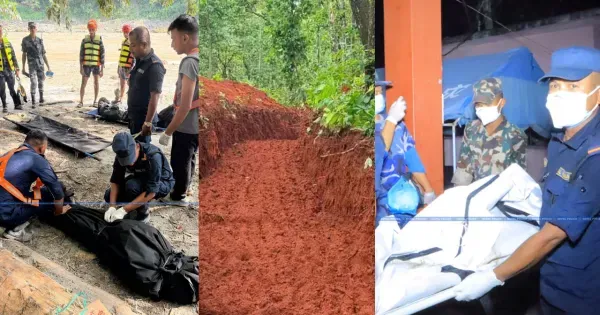
Kathmandu: The severe floods and landslides in Nepal have shown a scene of devastation that is heart-wrenching. In this, a large number of families are waiting for the identification of their missing relatives. About 250 bodies are kept in Chitwan district awaiting identification. Of these, about 100 dead bodies were buried by the authorities on Saturday by making temporary graves.
The decision to bury the bodies temporarily has also been questioned by some local people and affected families. He says that according to Hindu tradition of Nepal, the dead are usually cremated and it is not appropriate to bury the dead bodies without the consent of the families.
More than 800 dead, thousands missing in floods and landslides
At least 800 people have died and more than 3,000 are missing in these floods and landslides in Nepal and Tibet. These bodies, which were recovered in Chitwan, hundreds of kilometers away from the area most affected by the flood, were swept away by the strong current of the Bhotekoshi river. Officials said around 100 bodies were temporarily buried on Saturday amid increasing pressure on forensic teams. A convoy of vehicles carrying the dead bodies reached the dense and lush green forest area. There an digging machine dug a deep trench.
From DNA samples to photographs, evidence is being collected for identification.
Police Inspector Anil Thapa, who is coordinating the process of management and identification of dead bodies, said that DNA samples of these bodies are being taken before burial. Thapa said officials were preserving DNA samples, taking photographs of facial features to help in identification and recording other identification information. Each body is being given a reference number so that the family can identify it later and take the body.
The condition of the dead bodies deteriorated after being in water for four days.
Anil Thapa said that many bodies were submerged in flood water for about four days and by the time they were recovered, the process of decomposition had started. Many houses, vehicles and tractors used in farms throughout the area are still half buried in mud. According to officials, the lack of forensic facilities in the district and insufficient space in mortuaries have further increased the challenge of handling the large number of recovered bodies. Due to excess moisture and extreme heat, the dead bodies are rotting rapidly. Health experts have warned that keeping dead bodies in the open for too long could increase the risk of spreading diseases.
Local people said- the last farewell should be done with respect
Meanwhile, resentment over the burial of dead bodies is increasing among people trying to recover from the disaster. Some local people said that the dead could not get a respectable farewell even after death. Families and some others searching for their missing relatives also raised questions about whether the authorities were too hasty in burying the bodies. The issue is particularly sensitive in Nepal, a country with a majority Hindu population, where the last rites of the dead are traditionally performed through cremation. Ruby Chaudhary, who has been searching for two of her relatives after they went missing, said bodies should not be buried without the consent of the families. “The dead should be treated with respect,” he said. Our tradition is that the last rites of the deceased are performed on the banks of the river in the presence of his immediate family members.
Baburam Bhattarai also raised questions
Former Prime Minister of Nepal Baburam Bhattarai also said that it is not appropriate to bury unidentified bodies before rescue and search operations are completed and without extensive consultation with the families of the missing. He said in a post on social media on Saturday night that if there was shortage of space in mortuaries, authorities could use emergency resources to arrange temporary morgues or 'cold storage' to keep the bodies safe.
Police said – the bodies were not buried permanently
Anil Thapa said, “People are worried that the bodies have been buried permanently but? This is only a temporary arrangement. If someone later confirms the identity of a body on the basis of information available, then he can take the body back and perform the last rites as per his religion and tradition.
Foreign Secretary said steps were taken as per international protocol
Nepal's Foreign Secretary Amrit Bahadur Rai said the process of temporary burial of unidentified bodies was done in line with internationally accepted disaster management protocols. These also include the protocols set by the International Red Cross Committee. “Families can later identify the bodies from records and will be allowed to exhume the bodies to perform necessary religious rituals,” Rai said during a press conference in Kathmandu.
-
7 transfers that were called off after fan pressure: Arnautovic, Ronaldo, Diouf and more

-
cool tourist places around gujarat
-
Inside John Galliano’s decision to pull out of Met Gala — and how it could affect Anna Wintour’s legacy

-
Vietnamese engineer becomes first foreign member of Japanese volunteer fire brigade
-
Hamza Ali Abbasi urges society to support women seeking remarriage