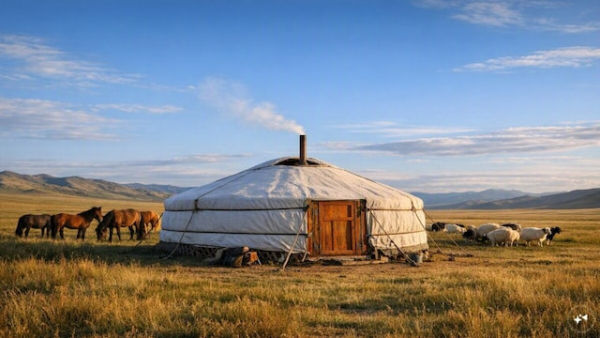
In this blind race of the modern era, where the whole world is competing to build concrete forests, luxurious multi-storey buildings and palaces equipped with state-of-the-art facilities, there is still a unique and mysterious corner on this earth where the lifestyle will take you back centuries in time. You must have heard and seen about beautiful colonies, pucca houses and grand flats in many countries around the world, but can you imagine a country where houses made of brick, mortar or cement do not matter to the residents? Yes, today we are going to tell you about such an extraordinary and traditional country where for centuries, generations after generations, people have been living their entire lives in round-shaped traditional tents instead of living in permanent houses. No matter how far the world has progressed with the wheel of time, the people of this country have still preserved their ancient and unique culture with full pride and vitality, seeing which tourists and researchers from all over the world are astonished. Mongolia's ancient nomadic culture: Where tents are the real identity and basis of life. We are talking about Mongolia, a beautiful country situated in the vast and open plains of Central Asia, which is recognized all over the world for its unique nomadic culture. A very large part of Mongolia's total population still lives in rural and open steppe plains, away from the glare of cities. The geographical location and weather patterns of these areas are such that building permanent concrete houses here is not only practically difficult, but is also not compatible with their lifestyle. In Mongolian culture, these traditional and portable tents are called 'Ger' or 'Yurt' in the local language. It is not an ordinary tent or camping tent, but it is made using highly scientific and traditional methods with a strong structure of wood and a felt cover made of thick sheep's wool, which has been the most trusted shelter of the people of this country for centuries. This traditional 'Ger' tent is capable of withstanding every weather. The weather in Mongolia is extremely extreme and harsh, where in winter the temperature drops to 40 to 50 degrees Celsius below zero and icy winds blow, while even in summer one has to face strong sunlight and storms. In such a situation, the question arises that how do these tent-like houses survive in these dangerous climates? You will be surprised to know that the structure of these traditional 'Ger' tents is so wonderful and flexible that they can easily withstand even the most severe snow storms and strong winds. Due to its round shape, the air pressure is distributed equally all around, due to which the tent does not crumble. There is a traditional iron or clay stove in the middle which keeps the entire tent warm. Even in the harsh cold of winter, this tent proves to be no less than a warm shelter, and this is the reason why people here consider these natural tents more comfortable than modern houses. A unique fabric of culture based on nomadic lifestyle and animal husbandry. The entire life of the people living in these tents in Mongolia revolves around nature and animal husbandry. People here migrate from one place to another several times a year, depending on the weather and in search of pasture for their animals. They have cattle like horses, sheep, goats, camels and yaks, which are their main means of livelihood. When the grass in one area runs out or the weather changes, they load their entire families and belongings, including tents, onto carts and move to new, greener pastures within a few hours. From children's education to elderly care, everything happens inside this portable tent. There may not be a blind race for modernity in this lifestyle, but the intimacy, openness and coordination with nature that is seen here is impossible to find in any other corner of the world. The people of Mongolia are strongly connected to their roots even in the era of modernity. In today's digital and modern era, when the entire world is shrinking into concrete jungles, this tent culture of Mongolia is a living proof that humans can live a satisfactory life even while keeping their traditions along with them. Although modern buildings and apartments are now being built rapidly in big cities like the capital Ulaanbaatar, and people are now living in permanent houses in many parts of the city, yet in rural areas and remote plains of the country, about half the population still lives in their traditional 'ger' tents. Foreign tourists coming here also prefer to experience this unique lifestyle by staying in these traditional tents instead of staying in hotels. This unique tradition of Mongolia teaches us that beyond material comforts, living close to nature and preserving our culture is the identity of real humanity.
-
Khajaguda hit-and-run: Police move to cancel Sandeep Sai licence
-
Release Nagarjuna Sagar water or I’ll march again, warns KTR
-
Teachers’ Day: Telangana to felicitate 123 with state awards
-
Bengal to get 1,000 RSS schools for nationalistic learning: CM
-
'Babar Azam The Next Target?' Pakistan's Sacking Move Raises Big Questions