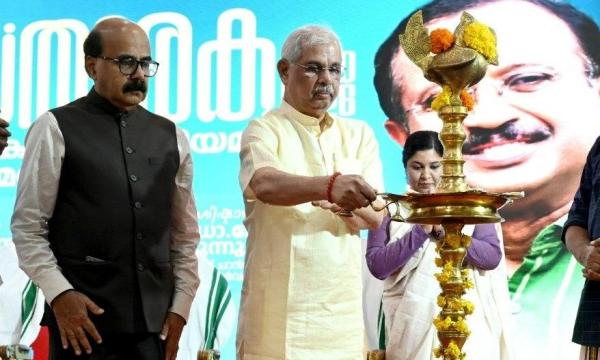
When Kerala University Vice-Chancellor Mohanan Kunnummal stood before a gathering at an RSS youth programme on Independence Day and spoke about Vande Mataram, he was not speaking in the usual language expected of a university administrator.
At the RSS-organised Sankalp 2026 Yuva Sangamam in Thiruvananthapuram on August 15, Kunnummal said that those who opposed saying “Vande Mataram” did not know who their mother was. The remarks immediately triggered a political controversy. Student organisations, including the Students’ Federation of India (SFI) and Kerala Students’ Union (KSU), questioned the propriety of a Vice-Chancellor making such remarks at an RSS programme. Kunnummal later said his reference to the mother was part of a larger speech about the motherland.
Government vs Lok Bhavan
But the controversy did not end with the speech. Days later, at another public function, Kunnummal asked school students to declare loudly that they were not “cockroaches”. When the audience’s response was muted, he repeated the question. The episode added another layer to the criticism of a V-C whose public interventions have increasingly acquired a political colour.
Also read: Foreign forces turning youths into ‘cockroaches’, drug addicts: Kerala University VC
The question now confronting Keralam is bigger than Kunnummal. Keralam’s universities have become the latest arena in the long-running political contest between the Lok Bhavan and the elected government. The Governor, who is also the Chancellor of the state universities, has a statutory role in appointing Vice-Chancellors and exercising other powers under individual university laws. The Governor’s office itself describes the Chancellor as exercising powers independently of the Council of Ministers in university matters. That arrangement has created a peculiar power structure. The elected government is responsible for higher education policy and funding. But several crucial decisions concerning university administration and leadership can fall within the Chancellor’s statutory domain.
The relationship between the Raj/Lok Bhavan and the Keralam government has travelled a long way from quiet constitutional engagement to an open institutional confrontation. During Governor P Sathasivam’s tenure from 2014 to 2019, including the period after the LDF government came to power in 2016, differences were largely handled within the constitutional framework, through official correspondence rather than public exchanges. That changed dramatically with the arrival of Arif Mohammed Khan as Governor in late 2019. His disagreements with the government over the Citizenship Amendment Act (CAA), followed by the increasingly bitter battle over his role as Chancellor of state universities, turned the then Raj Bhavan into a major political flashpoint.
Constitutional dispute
The dispute escalated over the appointment and reappointment of Vice-Chancellors, with the government attempting through legislation to curtail the Governor’s powers as Chancellor. The confrontation then moved to the issue of assent to Bills, eventually forcing the Keralam government to approach the Supreme Court over the Governor’s prolonged inaction.
Also read: Three homes, no answers: Shock and disbelief in Keralam over California murders
The Governor-government battle subsequently became a constitutional dispute, with the Supreme Court intervening on the question of gubernatorial powers. Yet, even after Rajendra Arlekar replaced Khan in January 2025, and the Raj Bhavan became Lok Bhavan, the underlying friction did not disappear. The deadlock over Vice-Chancellor appointments continued, eventually drawing direct judicial intervention, while disagreements over Lok Bhavan events and even the constitutional position of the Governor spilled into the political and educational spheres.
One key dispute was settled last week, with the government and Governor Arlekar reaching an agreement before the Supreme Court on the appointment of Vice-Chancellors. Under the settlement, both sides agreed to jointly approve candidates from a panel constituted under the court’s directions. Dr Ciza Thomas was retained as Vice-Chancellor of APJ Abdul Kalam Technological University, while Dr Saji Gopinath continued as Vice-Chancellor of Digital University Kerala. Though an agreement was reached on the appointment, the question of law is still pending before the Supreme Court.
What higher education minister said
However, LDF leader Pinarayi Vijayan accused the UDF government of surrendering to the Governor by agreeing to amend state university laws in accordance with UGC regulations.
“The UDF government’s action of giving a written undertaking before the Supreme Court that university laws can be amended in accordance with UGC regulations is a shameful surrender before the RSS agenda of using the Governor to bring universities under its control,” Vijayan said in a statement.
“This not only wipes out in one stroke the legal battles waged by the LDF government over the past decade to uphold federal principles and protect Kerala’s higher education sector, but also closes the last legal avenue available to the state government to resist such moves,” he said.
Higher Education Minister Roji M John said the UDF government had nothing to do with the settlement, as the case had already been resolved before it came to power.
Also read: How TN Governor has rekindled state-Centre power clash with Madurai review meet
“There was no point in pursuing the case further, as the Supreme Court had referred the matter to the Lok Adalat. The previous government had already reached an agreement, and the case had consequently become infructuous,” said Roji. However, the minister said that the government has limited powers over V-Cs once they are appointed under university statutes.
“These universities are all now governed by their independent statutes and Acts,” Roji told The Federal. “Based on the provisions of the Acts, the government has limitations in taking action against these Vice-Chancellors. However, in a democratic system, the will of the elected government should prevail,” he said. “Wherever any sort of intervention or any sort of outside involvement comes in, we will definitely resist that.”
Roji also argued that a VC should be above party politics.
“We always feel that they should be beyond party politics and partisan politics. And there should not be any allegiance to any political ideology,” he said. “But we often see some of the Vice-Chancellors taking a political stand and trying to identify with some of the right-wing organisations, especially the RSS, which we don’t agree with at all,” Roji said. “Because that is not good for our education system. We feel Vice-Chancellors should be neutral and should be beyond party politics.”
In the midst of the controversy, Kerala chief minister on Wednesday (September 2) clarified that the state government would follow the protocol set by the Centre on the recitation of Vande Mataram when the president, the vice president or the prime minister attends a government function.
SFI disagrees with UDF govt’s approach
The minister’s position raises an uncomfortable question for the government itself. If political neutrality is a prerequisite for a university head, what happens when the government has little or no direct power to remove a V-C it considers politically partisan?
SFI, the students’ wing of the CPI(M), strongly disagrees with the UDF government’s approach to the Governor and the universities. The organisation has been protesting against the Governor for several years, and is now also agitating against the university Vice-Chancellors over several issues.
Also read: Kerala RSS row: CM Satheesan, Vijayan slam VCs for attending Bhagwat event
“Even though there are certain limitations on the state government when it comes to challenging gubernatorial interventions, the government’s approach matters,” says PS Sanjeev, state secretary of SFI. “The LDF government challenged the Governor in every possible way, including through legislation and litigation. The UDF, on the other hand, opposed the legislation seeking to remove the Governor as Chancellor. That legislation is now pending before the President.”
On the other hand, KSU, the student wing of the Congress, views the SFI agitation as politically motivated.
“KSU believes that this kind of confrontation between the Governor and the government should not happen. It is a fact that Governors are trying to push the RSS agenda through Lok Bhavan, and KSU will oppose that. But the SFI protests and the LDF’s confrontation with the Governor were not sincere. They were political gimmicks. The LDF and the Governor raised these issues whenever the previous government was on the defensive. We believe the UDF government will seek mutual understanding with the Governor on administrative matters. But that does not mean it will compromise on its politics,” said Alosious Xaviour, state president of KSU.
Questions arise about other V-Cs
The UDF’s non-confrontational approach towards the Governor has also left it facing uncomfortable questions. While the government has sought to avoid the prolonged institutional battles that marked the LDF’s tenure, student organisations and the Opposition are questioning whether a softer approach risks allowing the Lok Bhavan greater space to influence university affairs.
Kunnummal is not an isolated case. The same question is now being raised about other V-Cs. At Sree Sankaracharya University of Sanskrit at Kalady, Vice-Chancellor Ciza Thomas became embroiled in a confrontation with SFI students. After protests on campus, she approached the Governor, who took up the issue with the police and administration. The dispute subsequently became another confrontation involving the V-C, students, government machinery and Lok Bhavan. At Mahatma Gandhi University, Vice-Chancellor Dr D Mavoothu has also come under political scrutiny over allegations about his ideological leanings.
Also read: Governor as catalyst, not inhibitor: When SC showed Raj Bhavan its place
The latest episode has added another layer to the Governor-government tensions and given a shot in the arm to the Opposition and student organisations. At an event organised by Kerala University to mark National Sports Day, Vande Mataram was sung in full in the presence of Governor Arlekar and Kunnummal, leaving Higher Education Minister Roji M John and Sports Minister OJ Janeesh embarrassed. The organisers claimed that the decision to sing the full version came from Lok Bhavan, providing fresh ammunition to the Opposition and student organisations in their criticism of the Governor’s growing role in university affairs.
-
10 fake doctors held in raids across Hyderabad, surrounding dists

-
Five dead in bus-truck collision in Madhya Pradesh’s Rewa

-
20-yr-old ate hair, Delhi doctors remove 1.16-kg hairball

-
US May Require Parents To Prove Citizenship When Applying For Their Children’s Passports
-
Kessie’s agent: “He wanted Juventus and waited for them until the end of August, but perhaps the directors were not convinced. It was about dignity, not money”