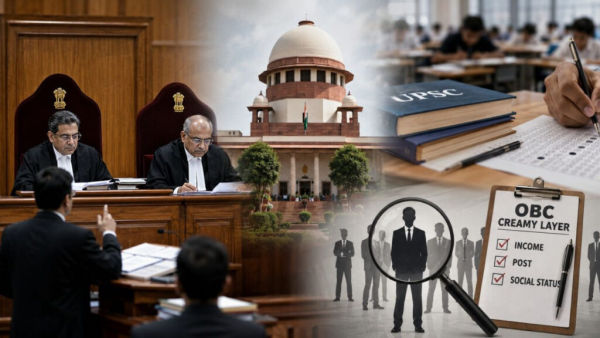
New Delhi: The Supreme Court has once again chosen its strict path on a decision with far-reaching implications to the creamy layer reservation of Other Backward Classes (OBC). While hearing the clarification petition filed by the Central Government, the court clearly refused to impose any kind of interim stay on the implementation of the decision. Justice P.S. Narasimha and Justice R. Mahadevan's bench made it clear that it is necessary to listen to all the parties on this issue. Along with this, the bench has directed all the parties to the case to file their written replies by 17 September 2026.
UPSC recruitment and cadre allocation stuck in trouble
This stance of the apex court has become a big administrative challenge for the central government. Solicitor General Tushar Mehta, appearing on behalf of the Personnel Ministry, presented the complete picture of practical problems in the court. He informed that the process of service allocation of 958 recommended candidates of UPSC Civil Services Examination 2025 was in its final stages, which was being completed on the basis of old fixed rules.
Social status is the real measure
The real root of the controversy is the historic decision of March 11, in which the Supreme Court changed the criteria for determining the OBC creamy layer. The court, in its historic order, had propounded the principle that a candidate cannot be excluded from the scope of reservation merely on the basis of high earnings or high monthly salary of his/her parents. According to the bench, along with income, their position, job category and their actual position in the society should be considered as the main criteria. After this arrangement, putting the children of employees working in Public Sector Undertakings (PSUs), Government Banks and private companies in the creamy layer only on the basis of higher salary will now be considered legally wrong.
Impact on administrative processes across the country
The Center also informed the court that the crisis is not limited to the Union Public Service Commission alone. The implementation of this decision is sure to have a deep impact on all the government recruitments and admission processes going on in higher educational institutions in 18 states and union territories of the country apart from the Centre. Despite this, the apex court has fixed September 17, 2026 for all parties to clarify their stand while not granting any immediate interim relief on the Centre's concerns. Now the eyes of the entire country are fixed on this next hearing. If this new order of the Supreme Court is implemented with retrospective effect, then the entire merit list, cadre allocation of IAS and IPS and the training process to begin with will be completely demolished.
-
VfL Osnabrück vs Bayern Munich: Match preview and team news

-
Julian Alvarez to Barcelona still on as club prepares fresh move in January or June 2027

-
Trump proposes renaming Strait of Hormuz ‘Trump Strait’

-
Manchester United transfer window rated as Lewis Hall move must be completed in January

-
Gardening Tips : Prices of ginger skyrocketed? It could be grown in pots in the house like this; This simple method will work