Ranked the world’s second-richest country by GDP per capita in 2025, the city-state saw core inflation rise from 1.6% in June, according to the Department of Statistics.
The reading, which excludes private transport and accommodation costs, was the highest since October 2024, though it remained below the 2.2% median forecast in a Bloomberg survey.
Headline inflation also increased to 2.2% from 1.9% a month earlier, supported by higher housing costs and the pickup in core inflation.
Utility prices were the main driver of the increase. Electricity and gas costs surged 8.7% year-on-year in July, reversing a 2.9% decline in June.
|
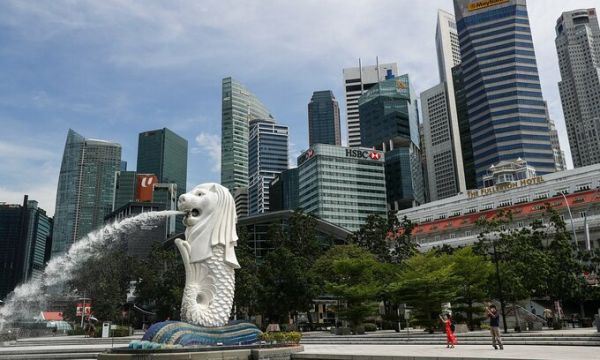
A view of the Merlion statue at the Marina Bay area in Singapore on June 30, 2020. Photo by AP |
“Elevated global energy prices have led to increases in Singapore’s electricity and gas tariffs and higher transportation fares,” the Monetary Authority of Singapore (MAS) and Ministry of Trade and Industry (MTI) said in a joint statement.
The agencies warned that global oil prices remained high and volatile, while unfavorable weather could hurt agricultural yields and push up Singapore’s imported food costs. Higher input costs moving through global supply chains could also raise prices for a broader range of imported goods and services in the coming quarters.
Zavier Wong, a market analyst at trading platform eToro, said the higher electricity tariff introduced in July was benchmarked against gas prices from April to mid-June, when disruptions in the Strait of Hormuz drove energy costs higher.
“That tariff hike is the steepest quarterly rise we’ve seen in years, which begs the question of whether households have enough room to absorb it,” he told The Straits Times.
He added that MAS would need to weigh persistent cost pressures against the risk that tighter monetary policy could weaken household spending.
Food inflation edged up to 2.2% in July from 2.1% in June, reflecting higher prices for restaurant meals and raw food ingredients.
Services inflation rose to 1.7%, partly due to more expensive airfares and point-to-point transport services.
Accommodation inflation increased to 0.8% from 0.6% amid higher rents and maintenance costs.
Private transport inflation, however, eased to 8% from 8.4% as fuel price increases moderated. Retail goods inflation also slowed to 1.4%, helped by lower prices for furniture and personal care products.
MAS and MTI maintained their 2026 inflation forecasts, expecting both headline and core inflation to average between 1.5% and 2.5%.
Wong said the next electricity tariff adjustment could benefit from calmer gas prices, but renewed tensions and a U.S. naval blockade of the Strait of Hormuz had introduced fresh cost pressures.
“The key question is whether these pressures feed through in time for MAS’ October review, or only after it,” he said.
Edward Lee, chief economist for ASEAN and South Asia at Standard Chartered, said the July inflation rise was smaller than expected.
He noted that the more hawkish tone of the inflation statement largely echoed the messaging from the July monetary policy announcement rather than signaling a significant policy shift.
Standard Chartered therefore continues to expect MAS to leave policy unchanged at its October review, although Lee said there remained a possibility of “very modest further tightening.”
Singapore has introduced two support packages worth a combined SGD2 billion (US$1.57 billion) in response to the Iran war, including cash payouts and consumption vouchers for households as well as tax rebates for businesses.
The latest inflation figures also come after the city-state sharply raised its 2026 economic growth forecast to 4.5%-5.5%, up from its previous projection of 2%-4%, according to CNBC.
-
BPSC TRE 4: Applications for Bihar teacher recruitment expected to begin on September 21; Commission tweets on X—check details..

-
UPSSSC PET 2026: Registration deadline for the Uttar Pradesh Preliminary Eligibility Test extended; apply soon..
-
RIMCEE 2026: Applications for the Military College entrance exam have started; check details here..

-
CTET Exam Date 2026: CTET September exam date could be announced anytime; here is the latest update on the city slip and admit card..

-
UPSC CMS Result 2026 OUT: UPSC Combined Medical Services exam result declared; 2,923 candidates shortlisted for the interview..