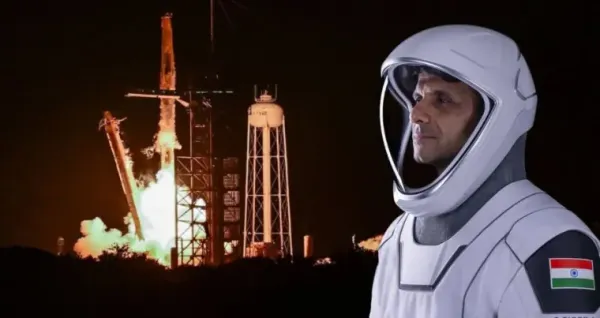
Indian astronaut Shubhanshu Shukla has shared a special post on social media, in which he hypothesized the possibility of humans living on other planets outside the Earth.
New Delhi: Man has been searching for the possibilities of life outside the Earth for a long time. The biggest question among the plans for future human missions on celestial bodies like the Moon and Mars is how safe habitats will be created for humans if they want to live there for a long time. Indian astronaut Shubhanshu Shukla has given a glimpse of the future space habitat by sharing his thoughts to this challenge.
Shubhanshu Shukla told through social media post that an important part of his training in space was not limited to just flying and physical preparation. He also got the opportunity to work on academic research to future space missions. During this time, he tried to understand what the living arrangements for humans could be like after landing from the Earth.
The idea of home on other planets seen in BHEEM
Referring to BHEEM (Bharatiya Habitable Expandable Extraterrestrial Habitat), Shubhanshu Shukla said that in future this can be an important concept towards developing habitable space for humans outside the Earth. He also shared a video of a concept to Aloke Lab of Indian Institute of Science i.e. IISc Bengaluru. It envisions the design and structure of potential habitats that could be used for human settlements outside Earth in the future.
According to Shukla, this idea is to his research in which he considered the circumstances ahead of the spacecraft's mission. His question was that where will humans stay after reaching another planet or world?
There will be many big challenges before space habitat
Creating human habitation on other planets will not be as easy as simply erecting a building. The extremely difficult conditions present there will present many technical and engineering challenges to scientists. Shubhanshu Shukla described issues like radiation, extreme temperatures, life support systems, energy availability and construction technology as important. Any potential human habitat would have to be designed to protect people in the harsh environments of space or another planet.
Apart from this, availability of water, oxygen, energy and other essential resources will also be decisive for the success of future space habitats. This is the reason why space habitat technology and extraterrestrial living are increasingly becoming important research areas for the scientific community.
Today's research will shape the future after 20 years
Shubhanshu Shukla emphasized an important thing in his message. If humanity wants to move towards human habitation outside the Earth in the next two decades, work on such technologies cannot begin after 20 years. Preparation for this will have to be done from now. His message is not limited to space scientists only.
He inspired the youth, researchers and scientists of India to work on new ideas to future space missions. According to him, building human habitation on another world probably starts with imagining that future before actually placing the building materials.
-
Bengal native arrested in Hyderabad with 91 gram heroin
-
Renowned Islamic scholar Abdul Hannan Siddiqui passes away

-
Govt bus fares set for revision in Karnataka amid rising losses
-
Bengaluru jail inmates attack warder, attempt to kill him
-
Bengaluru cops aid Bangladeshi woman, newborn before deportation