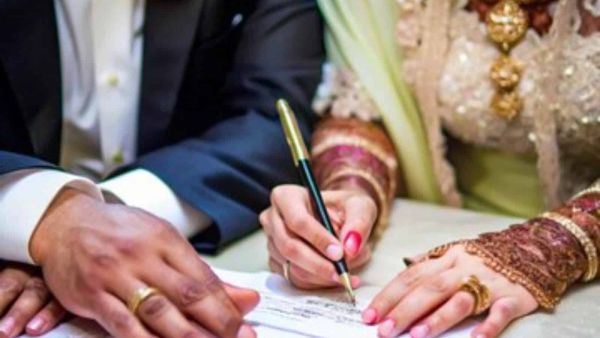
Patna: The Patna High Court on August 31 ruled that a Muslim man is not required to provide a reason to file for divorce under Muslim personal law.
Justices Bibek Chaudhuri and Rana Vikram Singh observed while dismissing Md Sarif Anwar’s appeal against his wife Noorjahan Khatoon. Despite its remarks, the court upheld the Family Court’s decision not to grant Anwar a divorce decree.
The husband alleged that his wife treated him with cruelty since their marriage on April 7, 1999, and left their home on October 14, 2008, permanently.
Anwar claimed to have made multiple attempts to bring Noorjahan back, but he said she refused as she wanted to end the marriage. He said he divorced her by pronouncing Talaq and went to the Family Court for a divorce decree. The wife, however, did not appear before the court even after receiving summons. The court continued its proceedings without her participation.
Both the husband and wife entered into second marriages after Anwar’s Talaq pronouncements, with the wife currently residing in Bengaluru.
Referring to the Supreme Court 2017 judgment declaring Triple Talaq as an unconstitutional practice, the Family Court said the husband had not legally divorced his wife. Thus, the court rejected his plea for a divorce decree.
The husband moved the High Court, contending that his wife abandoned him in 2008 and he only approached the court in 2021 after more than 13 years.
After looking into Mulla’s Principles of Mahomedan Law, the High Court said that under Muslim law, a marriage may be dissolved by the husband at his will, by mutual consent, or through a court-issued decree.
The court held that a Muslim husband is not required to provide a specific reason for dissolving a marriage through talaq. “Therefore, in order to dissolve a marriage by Mahomedan Male, no ground of divorce is necessary,” the Bench said.
The bench said Talaq may be pronounced through a written Talaknama or orally.
The High Court considered the different forms of talaq, including Talaq Ahsan, Talaq Hasan and Talaq-ul-Bidaat, also referred to as Talaq-i-Badai.
The court noted that Talaq-i-Bidaat, where talaq is pronounced three successive times, was declared unconstitutional by the Supreme Court.
The husband had not claimed to have divorced his wife through the other two forms Talaq Ahsan or Talaq Hasan, the court said, noting that his case was based on successive pronouncements of talaq.
The Bench noted that Talaq Ahsan becomes final and irrevocable after the Iddat period concludes, while Talaq Hasan becomes irrevocable upon the third pronouncement.
“Therefore, declaration of divorce by successive pronouncement of Talaq cannot be held to be irrevocable,” the court held.
The High Court further rejected the husband’s claims of cruelty and desertion. “The learned Advocate for the appellant is absolutely misconceived that the husband/appellant can dissolve the marriage by a decree of divorce on the ground of cruelty or desertion,” it said.
Finding no illegality in the Family Court’s decision, it dismissed the appeal.
-
Smriti Mandhana swings into history as leading run scorer

-
KCR to take massive bus rally in March next year, says KTR
-
‘Why isn’t Ram Temple donation theft report public?’Asaduddin Owaisi
-
Smriti Mandhana Goes Berserk In Women's Asia Cup, Breaks Two Major Records

-
Tata Curvv Series X Starts From Under Rs 10 Lakh With More Features