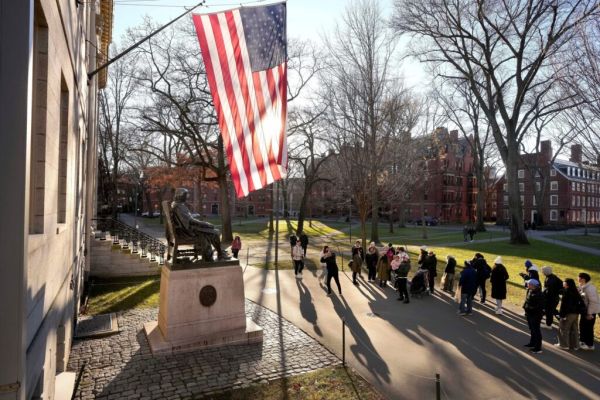
Trump Administration Targets Tax Breaks for Private Colleges With Race-Based Programs/ TezzBuzz/ WASHINGTON/ J. Mansour/ The Trump administration has proposed revoking federal tax-exempt status from private educational institutions that provide benefits based on race, color, national origin or ethnicity. The regulation could affect as many as 18,000 schools and would apply to admissions, scholarships, athletics, facilities and other programs. College leaders warn that the proposal could disrupt donations, financial aid and existing efforts to expand educational opportunity.
Quick Look
- Treasury and the IRS issued the proposed regulation Thursday.
- The rule would apply to private schools, colleges, universities, professional schools and trade schools.
- It targets race-based policies across admissions, scholarships, loans, athletics and other programs.
- Race-neutral assistance based on income, geography or individual hardship would remain permissible.
- Up to 18,000 educational institutions could be affected.
- Final rules would apply to tax years beginning on or after May 31, 2027.
- The administration says the proposal enforces a uniform nondiscrimination standard.
- Higher education groups warn of legal uncertainty and new compliance burdens.
- Losing tax-exempt status could reduce donations and funding for scholarships.
- The proposal is expected to face legal challenges.
Deep Look
Trump Administration Escalates Campaign Against DEI
The Trump administration is seeking to withdraw federal tax exemptions from private schools and colleges that offer admissions preferences, scholarships or other benefits based on race.
The Treasury Department and Internal Revenue Service issued the proposed regulation Thursday as part of President Donald Trump’s broader effort to eliminate diversity, equity and inclusion programs in education.
Under the proposal, a private educational institution would not qualify for tax-exempt status under Section 501(c)(3) if it maintained or enforced policies that discriminate based on race, color, national origin or ethnic origin. The rule would cover admissions, scholarships, student loans, athletics and other school-supported programs.
Race-Neutral Assistance Would Remain Permitted
The proposal would prohibit schools from making decisions or conferring benefits expressly on the basis of race. It would, however, permit institutions to support disadvantaged students through criteria such as family income, geographic location, first-generation status, individual hardship, academic achievement or membership in a military family.
Religious schools could also continue selecting students based on genuine religious membership or affiliation.
If finalized, the regulation would apply to tax years beginning on or after May 31, 2027.
Bessent Targets Rebranded Diversity Policies
The administration says some institutions have changed the names of their DEI programs without eliminating practices it considers discriminatory.
The Treasury Department and IRS estimate that as many as 18,000 private primary and secondary schools, colleges, universities, professional schools and trade schools could be affected.
IRS Chief Executive Officer Frank J. Bisignano said institutions continuing to use prohibited policies should expect enforcement.
College Leaders Condemn the Proposal
Higher education organizations argue that the regulation would undermine programs intended to expand access for historically disadvantaged students.
Universities across the country have already closed or renamed DEI offices and discontinued scholarships and organizations created for minority students amid federal pressure.
Tax Exemption Carries Major Financial Value
Private universities have generally received tax-exempt treatment for more than a century based on their educational and charitable missions. The benefit can save institutions millions of dollars while allowing donors to deduct qualifying contributions.
Losing nonprofit status could therefore affect university fundraising, especially donations designated for scholarships, according to Marjorie Hass, president of the Council of Independent Colleges.
Tim Powers of the National Association of Independent Colleges and Universities said schools are committed to following civil-rights requirements but may struggle with uncertainty created by the new standard.
Bob Jones Case Provides a Rare Precedent
Federal revocation of a university’s tax exemption is highly unusual, but the administration points to the case of Bob Jones University as an important precedent.
The IRS withdrew the South Carolina Christian university’s exemption because of policies prohibiting interracial dating and marriage. The Supreme Court upheld that action in 1983, concluding that institutions practicing racial discrimination were not entitled to tax-exempt status under established public policy. Bob Jones University later ended its prohibition and regained exemption in 2017.
Treasury says the new proposal applies principles from that decision along with the Supreme Court rulings in “Brown v. Board of Education” and “Students for Fair Admissions v. Harvard.”
IRS Faces Restrictions on Ideological Targeting
Federal law prohibits officials from directing IRS investigations or using the agency to target people and organizations for ideological reasons.
Tax-exempt organizations must comply with rules covering political campaign participation, lobbying, annual disclosures and other obligations. Private schools are already required to certify that they maintain racially nondiscriminatory policies.
The proposed regulation would broaden and clarify how the government applies that nondiscrimination requirement to programs framed as preferences or targeted assistance.
Medical Schools Face Separate Investigations
The Justice Department has separately investigated medical schools accused by the administration of favoring Black and Hispanic applicants.
Trump officials argue that such preferences violate federal civil-rights protections. Critics contend that the administration is using laws enacted to address segregation to dismantle programs designed to counter its continuing effects.
The tax proposal extends that dispute by placing nonprofit status—and potentially substantial institutional revenue—at risk.
Experts Warn of Political Retaliation
Preston Cooper, a senior fellow studying higher education policy at the conservative American Enterprise Institute, said both major parties have historically treated nonprofit status as requiring “a really high bar to mess with.”
He noted that conservative religious colleges once feared losing exemptions because of policies prohibiting same-sex relationships.
Cooper said the proposal’s long-term political consequences may depend on how broadly the administration enforces it.
If the regulation functions mainly as a warning to institutions, Cooper added, “that’s a different conversation.”
More on US News
-
‘Stop The Boats’: Masked Anti-Migrant Demonstrators Block UK-France Ferry Traffic

-
Former Arsenal midfielder Matteo Guendouzi handed Champions League ban after provoking rival supporters

-
From washing dishes to World Cup hero: the remarkable story of England’s 1950 tormentor Joe Gaetjens

-
India Humiliates Pakistan! Women In Blue Storm To Asia Cup Win In Just 8.4 Overs

-
Congress Major Reshuffle: Sachin Pilot Gets Punjab, Bhupesh Baghel Shifted To Assam