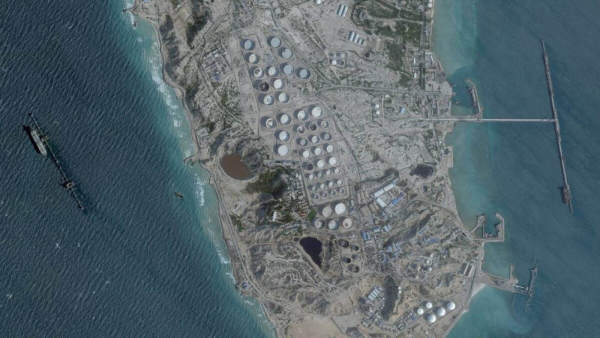
An Iranian oil tanker was hit by four US projectiles near the strategic Kharg Island on Saturday, September 5, Iranian media reported, amid renewed military escalation between Washington and Tehran and growing concerns over shipping in the Gulf.
No casualties were reported, and the vessel’s crew began evacuating, according to local accounts. Iranian authorities had not immediately confirmed the reported attack.
Explosions were heard in the Kharg Island area earlier on Saturday. Fars News Agency said its correspondent heard several blasts coming from the Persian Gulf but saw no smoke, while the source of the explosions was initially unclear.
State-affiliated Nournews, citing local sources, later reported that a tanker near the island had been targeted by a US missile. Asr Iran said four projectiles struck the vessel while it was being unloaded.
Mehr News Agency reported that the tanker was in the anchorage area about six miles off Kharg Island when it came under attack. It said authorities were assessing the damage and circumstances of the incident.
Iran’s Student News Network separately described the vessel as a small oil tanker and also reported no casualties.
Key oil export hub
Kharg Island is central to Iran’s energy infrastructure, serving as the country’s main crude export terminal and handling an estimated 90 to 95 per cent of its oil exports.
The reported strike comes days after US President Donald Trump raised the prospect of action against the island amid renewed tensions. Any disruption around Kharg could have significant implications for Iran’s oil exports and regional energy markets.
The incident comes as the months-long confrontation between the United States and Iran has intensified around the strategically vital Strait of Hormuz.
The latest exchanges followed a period of relative calm after the conflict began with US-Israeli attacks on Iran on February 28, prompting Tehran to launch missile and drone attacks against Israel and US interests in the region.
Maritime traffic under strain
The confrontation has increasingly affected commercial shipping through the Strait of Hormuz, a critical route for global energy supplies.
TankerTrackers, a maritime tracking service, said it identified at least 17 crude oil and gas ship-to-ship transfers in the Gulf of Oman on Friday, involving an estimated 24 million barrels of crude.
The service also reported that at least 7.25 million barrels of oil and two LNG tankers were assembling to transit the strait into the Gulf of Oman under the protection of US Central Command.
It said additional oil-laden tankers were waiting in the area for transfers, adding to congestion as port services worked to manage the increased activity.
Blasts east of Tehran linked to military drills
Separately, Iran’s Islamic Revolutionary Guard Corps said explosions heard in Damavand, east of Tehran, were caused by planned military exercises.
The IRGC’s Seyyed al-Shohada unit in Tehran province said the blasts were part of scheduled training activities and were not linked to any other incident.
Zakani urges domestic reform
Tehran Mayor Alireza Zakani said Iran must address domestic problems while resisting US pressure, warning that unresolved challenges could cause the country to “erode from within”.
Zakani said Iran faced three possible approaches: making concessions to reach an understanding with Washington, resisting without adequately addressing domestic requirements, or combining resistance with internal reform.
He cited inflation, the weakening of the national currency and sharp exchange-rate fluctuations among the country’s major challenges. He also argued that Tehran should not organise its entire foreign policy around relations with Washington.
Zakani said the current wartime conditions could provide an opportunity for economic changes, including reducing dependence on oil revenues and expanding what he described as a more people-based economy.
Judiciary chief urges BRICS action
Iran’s judiciary chief, Gholam-Hossein Mohseni-Ejei, urged fellow BRICS members to condemn attacks on Tehran’s sovereignty and pursue legal action against those Iran holds responsible for alleged war crimes.
He called for justice that was not selective or influenced by political considerations, saying Iranians had paid a heavy price to preserve the country’s independence.
Qatar rejects Iranian claims
Qatar’s Foreign Ministry spokesperson Majed Al Ansari reiterated that Doha is not a party to the regional conflict, rejecting Iranian claims to the contrary.
Qatar said attacks on its territory constituted “clear violations of international law” and that “no selective quotation or interpretation” could alter that fact.
Al Ansari said the country would continue its diplomatic efforts and sustained endeavours to de-escalate tensions and promote security and stability in the region.
Israeli attacks kill five in Lebanon
Meanwhile, at least five people were killed and 24 others wounded in Israeli attacks on southern and eastern Lebanon since Friday, according to the country’s Health Ministry.
The areas targeted included Nabatieh, Tyre and Western Bekaa. Lebanon’s National News Agency also reported two consecutive Israeli air raids on the town of al-Mansouri in the southern Tyre district, where several homes were targeted.
-
India’s auto-component sector to see earnings momentum: Jefferies

-
BJP Yuva Morcha’s bike rallies to connect Vadnagar and Varanasi

-
Kolkata court grants status quo on AITC’s Camac Street office

-
GIFT IFSC mobilises USD 54.2 bn overseas funds for India’s growth
-
Stalin recalls VOC’s freedom struggle, literary, labour achievements