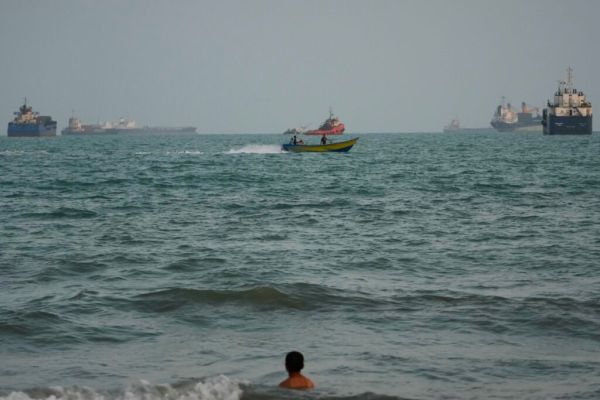
CENTCOM Disables Three Iranian Tankers Following Attacks on Warships/ TezzBuzz/ WASHINGTON/ J. Mansour/ The U.S. military struck three Iranian oil tankers after reporting that missiles targeted an American aircraft carrier and destroyer. CENTCOM said two tankers were permanently disabled and an empty third vessel was destroyed, with no American personnel injured. The attacks represent another escalation in the six-month conflict as negotiations remain stalled and Strait of Hormuz traffic stays depressed.
Quick Look
- CENTCOM said two U.S. Navy warships faced multiple missile attacks.
- The American vessels evaded the missiles, and no U.S. personnel were injured.
- U.S. forces struck three Iranian oil tankers in response.
- Two tankers were described as permanently disabled.
- A third, unladen tanker was destroyed in the Gulf of Oman.
- The strikes occurred near Kharg Island, Jask and in the Gulf of Oman.
- Washington accused the vessels of financing Iran’s Revolutionary Guard and allied groups.
- Iran earlier reported four U.S. missiles hitting a tanker near Kharg Island.
- The attacks follow the resumption of fighting after a monthlong lull.
- Maritime traffic through the Strait of Hormuz remains well below normal.
Deep Look
US Strikes Three Iranian Tankers
CAIRO — The U.S. military said Saturday that it attacked three Iranian oil tankers after missiles targeted an American aircraft carrier and a Navy destroyer patrolling the region.
U.S. Central Command described the Iranian attacks as “multiple unprovoked Iranian attacks” and said both warships successfully evaded the missiles.
No American service members were injured, according to CENTCOM.
The military said two Iranian tankers were “permanently disabled.” A third tanker, which was not carrying cargo, was destroyed.
CENTCOM Threatens Further Action
Adm. Brad Cooper, commander of U.S. Central Command, warned that American forces could target additional Iranian vessels if attacks continue.
The statement marked a significant escalation in the maritime confrontation, moving beyond attacks on military installations and directly targeting vessels involved in Iran’s oil trade.
CENTCOM released what it described as video footage of the strikes.
Tankers Targeted in Three Locations
The U.S. military said one tanker was struck near Kharg Island, the center of Iran’s oil-export infrastructure.
A second vessel was attacked near Jask, east of the Strait of Hormuz, while the empty third tanker was hit in the Gulf of Oman.
Iranian state television had earlier reported that four American missiles struck a tanker approximately six miles, or 10 kilometers, from Kharg Island.
Iranian media reported no casualties in that attack. The initial report provided no supporting evidence, but CENTCOM’s subsequent statement confirmed that an Iranian tanker had been targeted in the area.
US Alleges Tankers Funded Revolutionary Guard
The U.S. military accused the vessels of belonging to a shadow shipping network that generated revenue for Iran’s Islamic Revolutionary Guard Corps and armed groups supported by Tehran.
Iran has long used intermediaries, reflagged vessels and complex shipping arrangements to export petroleum while avoiding American sanctions.
Washington has intensified efforts to restrict those exports as part of a broader strategy combining economic sanctions, a maritime blockade and intermittent military strikes.
A U.S. maritime advisory says Iran continues to threaten commercial vessels in the Persian Gulf, Strait of Hormuz and Gulf of Oman with missiles, armed drones and unmanned surface vessels.
Kharg Island Remains Critical Target
Kharg Island has been attacked repeatedly since the conflict began, including U.S. strikes against military sites there in March.
The island historically handled most of Iran’s crude exports and remains essential to Tehran’s ability to generate oil revenue.
Any sustained attack on tankers or infrastructure surrounding Kharg could further damage Iran’s economy. It could also intensify risks to commercial shipping and global energy supplies.
The latest strikes came one day after President Donald Trump characterized the conflict as “small potatoes” and supported Vice President JD Vance’s position that the fighting should not be described as a war.
Fighting Resumes After Monthlong Lull
The U.S.-Iran conflict began with American and Israeli attacks on Feb. 28 and has continued intermittently for six months.
After a month of relative calm, both countries resumed attacks during the past week. Fighting has again focused heavily on Iranian coastal communities, maritime infrastructure and the Strait of Hormuz.
At least five people were killed during U.S. strikes on southern Iran earlier in the week, according to Iranian officials. One strike hit a home where a wedding was taking place.
The United States said it does not deliberately target civilians and acknowledged that it was reviewing the casualty reports.
Economic Pressure Fails to Produce Agreement
Before the renewed military action, Washington had increased economic pressure on Tehran in an attempt to secure concessions without sustained bombardment.
Iran’s new hard-line leadership has signaled that it is prepared to resist despite decades of sanctions, damage to its military and worsening economic conditions.
Both sides are seeking to impose military and economic costs. The United States is targeting Iran’s revenue and strike capabilities, while Tehran is using attacks on ships and restrictions in the Strait of Hormuz to pressure Washington and its regional partners.
Nuclear Negotiations Remain Stalled
Iran’s nuclear program was one of the primary issues leading to the conflict.
Washington and Tehran signed a memorandum of understanding in mid-June that was intended to lead to wider negotiations. The diplomatic process collapsed soon afterward.
No replacement agreement has emerged, leaving unresolved questions about Iran’s nuclear capabilities, sanctions and control of shipping through the Strait of Hormuz.
The United States is guiding some vessels through the waterway with military assistance. Overall maritime traffic, however, remains far below prewar levels.
The latest strikes on Iran’s oil tankers increase the economic stakes and create another potential trigger for retaliation in one of the world’s most important energy corridors.
More on US News
-
DCM loses control, rams into six vehicles in Hyderabad

-
Telangana Minister urges KCR to attend Assembly Monsoon Session

-
Analysis: 86 pc of Bahadurpura voters left off SIR have Muslim names
-
Nepal issues media safety protocol covering flood-hit areas
-
Dharwad school shoe quality under scanner as shoes tear within days