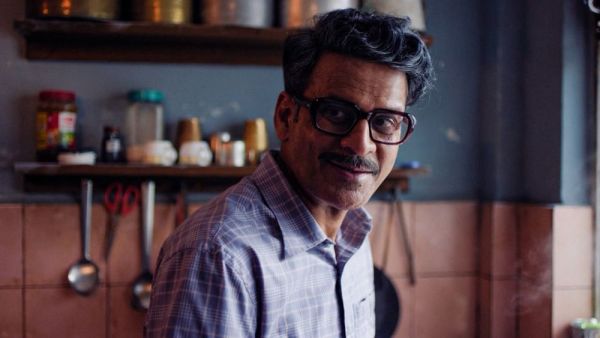
There is something in equal measure frustrating and endearing about Manoj Bajpayee’s septuagenarian Yogesh Mishra — the retired teacher everyone in Mumbai’s Vishram Housing Society calls ‘Masterji’ — in Last Man In Tower. A widower as familiar to Tower A as its peeling walls, he is the one who gives free tuitions to the society’s children, babysits a neighbour’s child with special needs when everyone else looks away and steps in as peacemaker whenever tempers flare.
But when a conniving real estate developer (Boman Irani) offers the residents a lucrative buyout, Masterji becomes the last man standing — protecting his rights, yes, but also clinging to the last vestiges of familiarity. Recalling his own journey from Bettiah in Bihar to Delhi and finally Mumbai, Bajpayee recites a couplet: “Na humara shehar tha na hum rahenge” (The city was never ours, nor will we remain).
Aravind Adiga’s book Last Man In Tower peeled back the layers of a rapidly growing Mumbai and the human mind’s uneasy flirtation with greed and money when it was published in 2011. In 2026, in the middle of an unprecedented, hyper-accelerated redevelopment boom, it is a premise that resonates even more sharply with Bajpayee, as he plays the protagonist in the book’s screen adaptation, to release in theatres on September 11.
Chronicle of changing times
“Cities have changed. The streets and alleys we knew no longer exist — they’ve given way to skyscrapers and flyovers, all in the hope that things would be better, more modern,” says Bajpayee. “I remember when people spoke about flyovers the way they’d speak of Shanghai, Beijing or Hong Kong — we take real pride in flaunting our cities. Now, in Mumbai, there’s the coastal road project — old buildings by the sea are giving way to skyscrapers and people are flocking to see sample flats and make bookings.”
Bajpayee continues: “There’s a curiosity and a hope that life will be better once we leave the old space for the new — but that hope is elusive. You may move from 800 square feet into 1,000, but your neighbours won’t be as close to you. You may not know anything about them in the times to come.”
He recalls the love-hate equation between Masterji in the film and his feisty neighbour, Mrs Puri (played by Divya Dutta) — the very woman who eventually turns against him.
Also read: Uttam Kumar at 100: The man behind the ‘hero’ who put super in stardom for the Bengali audience
The coastal road Bajpayee mentions is, in many ways, the real-world twin of Vishram Society’s story — a promise of a wider, shinier, more ‘modern’ city, built quite literally over the rubble of what came before it, leaving those displaced to wonder if the trade was ever worth it.
“I wonder, as we gain space, what are we losing? Relationships, humanity. That will be our achievement of the future. The film says this in a nutshell. It’s talking about a society, but really, it’s talking about something much bigger,” he says.
File photo of Manoj Bajpayee. By special arrangement
The adaptation, directed by Australian-American filmmaker Ben Rekhi, gives Bajpayee — an actor with a knack for turning the ordinariness of life into searing cinema — the opportunity for another riveting performance, as he transitions from being a man once regarded as Vishram Society’s blessing, into a person many come to regard as an ‘obstacle’, simply because he refuses to sell.
An extraordinary filmography
It is a filmography built almost entirely on taking the ordinary and making it extraordinary. From a blink-and-miss role in Bandit Queen three decades ago, Bajpayee has spent a career proving how much can live inside a small, quiet performance.
In Ram Gopal Varma’s Satya (1998), his Bhiku Mhatre remains one of Hindi cinema’s most quoted performances, built less on menace than on a strange, dangerous charm. As Sardar Khan in Gangs Of Wasseypur (2012), he turned a coal-town gangster’s swagger into something almost tender. As Professor Siras in Aligarh (2015), he shrank himself into the quiet devastation of a man persecuted for who he loved. In The Family Man (web series, 2019-present), he made an intelligence officer’s double life feel less like a thriller premise and more like the exhaustion of any working parent juggling two jobs.
Where does Masterji — a retired schoolteacher with nothing but his convictions — fit into this gamut of characters?
Bajpayee’s answer is simple: “The audience decides which performance, which film, they want to hold on to. When I looked at Masterji, for me he was somebody who’s been celebrated, admired, in his time. But that breed of person has become rare now. Once regarded as a blessing by his people — including his own son — he becomes a burden, an obstacle to anyone trying to get ahead without losing their integrity. He becomes annoying because he points fingers, holds up a mirror, cautions people.”
He continues: “In another era, he’d have been black and white. Today, he’s grey. I’m sure a lot of the audience will find him annoying and won’t see anything wrong with the other residents of the society. Ben and I decided to push him right to that edge, where there’s always a chance Masterji will be disliked. If that happens, it’s a win for all of us.”
Also read: 30 years since 1st album, why Colonial Cousins feel there’s still much to discover about their music
Bajpayee had previously called the industry’s obsession with box-office numbers the biggest deterrent to creativity — a self-destructive monster that consumes its own creators. Last Man In Tower arrives backed by Rana Dagubatti’s Spirit Media, the production house that has increasingly put its weight behind smaller, non-mainstream stories even as big-ticket films continue to struggle at the box office. Could a film like this be the change?
“It’s a very important film for this changing time — for a changing Mumbai, and for the big cities where the old is giving way to the new. I think this is exactly the right film for this moment,” says Bajpayee. “At the end of the day, you hope people are willing to spend that bit of money on a ticket. In this age, for a film that’s engaging and playing in theatres, the only hope we’re left with is that people won’t gamble with their money this time — that they’ll come in for something short, and sure: the weaving of a great story, written by a well-known novelist, made by passionate people. All of us in this industry have a bit of a reputation for always having the best intentions when it comes to our work. I just hope all of that is enough to bring people into the theatre — with their families, with their friends — to be part of this work by some truly lovely, creative people.”
-
Luke Shaw shines for Manchester United with 100% tackles, crosses and aerial duels despite Everton draw

-
Satwiksairaj Rankiredd & Chirag Shetty Script History In Shenzhen, Become First Indians To Win China Masters
-
Khadija Shaw nets twice as Manchester City make a strong start to their WSL title defence

-
Nurse rape-murder case: CM orders magisterial inquiry
-
Manchester United held 2-2 by Everton after added-time goal