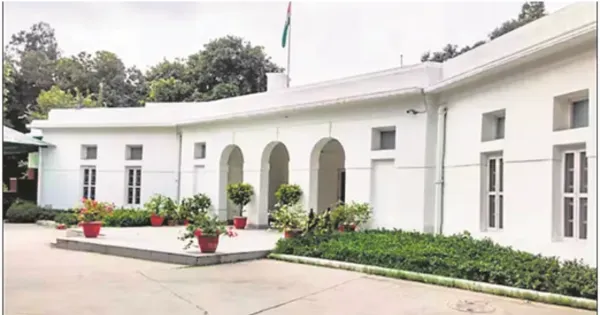
Lutyens Zone of Delhi is in discussion these days. The discussion is about the expenses incurred on its maintenance. That is a different matter, but the reality is that Lutyens Zone is a kind of addiction, once one stays in it, it becomes difficult for one to go out of here. In this sense, Baba Saheb Amdekar was perhaps the only leader who left his government bungalow in Lutyen's Delhi the very next day after leaving the post of minister. Baba Saheb unexpectedly resigned from Nehruji's cabinet on September 27, 1951. Deep differences had emerged between the two over the Hindu Code Bill, and after consultation with their supporters, they shifted to 26 Alipore Road (now Civil Lines) the very next day. Then he lived in the same bungalow till the end of his life.
In fact, it takes a very big heart to vacate a bungalow in Lutyens Bungalow Zone. Lutyens Zone is like heaven. Even when the Sun God spews fire in the heat of Delhi, only sweet breeze blows in the lush green area spread over 26 kilometers. The heavy branches of dense trees on both sides of every road here cover a large part of the road. Due to this, the sun's rays are stopped before they go down. Their sweet breeze gives a pleasant feeling even in summer. In Lutyens' Delhi, mainly trees like Tamarind, Amaltas, Jamun, Banyan etc. are planted. But perhaps the biggest one is blackberries. There are jamuns in Safdarjung Road, Sunhari Bagh, Rajaji Marg, Kushak Road, Tyagraj Marg, Motilal Nehru Marg. There are tamarind trees on Akbar Road and Teen Murti Marg. There are also some Amaltas behind Akbar Road. There are Neem on Prithviraj Road, Aurangzeb Road, Tees Jan Marg, Krishna Menon Marg. So Baba Kharak Singh Marg, Tilak Marg, Ferozshah Road, Teen Murti Marg are full of tamarind trees.
Lutyens' Delhi, that is, that area of Delhi which is considered a symbol of power, influence and luxury. This is the place where big bungalows, green roads and the most powerful leaders, government officials and judges live. The history and structure of Lutyens' Delhi make it special. Its layout is so magnificent that even today it is counted among the most beautiful and well-planned areas of the world. Anyone can be mesmerized by the wide roads, big bungalows and greenery here.
These bungalows were built during the British era. The work of making New Delhi the capital took place between 1912 and 1930. Lutyens Bungalow Zone developed during the same period. Big houses were built for the British officers to live in. After independence, these were given to senior government officials, ministers, MPs, judges and army officers. This trend continues even today. Lutyens Zone is named after Edwin Lutyens, the Chief Architect of New Delhi, but he actually designed only a few bungalows in the Rashtrapati Bhavan Estate. Most of the government bungalows were built under the supervision of Robert Tor Russell. He was in the same team as Lutyens. You get huge gardens, a compound, a main building and separate houses for the staff in these bungalows.
These bungalows are almost a hundred years old, but the questions raised on them are completely new. If expenditure is increasing, the debate should also intensify. The government will have to increase transparency and curb unnecessary decorations. The public will also have to be aware. Only then will the glory of Lutyens Zone remain intact and the burden on the taxpayer will not increase. A balance between legacy and frugality is the right path.
-Vivek Shukla, senior journalist
-
This Janmashtami, offer Mathura Peda to Kanha ji, note down the quick secret recipe.

-
AI Skills for Students: These 7 AI Skills are very useful for students, they will get job

-
The heat of Lamborghini and the technology of Tecno! Company's limited edition smartphone launch, the look will not take your eyes off

-
Duleep Trophy final: Sooryavanshi in focus

-
T20I Tri-Series: South Africa became champion even after losing to Namibia, defeated Zimbabwe in the final