At a 2019 Bollywood actors’ roundtable, a star kid griped about how hard her early career had been. An outsider on the panel, still fighting for his first big break, listened with quiet amusement. Then he said it: “Jahaan humaare sapne poore hote hai, waha inke struggle shuru hote hai” — where our dreams are fulfilled, their struggle begins.
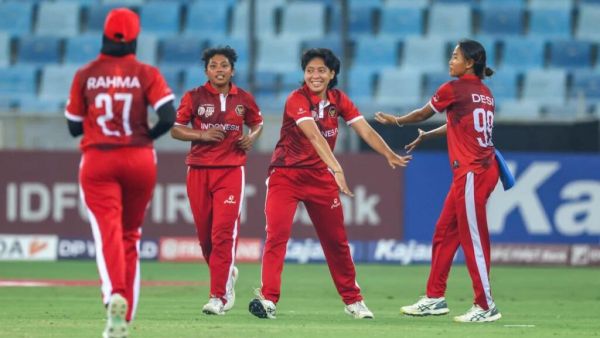
Indonesia, making its Women’s Asia Cup debut, knows that feeling only too well.
Placed in Group A alongside traditional cricketing giants like India and Pakistan, with Hong Kong China for company as it finds its feet in the game, three heavy losses have made the maiden campaign quite unforgiving.
But for these players, getting here has been a massive triumph by itself, given that a little over a decade ago, most of what one sees today did not exist.
Building from the ground up
Abhiram Singh Yadav – a social sciences academic, businessman and diplomat, with roots in Uttar Pradesh in India – is the face and backbone of the push for cricket in Indonesia as the president of the national cricket body since 2023. A conversation with him on the ecosystem starts with a line very familiar to a ‘desi’ sporting enthusiast: “We’re the fourth most populous nation in the world (286 million strong). If Ireland (5.3 million) and Afghanistan (50 million) can be Full Member nations, why can’t we?” he declares.
Cricket is now played by both genders in 21 of Indonesia’s 38 provinces, spread across over 17,000 islands. There is a national pathway; camps are organised particularly ahead of big tournaments, and provinces have their own competitive setups too. Indonesia’s cricketing beginnings depended on expatriate clubs in its infancy. The ecosystem now has near-total local participation and a robust setup within educational institutions to provide an assembly line of talent.
“It’s been a long journey to come this far, especially for a non-Commonwealth country starting cricket from zero. We’ve come from a place where nobody knew cricket. Schools 12 years ago would reject cricket, but now they are chasing the game, hoping to be accepted,” Yadav tells Sportstar from Dubai, where the Women’s Asia Cup is currently underway.
A national women’s competition emerged in 2014, while the women’s national team programme took shape in 2016, around the same time the sport was absorbed into the Pekan Olahraga Nasional (Indonesia’s National Sports Week). This brought cricket under the Indonesian Government’s multisport push and made regular stipends and high-performance support possible for the selected pool of players.
READ: Sri Lanka seals Women’s Asia Cup semifinal berth with win over Bangladesh
While all this has taken shape on one side slowly over the course of a decade, money and sponsorship have still been hard to come by for this game in the archipelago.
“That has been a challenge. Getting a sponsor for cricket in Indonesia is very difficult. For football, badminton, and now padel, it is quite easy. Even global sponsors are hard to come by now unless we have live streaming clauses and other arrangements. But the Indonesian side has gone into this tournament without a sponsor on the front of the jersey.
“We are hoping people see the fight these girls have put up to make it to the Women’s Asia Cup and the potential they have. I hope that slot doesn’t remain empty in the future. Please join us,” Yadav shrugs.
Help from the neighbours
As it stands, Thailand is head and shoulders above other Southeast Asian nations in terms of opportunity, funding and results. The side even made the 2020 Women’s T20 World Cup. So, when Indonesia finished behind it in the 2017 Southeast Asian Games – the first time cricket was included in the tournament – it had an immediate impact back home.
The administration decided to make exposure trips available to the senior pool. Visits to South Korea and Singapore followed. Before that, when foundational pathways were being laid out, the setup decided to use its proximity to cricketing superpowers on either side of its geographical boundaries (Australia to the East and the Indian subcontinent to the West).
Indonesian women’s squads were sent to Jaipur, Himachal Pradesh (although this came later), and Western Australia to learn from their systems and players.
Indonesia was no more a toddler who’s learned to crawl; it ran. Its first official women’s T20I arrived in 2019 against Hong Kong China, when the ICC expanded international status to fixtures played by Associate Members. The Under-19 women qualified for the inaugural World Cup in 2022 and pulled off a sensational win over Zimbabwe in the 2023 edition in South Africa. The same year, Indonesia also won gold in the Southeast Asian Games.
The Indonesian team which beat Zimbabwe at the 2023 U1-9 T20 World Cup.
| Photo Credit:
GETTY IMAGES
The Indonesian team which beat Zimbabwe at the 2023 U1-9 T20 World Cup.
| Photo Credit:
GETTY IMAGES
In 2024, Jay Shah, then the chairman of the Asian Cricket Council (ACC), decided to convene its Annual General Meeting in Bali. This marked Indonesia’s induction as a formal member of the ACC. Yadav credits this meeting as a key milestone in Indonesia’s global journey. A visit from ICC CEO Sanjog Gupta in June this year marked a continuation of interest in the nation, particularly as a hotspot for cricket.
“Mr. Shah thinks quite broadly about the game. He sees the potential of global markets. Indonesia is a country with a population of over 200 million. We are a G20 member. That recognition also came through in Mr. Gupta’s visit. Both are working towards developing emerging markets and looking at non-traditional cricketing nations. With the sport now in the Olympics, this is the only way we can make cricket inclusive,” Yadav explains.
The supreme powers of cricket have their sights set on displacing the FIFA World Cup in the universality of the sport’s spectacle.
“Cricket wants to work towards becoming bigger than FIFA, and that requires looking deep into different international markets. As an Associate member, we want to support that vision. Indonesia, Thailand, Malaysia, Japan and Korea are promising markets, and we want to be a model for others to follow,” Yadav explains.
That ambition is finding support from the neighbours. Beyond knowledge exchange, Indonesia’s ties Down Under have been particularly significant, given that the cricket body is playing a major role in the construction of its turf wicket and international stadium in Bali.
Ground zero: Bali
One might argue that a full-fledged cricket stadium might be premature in the nation’s trajectory. For Yadav and Indonesia, strengthening the roots and spreading the wings need to happen in parallel.
“We are building two grounds in Bali. Each ground will have a 70-yard boundary and nine pitches with 24 practice nets and an indoor facility. We are working towards a tier-two standard venue that I am still setting up with my personal funds. I want this to be my contribution to cricket,” Yadav reveals.
He says high performance is not being sacrificed. Given the government’s buy-in, there is technical support available to cricketers at different levels of the ecosystem.
“If we wait for sponsors, we will never proceed. So we’re proceeding first and waiting for others to join the caravan.”
Meanwhile, Yadav also wants to be smart about strategic alliances with India.
“We’re culturally similar. It’s easier for us to replicate systems and technologies in a cost-effective manner. Not just for players, but even for curators and staff. It’s important for us to know how we can harness our local soil and optimise it for venues. We hope India can be our big brother and help us grow,” Yadav says.
ALSO READ: Happy that we could be ruthless against Pakistan: Harmanpreet Kaur
A decade ago, Test status was the top priority for Yadav in his list of long-term plans. Years of actually working on the ecosystem have brought him closer to the ground. The struggles facing the red-ball game have steered his efforts towards Full Member status and capacity building geared towards more profitable home T20Is.
“It’s important for us to have achievable steps. We want to focus on getting as many Tier-2 fixtures as possible coming to Indonesia. We can grow from there,” he elaborates.
Planning a full-fledged cricket stadium in Bali is a layered decision. The Government’s push for sports tourism means cricket can offer an economic avenue for the nation, and Indonesia can offer a swanky new facility fit for hosting to the ACC and the ICC.
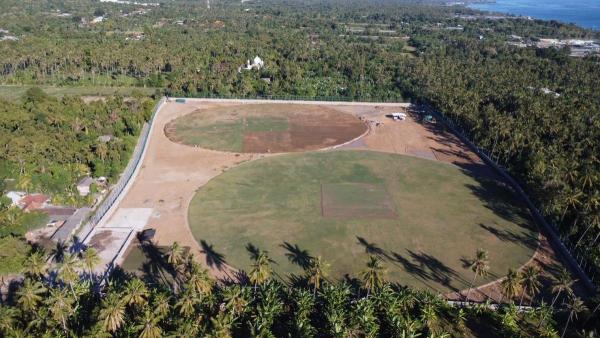
A bird’s eye view of a cricket ground in Indonesia.
| Photo Credit:
Sanjog Gupta – LinkedIN
A bird’s eye view of a cricket ground in Indonesia.
| Photo Credit:
Sanjog Gupta – LinkedIN
“We are ahead of many sports in Indonesia because we have our own venue. We’ve been able to make an ecosystem of over 200,000 local cricketers. Now, it’s my moral duty to turn it into an industry so these 200,000 people have something to live on. The idea is to make the ecosystem self-sustaining eventually.”
On the field, a promising run in the ACC Premier Cup, where the women’s team finished third, helped open a door to the Asia Cup. That push came days after Indonesia missed the Asian Games caravan after failing to make it out of the group stage of the qualifier in May.
A system in its infancy doesn’t fear stumbles, but Yadav understands how the stakes attached to such chances are increasingly more serious.
“We are a traditionally multisport country, and the Government, too, places value on that gold medal. We need to make sure we don’t miss out on this opportunity again,” Yadav notes.
Greater than the sum of its parts
Sport, at its core, is a community-building exercise. Despite the obstacles of the past, present and future, Yadav wears the story of his nation with pride when telling its story to the uninitiated.
Building the pillars for cricket in Indonesia also required taking the sport to cultural spaces often considered averse to sport. In ensuring the talent pool was diverse, Cricket Indonesia tapped schools – even traditional religious centres like madrasas – and universities to draw interested children towards cricket. Over a little more than two decades, he hails the national side’s pluralism as one of the programme’s successes.
“Indonesia is a majority Muslim nation, but in our team, a major chunk are Hindus. We have Christians and Buddhists in the mix too in the squad that’s participating in the Asia Cup. That itself is a unique identity. We’re lucky that in the generations of youngsters coming through, sports is an ingrained aspect of life. So parents don’t disallow certain genders from being completely involved in sport anymore. You’ll see players sporting hijabs and other paraphernalia, but you’ll see them play.
“That pluralism is something we are very proud of. A majority Muslim nation is led by a Hindu. Its big hitter can be Christian, and its best spinner can be a Buddhist. Those are ideals that are part of our culture. We have people with names like Muhammed Vishu. Our diversity is something we want to promote and take to the world.”
Indonesia also opened its arms to overseas players of native origin. Sixteen-year-old leggie Sophia Velic, born to a Bosnian father and Indonesian mother and raised in Australia, is part of the setup and snapped up Bangladesh captain Nigar Sultana Joty’s wicket in the Asia Cup.
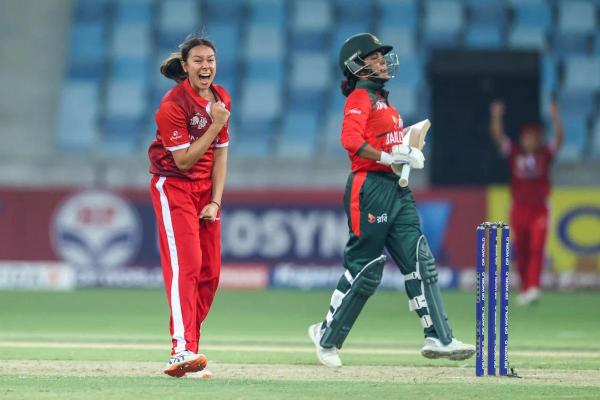
Indonesian team’s Sophia Velic, 16, was born to a Bosnian father and Indonesian mother and raised in Australia.
| Photo Credit:
Asian Cricket Council
Indonesian team’s Sophia Velic, 16, was born to a Bosnian father and Indonesian mother and raised in Australia.
| Photo Credit:
Asian Cricket Council
With established blueprints at the grassroots, committed leadership at the top and the ability to stay humble without losing out on ambition, Indonesia has put in the work to mould a sporting system that can tick and tick well. The sting of the Asia Cup losses will fade eventually, because nothing matters more than the next opportunity awaiting them.
“We want to be a story that an Associate country can achieve heights, especially in women’s cricket, because it’s not easy. We have our challenges, we have our limitations, but where there’s a will, there’s always a way. We are always ready to learn and always hungry to win,” Yadav signs off.
Published on Sep 07, 2026