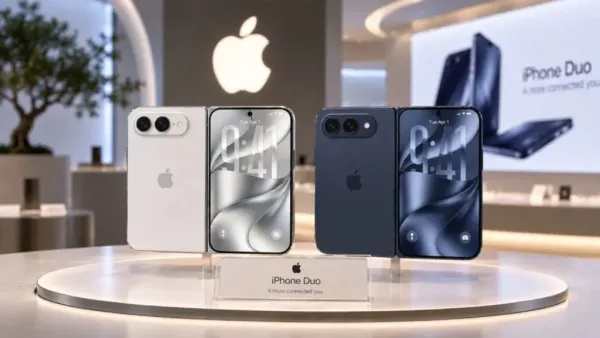
Apple’s first foldable iPhone is no longer a rumor. The iPhone Duo pairs a 5.4-inch outer display with a 7.6-inch inner display, Touch ID instead of Face ID, and the same A20 Pro chip powering the iPhone 18 Pro line. Pre-orders open October 16, with availability from October 23 in the first wave of more than 70 countries, India included.
India Pricing and Availability
- 256GB: ₹2,99,900 | 512GB: ₹3,24,900 | 1TB: ₹3,74,900 | 2TB: ₹4,49,900, roughly ₹1.20 lakh above the Galaxy Z Fold8 and about ₹1 lakh above the Fold8 Ultra
- Available in Star White and Night Sky, both in grade 5 titanium with a mirror-polished finish
- Pre-orders open October 16 at 5:30 PM IST via Apple India; sale begins October 23 through Apple India and partner stores
- Up to ₹7,000 instant cashback on eligible bank cards, plus no-cost EMI up to six months
At ₹2,99,900 to start, the iPhone Duo lands roughly ₹1.2 lakh above the Galaxy Z Fold8’s ₹1,79,999 starting price, and about ₹1 lakh above the Fold8 Ultra’s ₹1,99,999. That’s a meaningfully wider gap than the roughly $300-340 difference in the US and European markets, making India one of the more extreme examples of Apple pricing its foldable well above Samsung’s equivalent hardware.
What Apple Actually Built
- 7.6-inch inner display (7.58″ measured rectangular) and 5.4-inch outer display (5.36″ measured rectangular), sharing the same aspect ratio
- Apple says its A20 Pro is paired with a custom vapor chamber and a dual-battery architecture managed as one unit through its own energy-rebalancing software
- 48MP Fusion Main camera with an integrated 2x optical-quality telephoto, plus a 48MP Fusion Ultra Wide shared with iPhone 18 Pro
- eSIM-only worldwide, IP68-rated (per Apple’s own testing), and 11.3mm thick when folded
Apple’s nano-texture finish on the inner display is doing real work here: the company describes it as a matte, glare-reducing coating that minimizes crease visibility, not one that eliminates it. Apple never uses the word “crease-free” anywhere in its own materials. Worth being precise about that distinction, since it’s easy for secondhand coverage to round “minimizes” up to “gone.”
On battery, Apple cites up to 31 hours of video playback on the inner display and up to 44 hours on the outer display, versus Samsung’s advertised roughly 26-hour figure for the Fold8. These are manufacturer-reported numbers using each company’s own testing methodology, not independently verified, side-by-side results, so treat the comparison as a starting point.
Rumors vs. Reality
Months of prior coverage pay off here for readers. TechGeny’s July report on supply constraints cited analyst estimates of a $2,300–2,500 starting price; Apple’s actual $1,999 US base price came in notably lower, though India’s ₹2,99,900 still lands toward the higher end of what that earlier reporting anticipated. Separately, June’s iOS 27 beta coverage flagged early foldable-support clues well before any official confirmation — those earlier iOS 27 clues were broadly validated by Apple’s final foldable software implementation.
On the stylus question, earlier leak coverage had raised real doubt about whether Apple Pencil support would arrive at all. Apple has now confirmed Apple Pencil with USB-C support for both displays, though it won’t be available at launch — Apple says it’s coming later this year.
How the iPhone Duo Actually Compares to the Galaxy Z Fold8
It’s worth correcting a common assumption here: Samsung’s Galaxy Z Fold8 also uses a dual-cell battery design, not a single cell, so Apple isn’t differentiating itself simply by having two batteries. The real difference Apple is claiming is in battery management and implementation — how its silicon and software rebalance power across both cells, which both companies already share.

Apple has not simply reproduced Samsung’s existing foldable formula. The matched-aspect-ratio displays, the nano-texture anti-glare treatment, its specific battery-management approach, and the reimagined iOS 27 software experience are genuine differences from how Samsung’s foldables are built and run. Whether those differences justify an approximately ₹1 lakh premium over the Galaxy Z Fold8 Ultra is a separate question from whether Apple built a good foldable, and it’s one only extended, independent testing will really settle.
Should You Spend ₹2,99,900 on a First-Generation Apple Foldable?
The iPhone Duo isn’t priced near the iPhone 18 Pro Max either: the Pro Max starts at ₹1,79,900 for 256GB in India, putting roughly ₹1.20 lakh between the two.
For buyers already committed to iOS, the calculus is fairly direct: this is the only foldable inside Apple’s ecosystem, so ecosystem loyalty favors the Duo regardless of price gap. The Galaxy Z Fold8 and Fold8 Ultra remain genuinely relevant options thanks to their lower price and several generations of foldable refinement behind them. The more interesting question for Indian buyers specifically may be whether the iPhone Duo is worth choosing over the iPhone 18 Pro Max at a much lower cost, a real three-way tradeoff between form factor, ecosystem maturity, and price that doesn’t have one universal answer.
(Source)
-
Mauricio Pochettino says Chelsea’s 2016/17 Premier League title should be taken away and awarded to Tottenham

-
West Bromwich Albion star using Chelsea academy grounding and England’s loan system as a launchpad

-
Safety and Tips for Cleaning Switch Boards

-
Prince William’s charity cause could make millions from late mother’s ‘revenge dress,’ new doc reveals

-
Brooklyn Beckham, Nicola Peltz’s marriage in trouble
