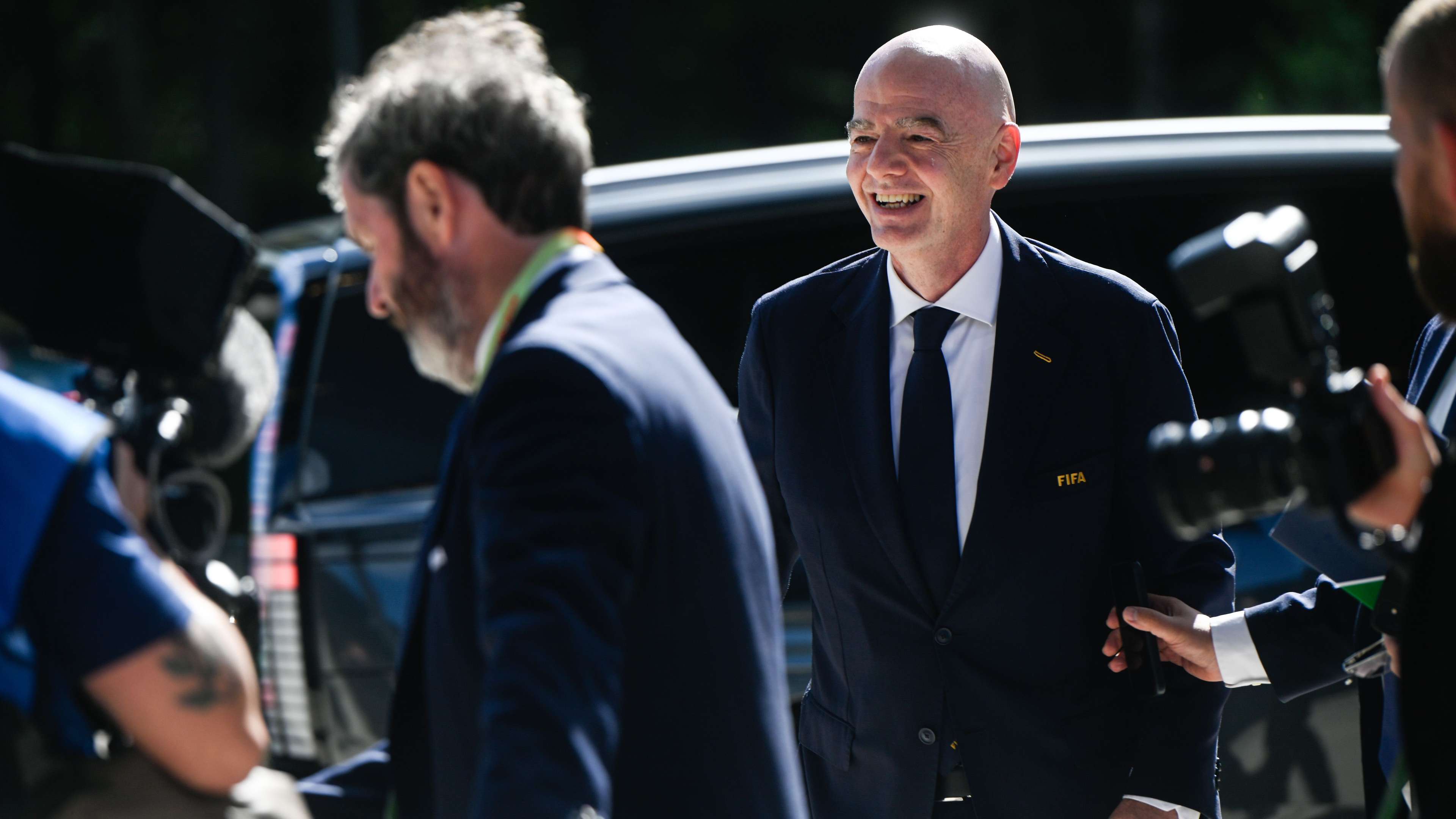
Did Morocco's influence save Infantino? Rivals have changed course from trying to remove him to cutting back his powers.
Morocco has become the key factor in the FIFA elections.
Just three weeks ago, it appeared only a matter of time before Gianni Infantino could be pushed out of the FIFA presidency. But behind closed doors in meetings in Rabat and Nyon, the calculations changed completely. The president whom his critics believed was on the way out re-emerged with a support network built over 10 years. Some figures have described that backing as "unbreakable", and it now appears strong enough to secure the votes he needs to remain in office.
With that shift, the European opposition camp has been forced to change its strategy. Its original aim was to unseat the most powerful figure in world football. It has now moved towards what it sees as a more realistic, and potentially more effective, objective: not necessarily removing Infantino, but reducing the power of the presidency itself and ending its near-absolute authority.
The sense that the contest may already be decided is growing.
Reuters quoted a source from global football familiar with the confidential talks between senior officials as saying: "Three weeks ago, I thought he was finished. What I did not realise was just how strong the relationships he built after ten years in power are, relationships that are almost impossible to break."
Infantino, 56, has faced the biggest challenge of his career this year after the collapse of his controversial proposal to sell a 20% stake in FIFA competitions, including the World Cup, to private investors.
The proposal was seen as explosive and sparked anger across the game. UEFA, the Asian Football Confederation and CONCACAF were at the forefront of calls for a change in FIFA leadership. A number of European associations also withdrew support for his re-election, with France becoming the latest to do so last Thursday.
FIFA Secretary General Mattias Grafstrom described the episode as "an unfortunate and shameful chain of events". However, after the crisis meeting in Rabat, he declared his full support for Infantino, a strong indication that the immediate threat had eased.
The arithmetic of 211 votes has left Europe facing a major dilemma.
Infantino's real strength lies in FIFA's electoral structure. At the FIFA Congress, each of the 211 national associations has one equal vote. Removing the president would require a worldwide alliance well beyond the 55 votes controlled by UEFA members.
That is precisely the danger for those trying to oppose him. If they challenge the president and lose, they risk reinforcing his authority rather than weakening it.
One source said: "I think the course of events has changed. It has become far too dangerous for UEFA to go into the vote and not win."
There is also no clear rival at this stage, after Nasser Al-Khelaifi ruled himself out.
No candidate capable of gathering enough worldwide backing has yet emerged ahead of next March's election. The final deadline to enter the race is 18 November.
Nasser Al-Khelaifi, the president of Paris Saint-Germain, is regarded by some within football as one of the few figures who could assemble the cross-continental coalition required to defeat Infantino. But through a spokesperson, he has completely dismissed that possibility, insisting that he "does not aspire to, intend, or wish to take up the FIFA presidency".
Victor Montagliani, president of CONCACAF, is the other prominent name being discussed. He has made clear that he will not run unless there are sufficient guarantees of victory. That still leaves open the possibility of a surprise candidate emerging from either Africa or Asia.
The loyalty of smaller associations remains one of Infantino's biggest strengths, and Morocco is central to that equation.
In contrast to Europe, Infantino continues to enjoy firm support from the main voting blocs outside the continent. Steve Laigle, president of the New Caledonia federation, summed up the feeling in Oceania: "Most of the presidents of Oceania's federations have declared their support for Mr Infantino, and we will support him to the end. When we make a promise and are loyal to someone, we remain loyal to them until the end."
Africa appears to share a similar outlook, with many believing that continued support could lead to greater development funding. Morocco is among Infantino's public supporters and is considered one of the most influential federations in Africa. Reports, which FIFA has denied, have suggested there was a promise to stage the 2030 World Cup final in Casablanca in exchange for preserving African backing. The Moroccan federation has made no comment.
With the deadlock continuing, some opponents are now examining a fallback plan.
Rather than replacing the president, the idea is to alter FIFA's administrative structure itself.
According to two sources, officials are looking at ways to reduce the powers concentrated in the presidency and transfer some of them to the general secretariat, while also strengthening scrutiny over major strategic and commercial decisions.
Philippe Diallo, president of the French Football Federation, withdrew his confidence in Infantino, saying that "the confidence granted to the FIFA president has broken". He also confirmed that the balance and distribution of power inside FIFA has become part of UEFA's internal discussions.
"The project cannot be purely European, but must bring together all the continents," Diallo added. "Our mission now is to ensure the emergence of a programme and a candidate, then to work on ensuring their victory."
Rabat will host the FIFA presidential election on 18 March 2027. What began as an effort to remove Infantino may now evolve into a fight to contain him.
-
44-year-old man kills wife half his age in Telangana’s Khammam
-
Wife’s angry relatives demolish Telangana Dalit man’s house

-
Prakash Raj slams modern censorship, calls SIR ‘bloodless genocide’
-
Fabrizio Romano says Lewis Hall move to Manchester United remains possible despite Newcastle agreement

-
Ganesh Chaturthi 2026: Before welcoming Bappa, shine copper puja thali like this, these things will clean the house