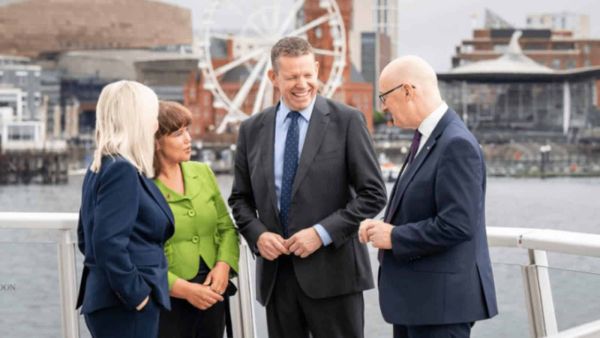
London: The leaders of Wales, Scotland and Northern Ireland signed a pact on Monday, September 14, that threatens to lead to the breakup of the United Kingdom.
The first ministers of the three semiautonomous regions of the UK told Prime Minister Andy Burnham and his government to prepare for constitutional change and that their future lies with the European Union.
“For people watching across these islands — for people watching around the world — there could be no clearer sign that Westminster’s time is coming to an end,” they said in a memorandum of understanding, referring to Parliament.
The announcement came about 48 hours after US President Donald Trump waded into the waters of the politically contentious issue when he said he would “love to see” a reunified Ireland during a trip to visit his golf course hosting the Irish Open.
It’s the first time the leaders of all three countries are either from pro-independence parties or pro-unification in the case of Northern Ireland, which was partitioned and remained part of the UK when Ireland won independence from Britain over a century ago.
Burnham’s spokesperson brushed aside the threat and said the prime minister strongly believes in the union and was more focused on lowering the cost of living than dealing with constitutional debates.
“The United Kingdom is at its best when people come together around our shared values and problem-solving, rather than division,” Tom Wells said.
‘No legal significance’
Nicola McEwen, director of the University of Glasgow Centre for Public Policy, said the summit was symbolically important but has no legal significance.
“I don’t see the threat to the union being bigger today than it was yesterday,” McEwen said.
In the late 1990s, the UK passed legislative acts that decentralised government through the process of devolution, giving each country except England some level of policy independence and self-governance through their own parliaments.
But tensions have remained with the UK-wide government in London, which retained control over national issues and those concerning England.
Scotland’s John Swinney and Northern Ireland’s Michelle O’Neill called for independence referendums in their countries, while Rhun ap Iorwerth did not provide a timetable for one in Wales.
The three leaders appeared in their political capacity, rather than their official one, possibly because O’Neill is in a power-sharing government with the Democratic Unionist Party.
Northern Ireland’s Deputy First Minister Emma Little-Pengelly, of the DUP, accused O’Neill, of the Sinn Fein party, of “weaponising” the role of first minister by signing the agreement.
“I am first minister in the north of Ireland,” O’Neill replied. “This is about historic change happening all around us.”
Support for Scottish independence has grown since Brexit
Scotland tried unsuccessfully to break away in 2014, with voters rejecting a referendum 55 per cent to 45 per cent. But McEwen said support for Scottish independence has grown since Brexit, in which the UK formally left the European Union in January 2020, following a referendum in June 2016.
Swinney, leader of the Scottish National Party, said he believed voters would now vote for independence if the UK government approved a referendum.
Burnham told Parliament last week he would allow such a vote to be held if there was a “clear consensus” in Scotland but later sent Swinney a letter saying a vote was “off limits”.
The 1998 Good Friday peace accord that ended three decades of sectarian violence in Northern Ireland, known as “The Troubles,” requires a vote on unification if polls there indicate it would likely pass, a threshold the UK government says has not been met. Ireland would also have to approve the change in a referendum.
Burnham has made devolution a major theme since taking office less than two months ago, but his focus has been on regional governments across England, a reflection of his years as mayor of Greater Manchester.
Swinney tried to turn Burnham’s ideology to his advantage, saying his frequent talk of devolution “leads you to the logic of recognising the right of the people of Scotland, in my case, to decide their own future”.
Beyond any threat of departing the union, McEwen said the greatest impact of the three joining forces could be that they agreed to cooperate with each other routinely, and that could help to exert more influence on the UK government.
“It does keep on the agenda that question about, well, if the United Kingdom is a union based on consent, what is the pathway where it looks like that consent may no longer be there?” McEwen said. “Any UK government has been very reluctant to engage in that discussion.”
-
Pakistan court orders blocking passports of KP CM, 24 lawmakers of Imran Khan's party

-
Navy chief visits New Zealand to bolster maritime ties
-
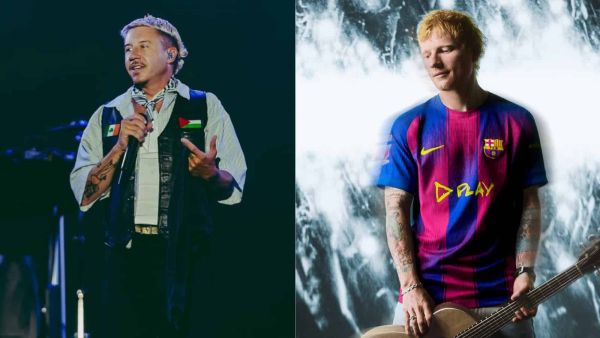
Free Palestine: Rapper Macklemore dropped from Ed Sheeran tour
-
“It was obvious”: Gary Neville identifies exactly where Michael Carrick got it wrong in Manchester United’s derby defeat

-
Teeth Care Tips: Teeth look yellow even after brushing? Then mix this substance in lemon juice, the teeth will have a pearly shine