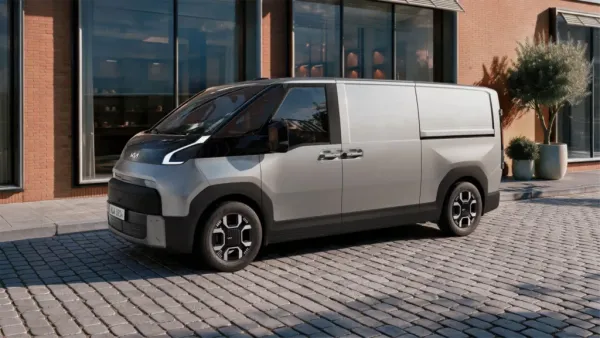
Kia took the wraps off the PV7 at IAA Transportation 2026 in Hanover, and the headline numbers landed as expected. Up to 460 km of WLTP range, 8.0 m³ of cargo volume, 1200 kilograms of payload, and charging from ten to eighty per cent in roughly twenty-five minutes courtesy of an 800-volt architecture.
“We sell business results, not cars.” Kia President Song Ho-sung said when describing the company’s purpose-built vehicle strategy. The PV7 represents Kia’s attempt to reposition the commercial van as a platform — hardware, software, and services bundled into a single offering aimed at fleet operators who measure success in uptime and operational efficiency rather than horsepower figures.
What Exactly Is the Kia PV7?
The PV7 arrives as Kia’s second dedicated all-electric PBV, following the smaller PV5 that launched roughly a year ago. Two NMC battery options anchor the lineup: 71.5 kWh and 96.2 kWh. The Long Range Cargo variant achieves a targeted 460+ km WLTP range, though internal measurements currently stand ahead of formal homologation. Treating this metric as an initial target rather than a certified figure remains wise. The Passenger version accommodates up to nine occupants, with an eleven-seat option for the Korean market.
An advanced 800-volt system modernizes the preceding 400-volt architecture. Replenishing energy from ten to eighty per cent takes roughly twenty-something minutes via 350 kW charging. Maximum DC power ratings and battery-specific capabilities await official confirmation from Kia.
Rear spaces benefit from dual charging ports. Front access covers standard combined AC/DC connections, while a rear-mounted AC-only port provides a practical remedy for cramped depots.
Battery, Range, and 800-Volt Charging
Underpinning both the PV5 and PV7 is E-GMP.S, Kia’s dedicated passenger EV platform specially re-engineered for commercial utility. Front-wheel drive with a 200 kW, 420 Nm single motor powers the launch models, while all-wheel drive arrives later.
Commercial payload demands drove this custom architecture rather than a simple passenger vehicle conversion.
Why Kia Calls This a Business Platform
Kia’s PBV strategy bundles vehicle hardware, fleet software, and connected services instead of merely selling the van.
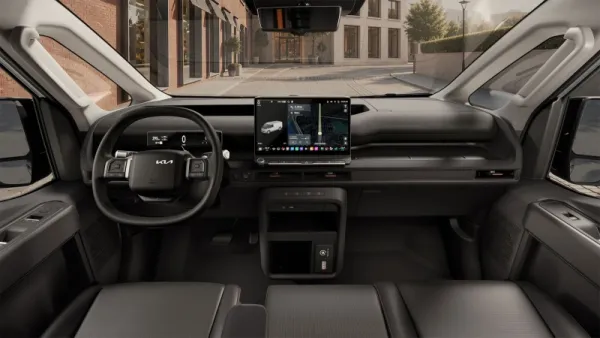
The Kia Business Solutions Portal bundles fleet management, charging coordination, predictive diagnostics, and uptime services into a single interface for the PV7.
Sjoerd Knipping, Kia Europe’s chief operating officer, framed it directly: “For large business customers, vehicle efficiency, uptime and systematic fleet management are decisive factors”. Software value or positioning remains an open question as operators decide based on uptime. Detailed portal specs or pricing remain unconfirmed by Kia.
Community Reactions and Early Sentiment
One widely viewed thread on Slrclub noted that the vehicle exceeds the Hyundai Staria in length, width, and height, with commenters debating parking implications and potential demand for shuttle and academy transport applications.
Spanish forum Forocoches hosted a thread where members expressed enthusiasm about camper conversion potential but questioned the economics. One commenter observed that an electric van costing a significant sum while sitting idle most of the time would erase fuel savings.
YouTube commenters have largely welcomed the 800-volt charging capability while wondering whether Kia will price the PV7 competitively against established commercial van brands.
Launch Timeline and What Comes Next
Production begins in 2027, with Korea and Europe as initial markets. Kia’s Flexible Body System allows the PV7’s upper body to be reconfigured for different applications, enabling the planned expansion to twenty-three variants, including a shorter body option and a cab-chassis model suitable for custom applications.
Further out, a PV9 is planned for 2029, extending the PBV range into even larger vehicle classes.
Though official verification from Kia remains pending, German publication WELT estimates the PV7 range may start around €50,000.
The Question Worth Asking
The PV7 packages hardware, software, and services into that promise. So, can Kia’s PBV strategy make electric vans as software-driven and customizable as modern passenger EVs? The answer will emerge not from press conferences but from fleet operators who test whether the business solutions portal actually reduces downtime and from the used market, where commercial vehicles ultimately prove their worth.
(Source)
-
Has Wrexham’s Hollywood fairytale run into the hard ceiling of reality?

-
‘That’s football’ — Harry Kane dismisses goal drought talk as Bayern Munich star reaches 150-goal mark and targets Bundesliga history

-
Manchester United: Premier League great blasts 'pathetic' Bruno Fernandes over Phil Foden red card

-
How Michael Carrick’s Manchester United completely failed to break down 10-man Manchester City

-
Hayden Panettiere cause of death disclosed a month after her death