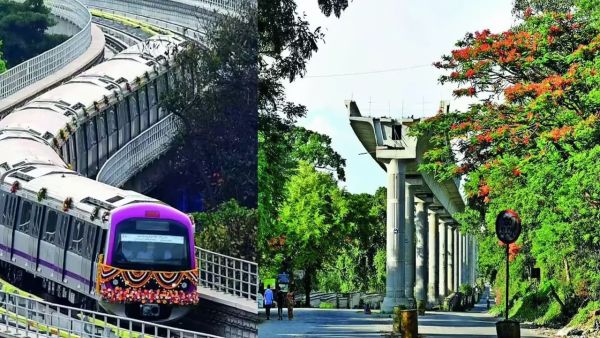
Bengaluru Metro’s network has expanded to 96 km with 83 stations, but daily ridership remains around 10 lakh against a projected 30-lakh target. Officials are now focusing on first- and last-mile connectivity to attract more passengers.
Fifteen years after Bengaluru’s Namma Metro began operations, the city’s metro network has expanded significantly, but passenger numbers have failed to keep pace with the growth in infrastructure. What started as a 7-kilometre stretch between MG Road and Baiyappanahalli has grown into a 96-kilometre network with 83 operational stations across three corridors. However, the metro is currently carrying only around 10 lakh passengers a day, against the 30-lakh daily ridership projected in the detailed project reports (DPRs) for the expanded corridors.
The widening gap between the metro’s infrastructure and its actual ridership has become a major concern for the state government and metro authorities. With Bengaluru’s traffic congestion worsening, officials are now focusing on improving connectivity to and from metro stations to encourage more people to use public transport.
Serious Discussion At GBA Meeting
The question of why more Bengaluru residents are not opting for the metro despite worsening traffic congestion was discussed at a Greater Bengaluru Authority (GBA) meeting on Thursday, chaired by Chief Minister D.K. Shivakumar.
Officials identified the lack of adequate first- and last-mile connectivity as one of the major reasons for the lower ridership. This refers to the difficulties commuters face in travelling from their homes to metro stations and from stations to their final destinations.
The state government has now ordered immediate measures to address the issue. The Directorate of Urban Land Transport (DULT) is preparing a Comprehensive Mobility Plan (CMP) for this purpose. Arcadis-Delhi Integrated Multi-Modal Transit Systems Ltd (Arcadis-DIMTS) has been appointed as the consultant at a cost of ₹4.2 crore, excluding GST. The firm has already submitted an initial report, while transport surveys are currently underway.
This is not the first attempt to address the issue. A CMP prepared in 2020 aimed to increase the share of public transport from 40% to 70% by 2035. The government also introduced a Transit-Oriented Development (TOD) policy in 2022. However, these measures have not delivered the expected results so far.
₹30.2 Crore Plan To Improve 19 Stations
DULT’s latest plan focuses on improving access to metro stations through better footpaths, cycling lanes, shared mobility options and proper bus bays.
In the first phase, development works have been proposed at 19 metro stations, including 11 on the Green Line and eight on the Purple Line, at an estimated cost of ₹30.2 crore. A GIS-based study is also being conducted to recommend new feeder routes for the Bengaluru Metropolitan Transport Corporation (BMTC).
During a GBA executive committee meeting on September 3, chaired by Bengaluru Development Minister Krishna Byre Gowda, officials discussed another major challenge. Bengaluru’s narrow roads make it difficult for large buses to operate as feeder services in several areas.
As a result, the BMTC has been instructed to purchase mini-buses measuring 6 metres or less for metro feeder services.
₹125 Crore For 500 Mini-Buses
Bengaluru Metro Rail Corporation Ltd (BMRCL) has also proposed providing a ₹125-crore grant to the BMTC. The funds would be used to purchase and operate 500 mini-buses as feeder services for metro stations.
Following a joint survey by the BMTC and BMRCL, bus stops have been shifted closer to metro stations, with the average distance reduced to around 100 metres.
Currently, all 83 operational metro stations have regular BMTC bus services. However, based on passenger demand, only 54 stations have dedicated feeder services, with 255 feeder buses serving around 1.5 lakh passengers daily. The remaining 29 metro stations do not have dedicated feeder bus services.
To address the gap in ridership, a meeting chaired by the BMRCL Managing Director on August 21 selected 10 major metro stations for a detailed study in the first phase.
Pink Line To Open By September End, But Access Issues Remain
BMRCL is planning to open the 7.5-kilometre elevated Pink Line section on Bannerghatta Road, between Kalena Agrahara and Tavarekere, for public use by the end of September.
However, concerns remain over connectivity to the new stations, similar to those raised when earlier metro lines were opened. Commuters continue to face issues such as inadequate footpaths, poor pedestrian infrastructure, garbage dumped on walkways, damaged roads and a lack of proper bus stops near metro stations.
Local residents are strongly demanding that the authorities address these access and infrastructure issues before the new line is inaugurated, as better connectivity could be crucial to attracting more passengers to the metro.
-
Horoscope for September 12: Which zodiac signs will be blessed by Shani Dev on Saturday?

-
She Started With A Rs 300 Oven And Turned It Into A Rs 7,400 Crore Company
-
Manicure Pedicure Care Tips: Do not make these 5 mistakes after manicure-pedicure, otherwise the skin will turn black.

-
Players of Uttarakhand shined… Became National Champion, won Vovinam Overall Trophy with 71 medals
-
Team India will not take Sri Lanka lightly in the Asia Cup final!