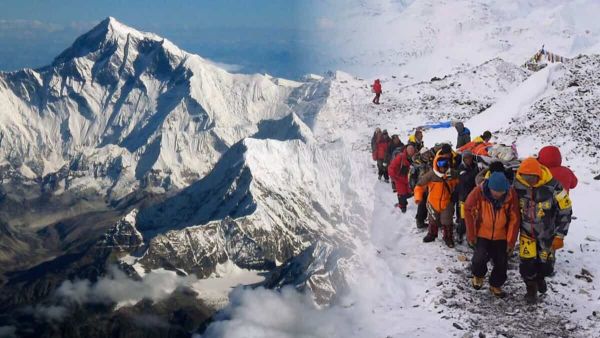
Will the world’s highest mountain peak become the world’s highest pile of dead bodies soon? The rate at which the tragedies are unfolding, that day may not be far off.
It is an aspect of climbing Mount Everest that has not received much attention in the media. Many people remain blissfully unaware of the toll that humans have to pay for the sake of bragging that he or she has conquered the tallest peak in the world.
So far, more than 300 people have died while climbing Mount Everest. Some died on the way up, and some while coming down. Mount Everest has gained a reputation as one of the deadliest peaks to climb. What is also gaining a reputation, however, is that many bodies remain on the mountain due to dangerous conditions, and the remains are visible to other climbers, serving as a grim reminder that even one single mistake can turn fatal.

This year, among the Indians who lost their lives was 45-year-old Subrata Ghosh of West Bengal. The school teacher, a family-loving man tragically died in May 2025 during his descent from Mount Everest after summiting. He succumbed to exhaustion and altitude sickness near the Hillary Step in the “death zone.” His body remains on the mountain slope due to the extreme difficulty of retrieval and the exorbitant costs involved in bringing back a body from the deathly grip of the ice.
An estimated 200 bodies are still on the icy slopes of Everest, too difficult to retrieve. The highest number of deaths by nationality are from Nepal, followed by India, the US, and the UK. A significant portion of deaths involve Sherpa guides, who often perform the most dangerous roles in any climbing expedition.
Retrieving bodies is risky
Retrieving bodies is dangerous work because the bodies are stuck fast to the ice. The majority of deaths occur in the region called the Death Zone, which is located above 8,000 metres. The air is so thin that oxygen volume is only about 7 per cent, whereas at sea level it is about 21 per cent. So, anyone attempting a rescue would find it extremely difficult and dangerous to prise loose a dead body from thick sheets of ice.
Then, strapping an 80-kilo dead body onto one’s back and bringing it down hundreds of meters over slippery slopes is a task that perhaps even Hercules would refuse. The retriever himself would slip on the ice and may fall to his own death.
Moreover, at that high altitude, climbers often lose their sense of perspective. The human mind does not work at its best. Oxygen deprivation, altitude problems and exhaustion set in. And along with these, there is a sense of disorientation. It is like being drunk and unable to control one’s thoughts and movements perfectly.
Only one cricketer has climbed Everest
New Zealand’s Adam Parore is the only cricket player to have climbed the world’s highest mountain. He succeeded on his second attempt in 2011. During his first attempt, Parore suffered from altitude sickness and had to abandon his climb. However, after succeeding on the next attempt, Parore told the media: “The feeling is not all sunshine and roses. In a lot of ways, it was quite disappointing at the time because you didn’t just have the mental faculties to actually enjoy it.”
Another avid mountaineer and journalist, Jon Krakauer, has written a book about climbing Everest titled ‘Into Thin Air.’
The book narrates Krakauer’s harrowing experience of the 1996 Everest disaster in which eight climbers were killed, and several others were stranded by a storm. Krakauer’s expedition was led by a guide named Rob Hall (who also lost his life). Other groups were trying to summit on the same day, each organisation being a business rival to the others.
Nowadays, there are many adventure sports organisers who try to earn money by taking amateur climbers to altitudes that are extremely dangerous for those who have not had enough training climbing lower-grade peaks.
Intense training needed to summit peak
According to former climber Sekhar Babu of Hyderabad, every aspiring climber should have at least three to five years of experience before trying higher peaks above 8,000 metres. For preparation before every climb, there should be consistent training focusing on low-intensity cardio workouts such as hiking long distances with weights and running.
It also requires building mountaineering skills, acclimatisation (including pre-acclimatisation), mental toughness, and proper nutrition and hydration to handle prolonged physical and mental stress over weeks. Training should involve four- to eight-hour hikes with 30-kg packs, focusing on speed and vertical gain.
Leg muscles can be built with squats and lunges with a weight. For the upper body, pull-ups and push-ups are the best. In addition, climbers should pre-acclimatise by spending time at high elevations (8,000-14,000 ft), if possible.
Mountain climbing is one of the riskiest adventure sports on the planet. Therefore, all those who have dreams of climbing Everest must take enough precautions and put in a few years of hard work and preparation before taking on the biggest challenge of them all.
-
Exclusive: Ankit Siwach Opens Up About 120 Bahadur, His Journey, and Staying Relevant in the Industry

-
Nupur Sanon-Stebin Ben to marry on January 11: Report

-
'We are forever': James Ransone's widow Jamie McPhee pens emotional note with pregnancy photo after 'The Wire's actor's tragic death

-
Street food fest brings the rich taste of India to the capital

-
Union Minister Jitendra Singh visits EV Expo at Bharat Mandapam, highlights PM Narendra Modi's vision for clean mobility and youth entrepreneurship
