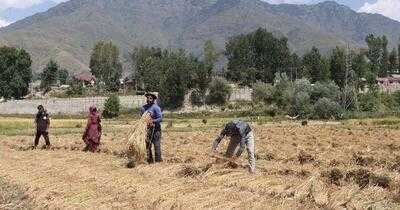
For years, many farmers across Kashmir had gradually stopped growing Mushq Budji, the region’s prized aromatic rice, after frequent outbreaks of blast disease made the crop too risky and expensive to maintain. But in the fields today, the tide is slowly beginning to turn.
Mushq Budji is a premium traditional rice variety native to the Kashmir Himalayas. It grows at an altitude of 1,600-1,800 metres above sea level and has a short, bold, translucent, and highly aromatic grain. It is especially prized as the preferred rice for Wazwan, the valley’s famed traditional feast. In 2023, the rice variety also received a Geographical Indication tag, protecting its authenticity and regional heritage.
However, Mushq Budji faced a major challenge. It was highly susceptible to blast disease, a fungal infection that can infect all above-ground parts of the plant, causing lesions on leaves, stems, and panicles and leading to total crop failure. Moreover, changing weather patterns worsened disease outbreaks. This disease had become so serious that the variety was almost on the verge of extinction.
The rice blast disease outbreak in Mushq Budji rice began in the early 1960s. Its cultivation began to decline from 1980 onwards, reaching its lowest level in 2000. “We worked specifically on addressing this...
Read more
-
Rule Change: From Aadhaar to car prices, many major changes will take place from January 1, 2026. Find out how it will affect you.
-
Migrant crime fury as ex-cop slams 'cowardice' and demands stats be released

-
After working for 15 hours, earning Rs 763, Raghav Chadha invited the viral delivery boy home and treated him to lunch.

-
'It's like Joe Biden' - Donald Trump suffering from 'alarming cognitive problems'

-
Iconic pub in pretty UK seaside village named 'best for pint'