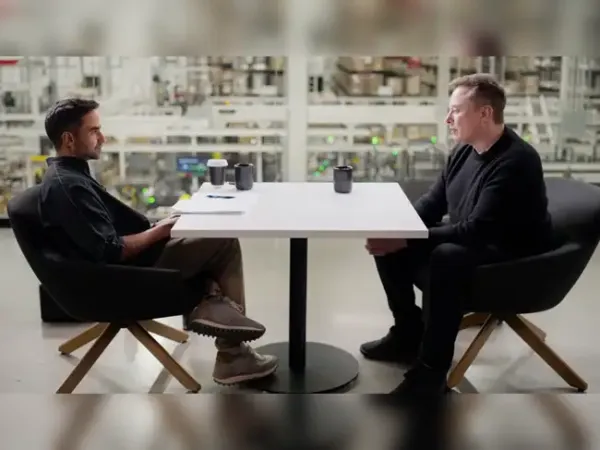
Billionaire Elon Musk made for a candid guest on Nikhil Kamath's latest 'WTF is' podcast episode released late on Sunday. The Tesla and SpaceX chief executive spoke in detail about his thoughts on the H-1B visa programme, global tariffs and his stint with the US government.
Here are some key snippets:
On global tariffs
Musk said he tried to convince US President Donald Trump that tariffs may be harmful to the economy, but was unsuccessful. "I mean, the President has made it clear he loves tariffs. You know, I've tried to dissuade him from this point of view, but unsuccessfully," Musk said.
“I think generally free trade is better, is more efficient. Tariffs tend to create distortions in markets,” he said, adding that barriers make little sense even at a basic level. “Would you want tariffs between you and everyone else at an individual level? That would make life very difficult. Would you want tariffs between each city? No — that would be very annoying. Would you want tariffs between each state within the United States? That would be disastrous for the economy."
Musk has expressed hopes of the United States and Europe moving to a “zero-tariff situation”, effectively a free‑trade zone, and has publicly criticised key Trump trade advisers over protectionist policies.
On DOGE
Musk described his involvement with the Department of Government Efficiency (DOGE) as an "interesting side quest" that revealed the inner workings of the US government.
"There's been quite a few efficiencies. I mean, some of them are very basic efficiencies, like just adding requirements for federal payments—that any given payment must have an assigned congressional payment code and a comment field with something in it that's more than nothing. That trivial-seeming change, my guess is, probably saves $100 billion or even $200 billion a year," he said.
Musk said entities such as the Department of Defense fail audits because necessary information simply does not exist. "So, a bunch of things that DOGE did were just very common-sense things that would be normal for any organization that cared about financial responsibility," the billionaire explained.
On H-1B and borders
Musk noted that border controls under the Biden administration were essentially nonexistent, creating a "total free-for-all" that led to massive illegal immigration and a negative selection effect.
He explained that generous government benefits for illegal entrants created a strong "incentive structure" and "diffusion gradient", drawing people to the US, adding, "You gotta have border controls—kind of ridiculous not to."
"On the right, you've got at least a perception that somehow their jobs are being taken by talented people from other countries. I don't know how real that is. My direct observation is that there's always a scarcity of talented people," he told Kamath when asked about immigration.
He also said there has been a misuse of the H-1B programme. "It would be accurate to say that some outsourcing companies have kind of gamed the system on the H-1B front. And we need to stop the gaming of the system. But I'm certainly not in the school of thought that we should shut down the H-1B programme," Musk said.
On X
When asked about his fascination with the letter X, Musk laughed and said he also "wonders sometimes what is wrong with me". He reflected on his "fixation" and its origins in 1999.
Musk had founded X.com as a "financial crossroads" or exchange, aiming to solve money from an information theory perspective by replacing the banking system's large number of "heterogeneous databases with batch processing that are not secure" with a single, real-time, secure database for greater efficiency.
X.com evolved into PayPal, which eBay acquired, though Musk later repurchased the domain. He viewed acquiring Twitter, now X, as a chance to "revisit the original plan" of building a "clearinghouse of financial transactions" and a "more efficient money database".
Here are some key snippets:
On global tariffs
Musk said he tried to convince US President Donald Trump that tariffs may be harmful to the economy, but was unsuccessful. "I mean, the President has made it clear he loves tariffs. You know, I've tried to dissuade him from this point of view, but unsuccessfully," Musk said.
“I think generally free trade is better, is more efficient. Tariffs tend to create distortions in markets,” he said, adding that barriers make little sense even at a basic level. “Would you want tariffs between you and everyone else at an individual level? That would make life very difficult. Would you want tariffs between each city? No — that would be very annoying. Would you want tariffs between each state within the United States? That would be disastrous for the economy."
Musk has expressed hopes of the United States and Europe moving to a “zero-tariff situation”, effectively a free‑trade zone, and has publicly criticised key Trump trade advisers over protectionist policies.
On DOGE
Musk described his involvement with the Department of Government Efficiency (DOGE) as an "interesting side quest" that revealed the inner workings of the US government.
"There's been quite a few efficiencies. I mean, some of them are very basic efficiencies, like just adding requirements for federal payments—that any given payment must have an assigned congressional payment code and a comment field with something in it that's more than nothing. That trivial-seeming change, my guess is, probably saves $100 billion or even $200 billion a year," he said.
Musk said entities such as the Department of Defense fail audits because necessary information simply does not exist. "So, a bunch of things that DOGE did were just very common-sense things that would be normal for any organization that cared about financial responsibility," the billionaire explained.
On H-1B and borders
Musk noted that border controls under the Biden administration were essentially nonexistent, creating a "total free-for-all" that led to massive illegal immigration and a negative selection effect.
He explained that generous government benefits for illegal entrants created a strong "incentive structure" and "diffusion gradient", drawing people to the US, adding, "You gotta have border controls—kind of ridiculous not to."
"On the right, you've got at least a perception that somehow their jobs are being taken by talented people from other countries. I don't know how real that is. My direct observation is that there's always a scarcity of talented people," he told Kamath when asked about immigration.
He also said there has been a misuse of the H-1B programme. "It would be accurate to say that some outsourcing companies have kind of gamed the system on the H-1B front. And we need to stop the gaming of the system. But I'm certainly not in the school of thought that we should shut down the H-1B programme," Musk said.
On X
When asked about his fascination with the letter X, Musk laughed and said he also "wonders sometimes what is wrong with me". He reflected on his "fixation" and its origins in 1999.
Musk had founded X.com as a "financial crossroads" or exchange, aiming to solve money from an information theory perspective by replacing the banking system's large number of "heterogeneous databases with batch processing that are not secure" with a single, real-time, secure database for greater efficiency.
X.com evolved into PayPal, which eBay acquired, though Musk later repurchased the domain. He viewed acquiring Twitter, now X, as a chance to "revisit the original plan" of building a "clearinghouse of financial transactions" and a "more efficient money database".