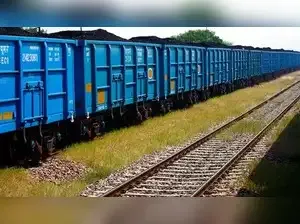
The Indian Railways loaded 135.7 million tonnes (mt) freight in November 2025, 4.2% higher than the same month a year ago. Officials said this has been driven by higher loading in pig iron and finished steel, iron ore, fertilisers, and containers among others. The monthly freight earnings for November also grew to the highest ever of Rs 14,310 crore.
“There was a 23.6% growth in Balance Other Goods, indicating healthy traffic diversification and new business addition for the Railways,” a senior official told ET.
Cumulatively, freight loading increased by 3.3% over last year touching 1070.8 million tonnes (mt) with earnings at Rs 1,15,232 crore. On the passenger front, Indian Railways has carried 493.7 crore passengers as against 473.6 crore in the first 8 months of the year, a growth of 4.2%.
An official statement issued last month said the national transporter crossed the 1-billion-tonne freight loading mark on November 19. Coal remained the largest contributor at 505 MT, followed by iron ore (115 MT), cement (92 MT), and container traffic (59 MT). Pig iron and finished steel (47 MT), fertilisers (42 MT), mineral oil (32 MT), foodgrains (30 MT), raw materials for steel plants (approx. 20 MT), and balance-other-goods (74 MT) also grew.
“Daily loading continues to hold strong at around 4.4 MT, higher than 4.2 MT last year, demonstrating improved operational efficiency and sustained demand,” the statement said adding measures aimed to increase bulk handling capacity, reduce transit time, and lower logistics costs, directly benefit both industry players and end consumers.
“There was a 23.6% growth in Balance Other Goods, indicating healthy traffic diversification and new business addition for the Railways,” a senior official told ET.
Cumulatively, freight loading increased by 3.3% over last year touching 1070.8 million tonnes (mt) with earnings at Rs 1,15,232 crore. On the passenger front, Indian Railways has carried 493.7 crore passengers as against 473.6 crore in the first 8 months of the year, a growth of 4.2%.
An official statement issued last month said the national transporter crossed the 1-billion-tonne freight loading mark on November 19. Coal remained the largest contributor at 505 MT, followed by iron ore (115 MT), cement (92 MT), and container traffic (59 MT). Pig iron and finished steel (47 MT), fertilisers (42 MT), mineral oil (32 MT), foodgrains (30 MT), raw materials for steel plants (approx. 20 MT), and balance-other-goods (74 MT) also grew.
“Daily loading continues to hold strong at around 4.4 MT, higher than 4.2 MT last year, demonstrating improved operational efficiency and sustained demand,” the statement said adding measures aimed to increase bulk handling capacity, reduce transit time, and lower logistics costs, directly benefit both industry players and end consumers.