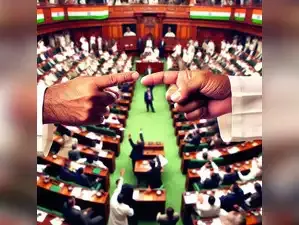
Parliament's winter session started on Monday. And then stopped. Lok Sabha was adjourned twice before being adjourned for the day around 2.15 pm. Rajya Sabha was adjourned around 5 pm. Because of the Opposition's 'hangama' demanding a debate on Special Intensive Revision (SIR). SIR has been controversial even before its ongoing roll-out across 12 states and 3 UTs.
Critics argue that the exercise shifts the burden of eligibility proof onto voters, creating confusion and uncertainty over documentation, especially affecting marginalised communities with weak or no records. They warn that SIR risks undermining the constitutional promise of universal adult suffrage, turning a fundamental right into a fragile administrative privilege. In West Bengal, deaths of block-level officers (BLOs) have added ghee to the fire. EC and GoI defend SIR as a necessary measure to maintain clean voter rolls. Updating rolls, they rightly argue, addresses migration, urbanisation and demographic changes.
Given these two polarised perspectives, it would be wise for our parliamentarians to discuss the matter reportedly affecting so many citizens where it is meant to be debated: in parliament. Instead of treating SIR through the prism of government-opposition win-loss, let the benefits and drawbacks of the process be argued in, literally, parliamentary language. A mature exchange of facts and opinions, promises and concerns, should have taken place before SIR was rolled out. In this context, it was reassuring to hear parliamentary affairs minister Kiren Rijiju state in Rajya Sabha that GoI is not averse to holding a discussion on SIR. Let our parliamentarians enlighten us on it. Entertainment of 'the fish market' is unhelpful, not to mention boring.
Critics argue that the exercise shifts the burden of eligibility proof onto voters, creating confusion and uncertainty over documentation, especially affecting marginalised communities with weak or no records. They warn that SIR risks undermining the constitutional promise of universal adult suffrage, turning a fundamental right into a fragile administrative privilege. In West Bengal, deaths of block-level officers (BLOs) have added ghee to the fire. EC and GoI defend SIR as a necessary measure to maintain clean voter rolls. Updating rolls, they rightly argue, addresses migration, urbanisation and demographic changes.
Given these two polarised perspectives, it would be wise for our parliamentarians to discuss the matter reportedly affecting so many citizens where it is meant to be debated: in parliament. Instead of treating SIR through the prism of government-opposition win-loss, let the benefits and drawbacks of the process be argued in, literally, parliamentary language. A mature exchange of facts and opinions, promises and concerns, should have taken place before SIR was rolled out. In this context, it was reassuring to hear parliamentary affairs minister Kiren Rijiju state in Rajya Sabha that GoI is not averse to holding a discussion on SIR. Let our parliamentarians enlighten us on it. Entertainment of 'the fish market' is unhelpful, not to mention boring.