
Few companies rode the SaaS wave as diligently as Freshworks which became the first and only such company from India to list on Nasdaq in September 2021. But that ride is being disrupted by AI today.
India has produced an army of SaaS giants such as Innovaccer, BrowserStack, Chargebee attaining unicorn status, not to mention Zoho, which has gone from strength to strength in the past decade. But none have taken to the global arena as much as Freshworks.
That’s till the age of AI arrived and threatened to displace even the most entrenched SaaS giants. This is exactly where the notion of ‘AI will kill SaaS’ comes from.
Freshworks was not the only company suddenly faced with existential questions. No other technology challenged the core SaaS model as much as GenAI. And then Freshworks had another setback as its two cofounders exited.
While Shan Krishnasamy, the cofounder and CTO quit in September 2022 after over a decade with the company, Girish Mathrubootham — the face of Freshworks — transitioned from CEO to executive chairman in May 2024.
As we wrote at the time, the AI revolution represents a paradigm shift for companies like Freshworks.
“Not only from the point of view of product development and operation but also when it comes to leadership. In fact, Freshworks’ example is just one of the many ways in which AI is transforming software giants and a sign of things to come,” we had said in our review of 2024 for Freshworks.
In the year since then, Mathrubootham has stepped away from most involvement, also stepping down as the executive chairman in December 2025.
The transition, however, did not trigger the kind of shock often associated with founder exits. Instead, it sharpened a more consequential question:
What does Freshworks look like when it is no longer defined by its origin story and when AI is running the world?
Now under CEO Dennis Woodside, Freshworks is forging a new identity. Here’s where the SaaS giant is heading in 2026.
The New Age Of FreshworksUnder Woodside, who took charge in 2024 and now stands firmly at the helm, Freshworks is attempting to answer that question by recasting itself as something more ambitious than a SaaS vendor.
Insiders mention that there are serious attempts underway to amalgamate SaaS, AI, and cloud services, with a specific focus on surviving the post-subscription era, which many believe is coming in a GenAI world.
As SaaS growth slowed down globally after the post-pandemic boom, AI startups began to gather steam.
Radical automation was now available at a fraction of traditional costs, roles were being replaced, but more crucially, GenAI platforms were able to handle tasks that were typically being managed by SaaS.
Freshworks found itself at a crossroads: defend its core, or revamp the business model for the AI age i.e. go from a helpdesk SaaS model to an AI-native platform
Freshworks CEO Woodside has been explicit about this strategic shift in his recent public statements emphasising that the company does not see AI as another add-on feature but as a structural re-architecturing of its products.
While acknowledging the fact that Mathrubootham had set Freshwork on an AI strategic path since 2018, Woodside said in an earlier interview that AI has unlocked a fast-paced transformation over the past two years and led to some consolidation in the SaaS world.
This meant Freshworks had to wind down modules and individual software features that were not adding direct value under the AI vision. For the time being, the company seemed to have avoided the worst when it comes to revenue, and has managed to continue growing despite the obvious changes at the top and in its business structure.
Profitability On The Anvil?Freshwork’s revenue for the Q3 CY2025 (ending September 2025) came in at $215 Mn, up 15% YoY while full-year revenue guidance was raised to a range of $833–836 Mn. With the results for Q4 expected around February, it will be interesting to see how the AI shift has changed Freshworks’ revenue goals.
In Q3 2025, Freshworks significantly narrowed its net loss by 84% YoYto $4.7 Mn showing strong signs of momentum towards profitability and the company is targeting GAAP profitability by 2026.
While the growth in topline had tapered in 2025 compared to 2024, the company seemed to be optimistic about healthy revenue growth in upcoming quarters due to quality clients retention.
Freshworks expectedly experienced slowdown in customer experience business in 2024 and 2025 with automation impacting end-client customer support interactions. In Q3, this business grew by just 8% YoY.
On the brighter side Freshworks made significant strides in its employee experience business which includes supporting its client’s IT management, HR processes as well as expansion into other verticals. This business grew by 24% YOY in Q3.
The company earlier said that high-value customers — contributing more than $5,000 in annual recurring revenue — grew faster than the overall base.
At the same time, Freshworks highlighted strong adoption of its AI-led offerings, particularly Freddy AI, which now spans customer support, IT service management, and sales workflows.
Freshworks Goes AI-FirstThe AI-oriented product philosophy is evident across Freshworks’ entire portfolio. Instead of positioning AI as a threat to its subscription model, the company leaned into AI as a usage-expansion engine.
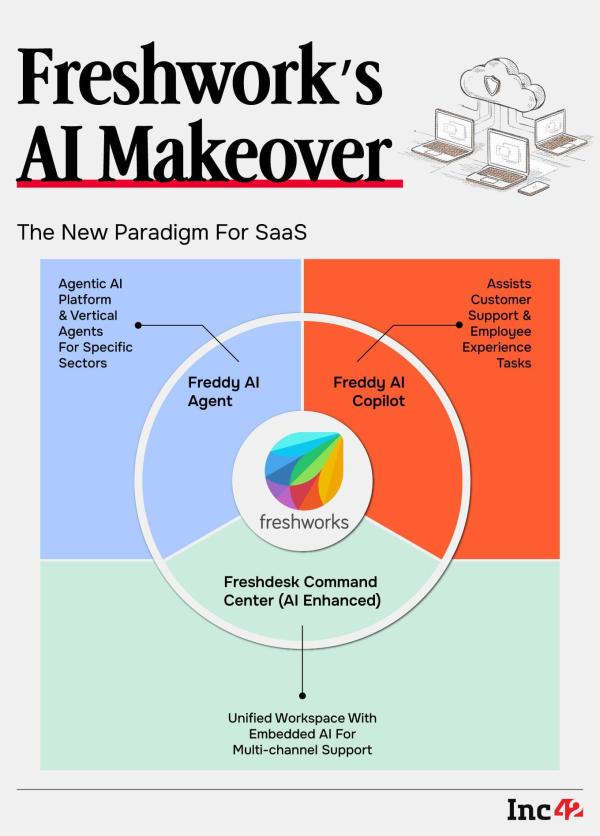
Freddy AI, which had existed in earlier, more limited forms, was rebuilt as a cross-suite layer agentic AI product— embedded into workflows rather than sold separately.
For instance, Freshdesk, the customer support business, is now firmly positioned as an AI-first software.
Similarly, Freshservice has expanded beyond IT into broader enterprise service management in other departments such as finance, HR thanks to AI-driven feature sets. In this context, Freddy AI Copilot and Freddy AI Agent promise autonomous resolution of routine tasks — a response to growing enterprise appetite for cost-cutting automation.
In Q3 2025, Freshworks disclosed that AI-related annual recurring revenue more than doubled year-on-year, and that customers using Freddy features showed higher retention and expansion rates .
Key to this growth were late 2025 product launches including vertical AI agents tailored for industries like ecommerce, fintech, travel, and logistics, which pushes Freshworks away from the traditional horizontal SaaS model. It’s a hybrid SaaS platform today, and this change has largely been driven by the advent of GenAI and LLMs.
The vertical agents are claimed to resolve up to 80% of queries instantly with prebuilt workflows, reducing repetitive tasks and turning potential disruptions into efficiency gains.
Freshworks also expanded its cloud services after acquiring Device 42 for $230 million in 2024 and FireHydrant in late 2025 to bolster IT management and incident response in cloud environments.
This convergence of traditional SaaS, AI and cloud environments has stabilised the business, according to insiders. As per the disclosures, non-GAAP operating margins expanded to 21% in Q3 CY2025 largely driven by AI monetisation—through features like price optimisation.
Currently Freshwork’s as per its Q3 2025earnings report has 50 AI based applications available for its customers right now with its copilot integrated into 60% of the new deals that the company is signing with an average deal value of $30,000.
“Our products are where real work happens in customer support, IT, HR, and operations, helping businesses automate tasks, resolve issues faster, and deliver better experiences with less effort. It’s writing replies, our AI is deeply embedded in how our customers work every day, classifying tickets, generating insights, and increasingly taking action on behalf of employees and customers. The results speak for themselves,” the company management said in a statement.
The statement added that AI-related annual recurring revenue has doubled year-over-year. “Customers are now using Freddie AI to resolve millions of problems every week. And our new AI agents are performing real work across industries, from handling returns in ecommerce to managing employee requests in HR.”
The emphasis on simplicity — long a Freshworks calling card — is now being repurposed as an AI differentiator, especially against enterprise behemoths like Salesforce, Oracle and others.
The $1 Bn AmbitionPost its AI-led transformation, Freshworks is also targeting a $1 Bn revenue milestone in CY2026 led by expanding, large client deals as it broadens its AI product suite and brings in deeper cloud integration thanks to its recent acquisitions.
One such deal — Device 42 — was Freshworks’ largest new deal to date. It contributed a one-time $1 Mn revenue benefit in 2025.
Freshworks’ CEO Woodside has publicly acknowledged the target,framing it not as a near-term promise but as a credible medium-term objective driven by AI-led expansion and deeper enterprise penetration.
Importantly, the revenue ambition is paired with a sharper focus on profitability. The guidance for Q4 and beyond reflects this balancing act. While growth expectations remain in the low-to-mid-teens, the emphasis is on predictability and quality of revenue.
Any discussion of Freshworks’ status as a SaaS posterchild inevitably invites comparison with Zoho. On paper, the contrast is stark.
Zoho reported revenues of over $1 Bn as early as 2022, and has since grown beyond that. It serves tens of millions of users globally, largely without external capital. And like Freshworks, its product suite spans CRM, finance, HR, collaboration, and analytics, all deeply integrated and aggressively priced.
Freshworks, by comparison, remains smaller in absolute scale, with a more focused portfolio and a public-market mandate that prioritises transparency and capital discipline.
The differences run deeper than size.
Zoho emphasises vertical integration and control — owning its data centres, avoiding acquisitions, and building slowly rather than buying out companies.
Freshworks embraces a more conventional Silicon Valley playbook — public market value, selective M&As, and faster product iteration.
In terms of customer profile, Zoho skews heavily toward small businesses and cost-conscious enterprises, particularly in emerging markets. Freshworks, especially under Woodside, is increasingly courting mid-market and enterprise clients willing to pay for automation and scale.
Revenue growth trajectories also diverge. Zoho’s growth, while strong, is opaque due to its private status. Freshworks’ growth is slower but visible, and increasingly driven by upsell rather than new logos.
Zoho has made strides in its AI journey having developed its own LLM for enterprise use-cases, developing AI agents for niche client verticals, speech to text recognition models and other AI- embedded products.
The comparison underscores a broader truth: there is no single Indian SaaS archetype anymore. Zoho has reportedly seen the India market growing aggressively contributing 15% of the overall revenues whereas for Freshworks India is still a small market with the entire Asia-Pacific region including India adding 12% to the overall topline.
Zoho’s FY24 and FY25 disclosures aren’t public yet, but as per its last reported FY23 financials, the bootstrapped SaaS giant was profitable posting profits of INR 2,836Cr.
Why Wall Street Remains WaryDespite operational improvements, Freshworks’ stock performance has been muted for the past year. Freshworks listed at $36 per share in September 2021, giving it an initial market cap of about $10.13 Bn at listing. As of January 9, 2026, Freshworks’ market cap stands around $3.45 Bn, implying a total decline of roughly 65.9 % from its IPO valuation.
Analysts often cite three overlapping concerns.
First, growth fatigue. In a market still flooded with AI hyperscalers and infrastructure plays, a 15% growth rate in topline — however stable will need to show further scale especially in a competitive
Second, competitive intensity. Freshworks operates in markets dominated by giants like Salesforce, ServiceNow, and Zendesk, all of whom are aggressively integrating AI and bundling features.
Third, SaaS valuation compression. Even well-executed SaaS stories have seen multiple contracts as interest rates and investor preferences shift.
Despite Freshworks posting topline growth above street estimates, there is an apprehension of how the company will further navigate the sector-specific challenges in SaaS industry, the execution after the co-founder exits.
The departure of Girish Mathrubootham has also prompted a subtler debate: does Freshworks lose something intangible when its founder steps back?
For years, Mathrubootham embodied the company’s outsider ethos — the Indian startup that took on Silicon Valley incumbents. His exit symbolically closes that chapter.
Yet Freshworks today is not the company he founded. It is larger, more complex, and operating in a market that demands different skills. In that context, Woodside’s leadership will be put to test in 2026.
This scepticism is not necessarily a verdict on Freshworks’ strategy, but it does raise the stakes. As one analyst noted, Freshworks must now “prove that AI can reaccelerate growth without eroding margins.
And in an era where software itself is being rewritten by AI, that may be the harder — and more valuable — achievement.
[Edited By Nikhil Subramaniam]
The post Freshworks’ AI Reinvention: SaaS Giant Enters New Era With AI-First Playbook appeared first on Inc42 Media.
-
Steel tycoon Lakshmi N Mittal pays tribute to father Mohan Lal Mittal

-
FPJ Exclusive Interview: Seven-Time Olympic Medallist Andre De Grasse Still Aims To Be The Best And Fastest On The Planet

-
RCB Vs GG, WPL 2026: Gujarat Giants Win Toss, RCB Women To Bat First In Navi Mumbai

-
Amazon Great Republic Days Sale 2026 Has Begun: iPhone 15 At ₹50,749, iPhone 17 Pro Max At ₹1,40,000

-
Vishvaraj Jadeja’s unbeaten knock guides Saurashtra to nine-wicket win over Punjab, sets up final clash with Vidarbha