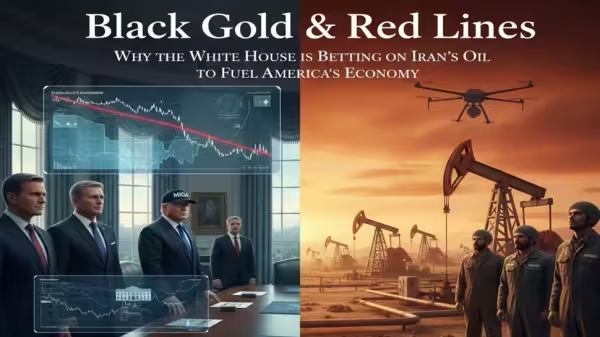
You might have heard Donald Trump saying “Make Iran great again” recently. Sounds friendly, right? But there’s much more to this story than meets the eye. Let’s understand what’s really happening and why oil is at the center of everything. Trump keeps repeating one thing over and over: he wants to bring oil prices down. During his 2024 campaign, he even promised to cut energy prices by half. He told OPEC, the group of countries that controls most of the world’s oil supply, to pump more oil. His famous slogan “Drill, baby, drill” became his rallying cry to produce more oil in America. Simply put, Trump is obsessed with keeping oil cheap.
Now, where does Iran fit into all this? Iran is one of the biggest oil producers in the world. Even with all the Western sanctions against it, Iran still produces about two million barrels of oil every single day. That’s roughly four percent of what the entire world needs. Imagine all that oil just sitting there, and America wants access to it.
Here’s where things get interesting. The American oil industry is already excited about this possibility. There’s a group called the American Petroleum Institute that represents all the big oil companies in America like Chevron and ExxonMobil. When protests were happening in Iran, the head of this group, Mike Sommers, made a bold statement. He said American oil companies are ready to be a “stabilizing force” in Iran if the government there gets overthrown. Basically, he’s telling the US government that if they attack Iran, the oil companies will handle everything afterward.
Add Zee News as a Preferred Source
But why Iran specifically? Doesn’t America already have access to Venezuelan oil? Venezuela has the world’s largest oil reserves, and the US already has some control there. However, there’s a problem. Venezuela’s oil industry is broken. The equipment is old, the infrastructure has fallen apart. American oil companies would need huge guarantees, better security, and proper laws before they invest there. That would take years and billions of dollars.
Iran is different. It’s the world’s sixth-biggest oil producer with a well-functioning oil sector. The wells work, the infrastructure is solid, and Iranian workers know exactly how to extract oil efficiently. American companies could walk in tomorrow and start pumping oil without spending years fixing things first. That’s the real appeal.
So we have a clear picture: Trump desperately wants lower oil prices, American oil companies want access to Iran’s resources, and Iran has plenty of oil. Does this mean America will definitely invade Iran?
Not so fast. The Middle East isn’t like Venezuela. The risks are much, much higher here. One wrong move could make everything explode. Instead of oil prices going down, they could shoot up dramatically.
We’ve actually seen this happen before. Last year, there was a brief twelve-day conflict involving Iran, America, and Israel. During those twelve days, oil prices jumped by nearly twenty percent. The US attacked Iranian nuclear facilities, and immediately oil became more expensive. That war taught everyone a clear lesson: when there’s fighting in the Middle East, oil prices go up, not down.
History shows us this pattern repeatedly. When America invaded Iraq in 2003, it destroyed much of Iraq’s ability to produce oil. Even today, twenty-two years later, Iraq can only produce seventy percent of what it’s actually capable of producing. The war damaged so much equipment and infrastructure that they still haven’t fully recovered. Libya faced the same problem. After American strikes more than a decade ago, Libya’s oil production is still unstable and unpredictable.
So Trump has a real dilemma. He wants cheap oil, but attacking Iran could make oil very expensive instead. Military action in the Middle East has always disrupted energy supplies and pushed prices higher over the long term.
But here’s the thing about Trump: he’s not exactly known for learning from history or worrying too much about risks. His focus remains laser-sharp on one goal, getting oil prices down by any means necessary.
The world is watching nervously. American military forces are on high alert. Iran is preparing for possible conflict. And all of this revolves around one thing: black gold flowing beneath Iran’s soil. Whether Trump will actually pull the trigger remains to be seen. But the incentives are clear, and so are the dangers. The next few months could determine whether this remains just tough talk or turns into something far more serious that affects oil prices, and therefore everything from fuel costs to grocery prices, across the entire world.
(Girish Linganna is an award-winning science communicator and a Defence, Aerospace & Geopolitical Analyst. He is the Managing Director of ADD Engineering Components India Pvt. Ltd., a subsidiary of ADD Engineering GmbH, Germany)
-
Kashi: Development Journey Amid Allegations and Political Statements
-
Tricolour Makeup Guide: Master This Easy Tricolour Makeup Look to Steal the Spotlight

-
Adventurous Bike Trip: Grab Your Bike and Hit the Open Road for Ultimate Thrills

-
Madhya Pradesh: Controversial Remarks by a Congress MLA Trigger Political Storm
-
Political: A New Crossroads for West Bengal Ahead of the Assembly Elections