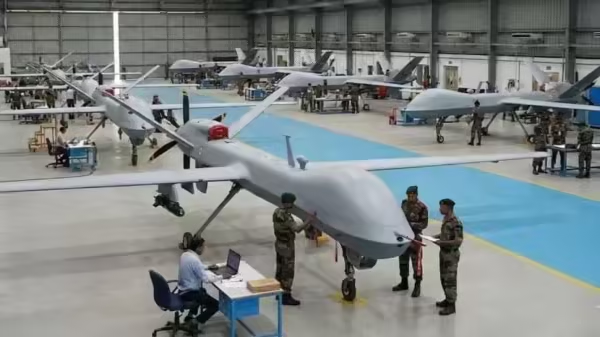
New Delhi: The Indian Army is quietly preparing for a transformation in how it fights future wars. In a disclosure that points to a change in both military doctrine and defense manufacturing, Chief of Army Staff General Upendra Dwivedi has revealed that the force is no longer only buying drones but is now producing them on a massive scale across all its operational commands.
Speaking ahead of the Army Day 2026, he confirmed that each military command has been authorized to manufacture or induct thousands of combat-ready unmanned aerial systems, moving away from dependence on slow and centralized procurement pipelines. The effort is designed to strengthen self-reliance while ensuring that frontline units receive systems tailored to their specific operational needs.
“We have taken a clear decision to manufacture as many drones as possible in-house. Each command is either already building or is in the process of fielding around 5,000 drones. These are not standard and off-the-shelf solutions but bespoke systems designed for our unique operational environments,” he said.
Add Zee News as a Preferred Source
End Of Centralized Buying
At the center of this push is what senior officers describe as a decentralized innovation model. Instead of waiting years for approvals and deliveries from a single procurement authority, individual commands are now empowered to design, build and acquire unmanned systems independently. The result is a distributed drone force that reflects local terrain, threat perceptions and mission profiles.
With roughly 5,000 drones planned per command, the Army is effectively creating a vast and flexible aerial arsenal that spans the length of India’s borders, from the high Himalayas to deserts and dense jungles.
Beyond Surveillance
General Dwivedi made it clear that the focus is on military-grade systems. These are not short-range surveillance quadcopters or hobby platforms, but long-range strike drones and loitering munitions designed for contested airspace.
Recent reports indicate that the Army has already test-fired indigenous drones capable of striking targets more than 100 kilometers away. These systems are intended to carry out precision attacks against high-value targets, suppress enemy air defenses and maintain continuous surveillance deep inside hostile territory without exposing pilots or ground teams to risk.
Next-Gen Combat Units
To manage this surge in unmanned capability, the Army is also restructuring its force. Open-source intelligence points to the creation of specialized formations such as Bhairav Battalions, ASHNI Drone Platoons and Shaktibaan regiments. These units are dedicated to operating, maintaining and integrating drone systems directly into combat formations.
Rather than treating drones as niche support assets, the Army is embedding them within infantry and mechanized units, ensuring unmanned platforms become an integral part of frontline operations.
Designed For Every Battlefield
One of the biggest advantages of command-level production is the ability to engineer drones for specific environments.
Commands operating in high-altitude regions are prioritizing platforms that can fly in thin air and withstand extreme cold. Desert formations are focusing on long-endurance systems with stabilized optics for vast and open terrain. Eastern commands are developing quieter and low-visibility drones suited for dense jungles and limited lines of sight.
This approach has encouraged rapid prototyping, allowing ideas to move from design to deployment in months rather than years.
Strength In Numbers
Underlying this effort is a clear operational concept. By deploying tens of thousands of drones across different roles, including electronic warfare, communications relay, decoys and armed strike missions, the Army aims to saturate and overwhelm adversary defenses.
This mass-drone approach is designed to maintain constant battlefield awareness, apply pressure across multiple fronts and deny opponents the ability to adapt quickly.
General Dwivedi’s remarks highlight a change in India’s military thinking. By bringing production in-house, the Army gains the ability to replace losses quickly, adjust designs as threats evolve and preserve the element of surprise. As unmanned systems take center stage, India’s future battlefields are set to be defined as much by factories and innovation hubs as by soldiers on the ground.
-
Bihar Kathavachak : Arrested in Minor Assault Case Raises Serious Questions on Trust and Accountability

-
Virat Kohli: A Small Dressing Room Moment That Revealed True Personality

-
Indore’s Beggar-Free : Campaign Exposes an Unexpected Story of Wealth and Welfare

-
Bigg Boss: Raqesh Bapat’s Journey in Marathi Season 6 and Insights Into His Personal Life

-
Headline: Matrimonial Deception in Bengaluru Exposes a High-Value Financial Fraud Case