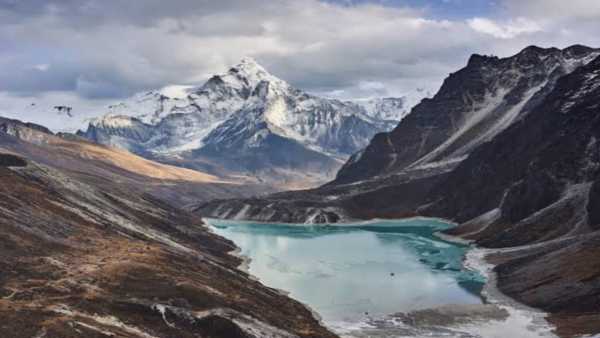
Dehradun: Uttarakhand’s Himalayan region is home to nearly 1,200 glacier lakes spread across 968 glaciers. Out of these, five glacier lakes have been classified as highly sensitive.
To protect these fragile water bodies and reduce disaster risks, the state government has taken a major step by appointing the Wadia Institute of Himalayan Geology as the nodal agency for monitoring.
Report identified 13 sensitive and highly sensitive glacier lakes in Uttarakhand
This decision follows a 2024 report by the National Disaster Management Authority (NDMA), which studied glacier lakes across the Himalayan states. The report identified 13 sensitive and highly sensitive glacier lakes in Uttarakhand and instructed states to monitor them regularly. Acting on this, the Uttarakhand Disaster Management Department decided to focus on the five most vulnerable lakes.
In 2024, a team of experts was formed to study the Vasudhara Glacier Lake in Chamoli district. Later, in 2025, the department also planned to study two of the four highly sensitive glacier lakes in Pithoragarh district. However, due to heavy monsoon disasters in 2025, the study could not be completed.
Govt has appointed Wadia Institute as the nodal agency
Now, the government has formally designated the Wadia Institute of Himalayan Geology as the nodal department. The institute will lead the study in collaboration with other central institutions, while the Disaster Management Department will coordinate and support the process.
According to Vinod Kumar Suman, Disaster Management Secretary, “The Director of the Wadia Institute will serve as the nodal officer. Several meetings have already been held to discuss strategies. Based on current data, future plans will include installing sensors and sirens at glacier lakes to provide early warnings.
Wadia Institute will compile reports from multiple agencies
Suman added that the Wadia Institute will compile reports from multiple agencies, including the Central Water Commission (CWC), the National Institute of Hydrology (NIH), and the Geological Survey of India (GSI). These reports will be combined to prepare a comprehensive strategy. The specifications of sensors and sirens are being finalized, and the Wadia Institute is working on technical details.
Institute has accepted the responsibility
Dr. Vineet Gehlot, Director of Wadia Institute of Himalayan Geology, confirmed that the institute has accepted the responsibility. He said that all central institutions are equally involved, including the Indian Remote Sensing (IRS), the India Meteorological Department (IMD), the CWC, and the NIH.
Dr. Gehlot explained that the work will be carried out at two levels: operational and research. At present, the focus is on operational tasks so that monitoring can begin quickly. This will ensure that if any disaster occurs during the next monsoon season, all institutions can respond together.
With sensors, sirens, and coordinated efforts, an early warning system may be developed
He also emphasized the importance of coordination and data security. Institutions sharing information must be assured that their data will remain safe. Discussions are ongoing about whether to start with one glacier lake or to monitor all lakes simultaneously. With sensors, sirens, and coordinated efforts, Uttarakhand hopes to create an effective early warning system.
-
ICC T20 World Cup 2026: Bangladesh remain adamant on decision in spite of deadline, refuse to play in India

-
Ravi Kishan Pushes for National Awards recognition for television: ‘I will write to the ministry’

-
Kiara Advani and Kartik Aaryan face backlash after flyer alleges cold behaviour on Jaipur–Mumbai flight: ‘Ganda Sa expression diya’

-
This Dryrobe dog coat has been a game-changer for winter walks

-
How to grow avocado at home from seed: Foolproof guide to grow exotic fruits