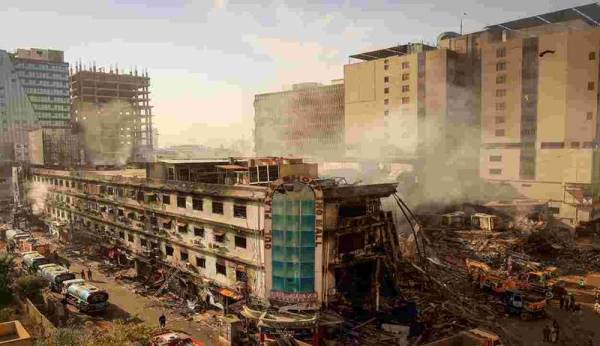
Karachi Fire: The Human Rights Council of Pakistan organized a strong public protest outside the Karachi Press Club, calling for immediate accountability over the devastating Gul Plaza shopping mall fire. The demonstration reflected growing public anger and grief after a deadly blaze claimed at least 60 lives and left many others injured, exposing serious gaps in urban safety governance and emergency response systems.
According to organizers, the protest brought together men, women, and children from different walks of life. Members of the Human Rights Council, civil society activists, and families affected by the tragedy gathered to demand justice, transparency, and meaningful reform. The protest was peaceful but emotionally charged, with participants holding placards and chanting slogans against administrative negligence.
Public Anger After Deadly Fire Incident
The fire broke out late on the night of January 17 at Gul Plaza, a commercial shopping mall located in Karachi. Eyewitnesses reported chaos, thick smoke, and a lack of timely rescue operations. Many victims were trapped inside the building, while others suffered severe injuries attempting to escape. The scale of casualties quickly turned the incident into one of the city’s deadliest commercial fires in recent years.
In the days following the tragedy, public outrage intensified as questions emerged about delayed emergency response, poor building safety standards, and the absence of effective fire prevention measures. Critics accused city authorities and the provincial administration of failing to enforce safety regulations, despite Karachi’s long history of similar incidents.
Human Rights Council’s Stand on Negligence
Addressing the protesters, Human Rights Council Chairman Jamshed Hussain described the Gul Plaza fire as more than an unfortunate accident. He stated that the incident represented criminal negligence by responsible institutions and amounted to a serious violation of fundamental human rights. According to him, the loss of over 60 lives and the continued uncertainty regarding missing persons clearly demonstrated systemic failure within the governance structure.
He emphasized that the right to life and safety is a basic obligation of the state. When commercial buildings operate without proper safety compliance and emergency services remain ill-prepared, such tragedies become inevitable rather than accidental.
Demand for Resignation and Legal Action
One of the central demands of the protest was the immediate resignation of Karachi Mayor Murtaza Wahab. The Human Rights Council argued that moral responsibility must be accepted for administrative failure in the city, particularly regarding the lack of preparedness of the fire brigade and oversight authorities.
The Council also demanded strict legal action against officials of the Sindh Building Control Authority and the Fire Brigade. According to speakers at the protest, negligence, weak enforcement, and institutional incompetence directly contributed to the scale of human loss witnessed at Gul Plaza.
Concerns Over Compensation and Relief
The provincial government of Sindh announced financial compensation of one crore Pakistani rupees per deceased victim. However, the Human Rights Council rejected this amount as extremely insufficient given the magnitude of loss and suffering. Protest leaders argued that no amount of money could replace lost lives, but fair compensation was necessary to support affected families.
Additionally, the Council demanded full financial compensation for traders who suffered massive economic losses due to the fire. Many shop owners lost their entire livelihoods overnight. Protesters also called for the injured to receive the best possible medical treatment at government expense, without bureaucratic delays.
Call for Independent Investigation
Another key demand was the formation of an independent and transparent investigation committee. The Human Rights Council stressed that such a committee should not be symbolic or created merely to calm public anger. Instead, it must identify those responsible at every level and ensure concrete legal consequences.
HRC Karachi Division President Bashir Daras stated that repeated tragedies prove that lessons are not being learned. He warned that without accountability, similar disasters would continue to occur, endangering countless lives in densely populated commercial areas.
Warning of Expanded Protests
The Human Rights Council concluded the protest with a clear warning. If immediate justice is not delivered and responsible officials are not held accountable, the scope of demonstrations will be expanded across the city. According to the Council, sustained public pressure is necessary to force systemic reform and protect citizens from preventable disasters in the future.
-
Bank Job: Job opportunity at Central Bank of India; application process begins for recruitment to Foreign Exchange and Marketing Officer positions..

-
Internship: An opportunity to work with the World Bank, stipend will be paid on an hourly basis, graduate and postgraduate students can apply..

-
TET: The UP TET exam will now be held in July, bringing relief to 15 lakh candidates; UPESSC has released the recruitment calendar..

-
JAC Final Exam Schedule: When will the final exams for classes 8th, 9th, and 11th be held in Jharkhand? JAC has released the complete schedule..

-
Private School Free Admission: Yogi government's big decision! Free admissions available in private schools in UP, 6.80 lakh seats...