
Listen to this article in summarized format
Loading...
××
Subscribe to

Unlock AI Briefing and Premium Content
Subscribe NowWhat's Included
- Exclusive Stories
- Daily ePaper Access
- Smart Market Tools
- Curated Investment Ideas
- Ad-lite Experience
Subscription

India’s IT and engineering services industry has long been one of the engine rooms of the nation’s economic resurgence. Curriculums in even country’s top engineering institutions emphasise coding, algorithms, and examinations to provide a steady stream of talent to fuel the thousands of Global Capability Centres (GCC) across the country. Over time, these curriculums evolved in isolation (mechanical, electrical, and computer sciences) and did not have avenues to integrate at a systems level – the delicate interplay of hardware, software, manufacturing process, supply chains, costs, and markets that determine the success of a product or a solution.
With concerted efforts to manufacture semiconductors in India making meaningful progress, there is a need for talent that can think and solve at a systems level. This is crucial, not only due to the sheer number of process steps involved, but also due to the extreme complexity, precision, and interdependence of processes involved. Cause-effect modelling, feedback control, and design of experiments to manage these process interactions to ensure yield stability are essential to success.
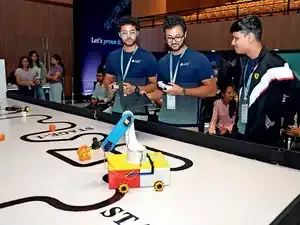
The Lam Research Challenge, a nationwide systems engineering competition, first touched down on Indian campuses in 2024, with an intent to underline the nuances and select talent with the capacity for systems-level thinking as it pertains to the semiconductor industry. Demanding a multidisciplinary approach to solving the problem statement, the Lam Research Challenge required teams to field members from different engineering disciplines and had rigorous systems-driven judging criteria.
This year, the challenge has doubled down on its charter to further system-driven frameworks and challenge students with industry-relevant problems. Initiatives like the Lam Research Challenge will play a key role in helping evolve mindsets from services to systems, encouraging Indian engineers to look beyond coding to become integrators.
According to Rangesh Raghavan, corporate vice president and managing director, Lam Research India, “The Lam Research Challenge has evolved into more than a systems engineering challenge. Through problem-solving and transformative learning, we strive to inspire the spirit of innovation and help foster future talent for the semiconductor industry. Congratulations to this year’s winners and all the bright students who made the competition a success.”
With concerted efforts to manufacture semiconductors in India making meaningful progress, there is a need for talent that can think and solve at a systems level. This is crucial, not only due to the sheer number of process steps involved, but also due to the extreme complexity, precision, and interdependence of processes involved. Cause-effect modelling, feedback control, and design of experiments to manage these process interactions to ensure yield stability are essential to success.
This year, the challenge has doubled down on its charter to further system-driven frameworks and challenge students with industry-relevant problems. Initiatives like the Lam Research Challenge will play a key role in helping evolve mindsets from services to systems, encouraging Indian engineers to look beyond coding to become integrators.
(This article is generated and published by ET Spotlight team. You can get in touch with them on etspotlight@timesinternet.in)