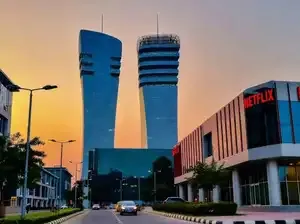
New Delhi: As the mature, high-cost markets for office space globally are stabilising, a new set of cost-efficient, high-velocity markets are emerging as core engines of global expansion.
According to Altre, a tech-enabled workplace consultancy, as global enterprises rethink where to place talent, capital, and long-term operations, the world’s office markets are no longer moving in a single direction.
The research compares office markets across India, the United States, the United Kingdom, Japan, Singapore, Dubai, and Poland.
India ranks among the largest office markets in the world, accounting for nearly a quarter of global leasing during the period. Despite being a relatively young market, India has emerged as the fastest-growing large-scale office market globally, alongside some of the lowest rents among major global hubs.
Crucially, India is the only large market where scale, growth, affordability, modern supply, and long-term fundamentals are strengthening simultaneously.
“India uniquely combines scale, growth, and structural resilience at a time when several mature office markets face demand uncertainty. Increasing adoption of data-led planning, automation, and market intelligence is accelerating how workplaces are evaluated, designed, and delivered,” said Shweta Sawhney, Founder & CEO, Altre Digital Pvt Ltd.
India and Poland have emerged as cost-efficient growth corridors, absorbing space faster and at significantly lower rents than mature markets.
The United States, despite being the world’s largest office market, continues to recalibrate with demand increasingly concentrated in a narrow set of trophy submarkets amid elevated vacancy elsewhere.
Japan and the UK demonstrate how low vacancy, regulatory clarity, and high-quality stock allow markets to sustain premium rents, positioning them as stability-driven hubs.
Singapore and Dubai show strong headline growth off smaller bases, driven by prime submarkets and policy-led momentum, but with supply dynamics that require careful navigation.
As global enterprises restart long-term leasing cycles and expand Global Capability Centers (GCCs), real estate decisions are increasingly intertwined with talent strategy, execution speed, and long-term scalability.
“Leaders can no longer rely on legacy assumptions. They need clear, comparable insight into how markets differ in momentum, supply discipline, affordability, stability, and execution risk,” said Anurag Tyagi, Founder & CEO of Altre Build Tech, a subsidiary of Altre Digital.
India I s the only large-scale office market where demand is expanding, costs remain globally competitive, supply is increasingly modern and ESG-aligned, and long-term fundamentals are strengthening at the same time.
All of these factors have pushed India beyond a value-led alternative to a global office market, capable of supporting scale, speed, and resilience in equal measure.
According to Altre, a tech-enabled workplace consultancy, as global enterprises rethink where to place talent, capital, and long-term operations, the world’s office markets are no longer moving in a single direction.
The research compares office markets across India, the United States, the United Kingdom, Japan, Singapore, Dubai, and Poland.
India ranks among the largest office markets in the world, accounting for nearly a quarter of global leasing during the period. Despite being a relatively young market, India has emerged as the fastest-growing large-scale office market globally, alongside some of the lowest rents among major global hubs.
Crucially, India is the only large market where scale, growth, affordability, modern supply, and long-term fundamentals are strengthening simultaneously.
“India uniquely combines scale, growth, and structural resilience at a time when several mature office markets face demand uncertainty. Increasing adoption of data-led planning, automation, and market intelligence is accelerating how workplaces are evaluated, designed, and delivered,” said Shweta Sawhney, Founder & CEO, Altre Digital Pvt Ltd.
India and Poland have emerged as cost-efficient growth corridors, absorbing space faster and at significantly lower rents than mature markets.
The United States, despite being the world’s largest office market, continues to recalibrate with demand increasingly concentrated in a narrow set of trophy submarkets amid elevated vacancy elsewhere.
Japan and the UK demonstrate how low vacancy, regulatory clarity, and high-quality stock allow markets to sustain premium rents, positioning them as stability-driven hubs.
Singapore and Dubai show strong headline growth off smaller bases, driven by prime submarkets and policy-led momentum, but with supply dynamics that require careful navigation.
As global enterprises restart long-term leasing cycles and expand Global Capability Centers (GCCs), real estate decisions are increasingly intertwined with talent strategy, execution speed, and long-term scalability.
“Leaders can no longer rely on legacy assumptions. They need clear, comparable insight into how markets differ in momentum, supply discipline, affordability, stability, and execution risk,” said Anurag Tyagi, Founder & CEO of Altre Build Tech, a subsidiary of Altre Digital.
India I s the only large-scale office market where demand is expanding, costs remain globally competitive, supply is increasingly modern and ESG-aligned, and long-term fundamentals are strengthening at the same time.
All of these factors have pushed India beyond a value-led alternative to a global office market, capable of supporting scale, speed, and resilience in equal measure.