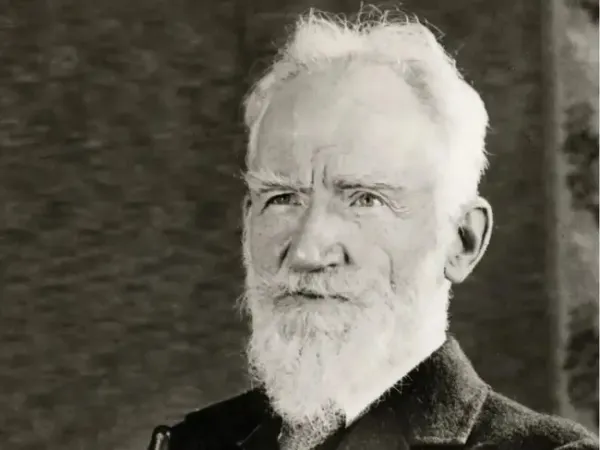
George Bernard Shaw stands among the most formidable figures in the history of English-language literature. His creative authority reshaped drama, social thought, and political discourse for decades, with an influence that stretched from the late nineteenth century well beyond his lifetime. Prolific to an extraordinary degree, Shaw produced more than sixty theatrical works, ranging from sharp social comedies to deeply philosophical historical dramas. Titles such as Man and Superman, Pygmalion, and Saint Joan exemplify the scope and ambition of his writing. His ability to combine biting wit with intellectual seriousness made him the dominant playwright of his era, a distinction formally acknowledged when he received the Nobel Prize in Literature in 1925.
One of his most well known quotes read: “Life isn't about finding yourself. Life is about creating yourself.”
For several years, Shaw earned almost nothing from his literary efforts and relied heavily on his mother’s support. These difficult years tested his resilience but also sharpened his discipline and intellectual independence.
One of his most well known quotes read: “Life isn't about finding yourself. Life is about creating yourself.”
Early Years in Dublin
Shaw entered the world on July 26, 1856, at 3 Upper Synge Street in Portobello, an unassuming neighborhood in Dublin associated with modest, middle-class life. He was the youngest child and the only son born to George Carr Shaw and Lucinda Elizabeth Shaw, known as Bessie before her marriage. His childhood household included two elder sisters, Lucinda Frances and Elinor Agnes, both of whom played formative roles in his early life. Though Ireland shaped his earliest experiences, it would not remain his permanent home.Loss, Departure, and Exile
In 1876, Shaw’s family life was shaken by devastating news when his mother informed him that his sister Agnes was dying from tuberculosis. In response, Shaw abandoned his position with land agents and traveled to England to reunite with his mother and sister Lucy for Agnes’s funeral. That journey marked a decisive turning point. After leaving Ireland, Shaw did not settle there again and remained absent from the country for nearly three decades, forging his identity and career elsewhere.Struggles of a Young Writer
Shaw’s early literary ambitions were met with repeated setbacks. His first completed novel, Immaturity, finished in 1879, was deemed too bleak for contemporary publishers and remained unpublished until many years later. Around the same time, Shaw took brief employment with the Edison Telephone Company, where he demonstrated aptitude and rose quickly through the ranks. However, when the company merged with a competitor, he declined to pursue a future in the reorganized firm, choosing instead to commit fully to writing despite its financial uncertainty.For several years, Shaw earned almost nothing from his literary efforts and relied heavily on his mother’s support. These difficult years tested his resilience but also sharpened his discipline and intellectual independence.