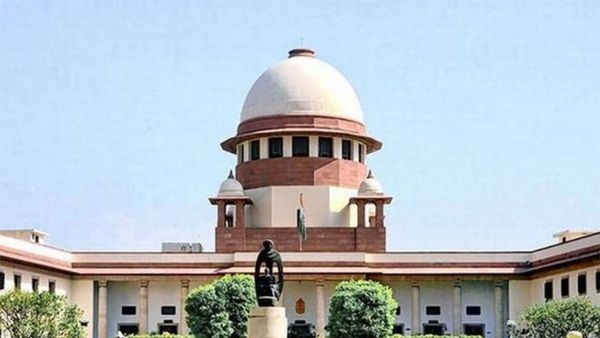
The Supreme Court ordered an interim arrangement at the disputed Bhojshala-Kamal Maula complex in Dhar, MP, allowing both Hindus and Muslims to offer prayers on a day when Basant Panchami coincides with Friday Jumuah prayers in separate spaces.
The Supreme Court on Thursday ordered an interim arrangement at the disputed Bhojshala-Kamal Maula complex in Dhar, Madhya Pradesh, to allow both Hindu and Muslim communities to perform their religious practices on Basant Panchami, which happens to fall on a Friday - coinciding with Jumuah (special midday prayer).

A bench led by the Chief Justice of India, Surya Kant, passed the order while hearing a plea seeking a ban on offering namaz from sunrise to sunset on Basant Panchami to facilitate Hindu rituals at the site. The Court directed the District administration in Dhar to provide separate and exclusive spaces for both communities to carry out their respective rituals.
Court's Interim Arrangement
"After knowing that persons from the Muslim community are likely to come tomorrow from 1-3 pm, an exclusive space including separate entry and exit will be made available so that namaz can be taken at the prescribed time. Similarly, a separate space shall be made available to the Hindu community to hold the celebration of Basant Panchami," the sourt noted.
Arguments Presented in Court
Appearing for the Hindu side (applicants) advocate Vishnu Jain informed the Court that the auspicious period for performing the puja on Basant Panchami lasts from sunrise to sunset. He suggested that namaz could instead be held later in the evening, around 5 pm, after the puja concludes.
Senior Advocate Salman Khurshid, representing the Muslim side, stated that Namaz prayers would be held only in the afternoon, between 1 pm and 3 pm.
Advocate Vishnu Shankar Jain reiterated that the religious observance (Muhurat) for Hindus spans the entire day from sunrise to sunset, and people would be praying as per their respective timings until sunset. Jain then argued that if namaz were shifted to the evening, Hindus could continue their long-standing religious practices such as Akhand Hawan.
Khurshid countered this by explaining that Jumma namaz is time-specific and is offered around noon.
Law and Order Measures
Following submissions by the Additional Solicitor General KM Nataraj and the Madhya Pradesh Advocate General Prashant Singh, who assured that law and order would be maintained, the Court noted that members of the Muslim community are likely to arrive between 1 pm and 3 pm. It said that an exclusive area with separate entry and exit would be made available for prayers at the prescribed time.
The Madhya Pradesh government assured the Court that the district administration would maintain law and order during the religious observances.
Senior Advocate Salman Khurshid, appearing for the petitioners, told the Court that the approximate number of Muslim worshippers expected between 1 pm and 3 pm would be shared with the District Magistrate in advance.
The Court also directed the district administration to take preventive steps to avoid any untoward incident. "The District Administration may ensure maintenance of law and order, issue passes for visitors or adopt any other fair means to ensure that no untoward incident happens," the Court said.
About the Disputed Complex
The Bhojshala-Kamal Maula complex is a protected monument under the Archaeological Survey of India and holds religious significance for both Hindus and Muslims. Hindus consider the site as Bhojshala, associated with Goddess Saraswati, while Muslims regard it as the Kamal Maula mosque.
(Except for the headline, this story has not been edited by Asianet Newsable English staff and is published from a syndicated feed.)-
Thousands of Brits set to receive £150 energy bill compensation

-
Ruuska storms to victory with stunning 62 at Egypt Golf Series New Giza

-
Tottenham announce tenth January deal as Thomas Frank moves continue after £48m splurge

-
UK snow maps show 24-hour blizzards bringing 54mm as 66 areas 'buried'
-
Bootle incident LIVE: Man 'hit in the head with an axe' with 'blood everywhere'