ABP Course Guide: Mechanical engineering continues to remain one of the most versatile and impactful disciplines for students who have completed Class 12 with Physics, Chemistry, and Mathematics. From robotics and automation to automotive design and advanced manufacturing, the field opens doors to both traditional and emerging technologies that power modern industry.
Undergraduate Programmes That Build Strong Foundations
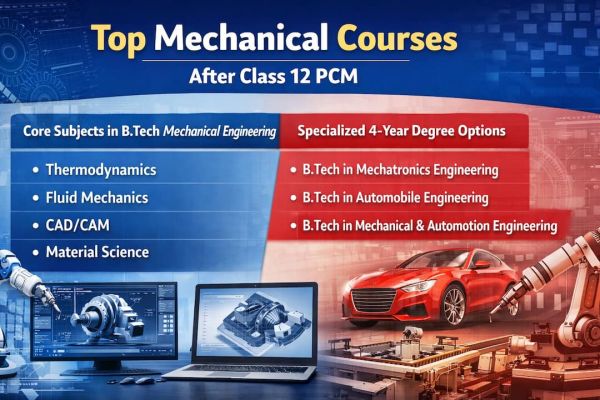
The most popular route after Class 12 PCM is the B.Tech/B.E. in Mechanical Engineering, a four-year degree that covers the full span of mechanical system development from concept and design to analysis, production, and maintenance. Core subjects typically include:
- Thermodynamics
- Fluid Mechanics
- CAD/CAM
- Material Science
These fundamentals help graduates build a strong base for advanced studies or technical careers in the engineering sector.
For students interested in specialised fields, several focused undergraduate options are also available:
Top specialised mechanical-related courses (4 years):
- B.Tech in Mechatronics Engineering
- B.Tech in Automobile Engineering
- B.Tech in Mechanical & Automation Engineering
These programmes allow learners to explore niche areas such as robotics, automation, smart manufacturing, and automotive technology fields that are expanding rapidly with Industry 4.0 innovation.
Diploma Pathways for Skill-Oriented Roles
Students who prefer shorter, application-heavy programmes may opt for three-year Polytechnic Diplomas. A Diploma in Mechanical Engineering prepares learners for entry-level technical roles in workshops, production units, or engineering support teams. Specialised diplomas such as Diploma in Mechatronics introduce students to automated systems, robotics, and electro-mechanical components skills aligned with modern factory operations and smart manufacturing units.
Specialisations Driving the Future of Mechanical Engineering
Mechanical engineering also offers numerous emerging specialisations that align with global industrial growth. Areas such as Robotics & Automation focus on intelligent machine design, while CAD/CAM and CAE use tools like SolidWorks and ANSYS for digital design and simulation. Another promising niche is HVAC (Heating, Ventilation, and Air Conditioning), which deals with climate control solutions for residential, commercial, and industrial infrastructure.
Eligibility, Exams, and Top Study Destinations
Admission to top mechanical programmes typically requires a minimum of 50% in Class 12 PCM. Competitive entrances like JEE Main serve as the primary gateway for institutes including IIT Madras, IIT Delhi, IIT Kanpur, IIT Bombay, IIT Kharagpur, and other leading NITs. Prestigious private universities such as VIT and Manipal also offer strong mechanical engineering programmes with industry-aligned curricula.
Career Pathways and Industry Roles
Mechanical engineers find opportunities across diverse industries from aerospace and marine to oil & gas, manufacturing, and heavy machinery. Professionals may work as Mechanical Engineers, CAD Designers, Production Supervisors, or move into verticals such as piping design and automotive systems. In India, starting packages often range between ₹5–10 lakh per annum, depending on the sector and institution background.
-
B'luru: Woman arrested for blackmailing seer of prominent mutt, extorting lakhs

-
US Officially Withdraws from World Health Organization Amid Pandemic Criticism

-
Railway's master vacancy has arrived, 10th pass candidates will get government jobs, recruitment for 22000 posts

-
European island 2 hours from UK named the 'hottest' this year with £11 return flights

-
How sneaker culture is reshaping fashion in the UAE and Saudi Arabia