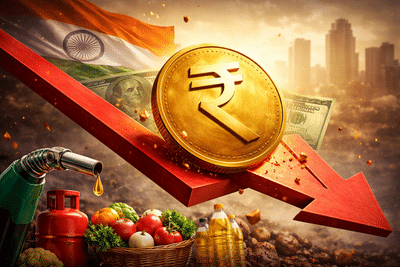
India does not need a currency crisis for this to become dangerous. With high import dependence and dollar-linked costs across the economy, a falling rupee pushes financial stress into the future, especially for households and businesses with limited buffers. That is why a number like 92 per dollar is not just a market headline. It is an early warning. 1. India Pays More for the Same Imports, By Design

New Delhi, Dec 19 (IANS) Consistent foreign institutional investor (FII) selling weighed on the Indian rupee in November while domestic flows supported equity markets and bond yields hardened, a report said on Friday.
India is structurally import-dependent.- Crude oil: ~85% of India’s oil demand is imported
- Edible oils: ~60% imported
- Electronics & machinery: heavy dependence on imported components
- Fertilisers: significant imports of urea, phosphates, potash
A 10% rupee depreciation mechanically raises the rupee cost of these imports by roughly the same margin even if global prices remain unchanged. India’s annual merchandise imports exceed $700 billion—which means every ₹1 depreciation materially raises the import bill.
This feeds directly into fuel prices, fertiliser subsidies, manufacturing costs, and eventually consumer prices. 2. Imported Inflation Pushes Up Domestic Prices With a Lag India’s CPI basket includes several categories that are indirectly dollar-linked:
- Transport & fuel
- Manufactured goods
- Medicines and medical equipment
This is why the Reserve Bank of India repeatedly flags exchange-rate volatility as a risk in its Monetary Policy Committee statements.
The effect is not immediate, but persistent: prices rise slowly, wages don’t adjust at the same speed, and purchasing power erodes quietly. 3. Capital Flows Become Volatile When the Rupee Weakens India runs a current account deficit, meaning it relies on foreign capital inflows to balance trade.

New Delhi, Jan 22 (IANS) Amid global uncertainties, the current state of the economy provides ground for optimism going forward and the GDP growth estimates for 2025-26 indicate that India will remain the fastest growing major economy in the world, according to the Reserve Bank of India (RBI).
According to RBI Balance of Payments data:- Portfolio flows (FPI) are highly sensitive to currency risk
- Periods of rupee weakness have coincided with equity and bond outflowsf
- Outflows push bond yields up, raising borrowing costs
- Tighten domestic liquidity
- Increase corporate borrowing costs
- Delay private investment
A significant portion is:
- Dollar-denominated corporate borrowing
- External commercial borrowings (ECBs)
- NRI deposits
- Debt servicing costs rise instantly in rupee terms
- Balance sheets worsen without new borrowing
Currency depreciation thus translates into real economic stress, not accounting noise. 5. Foreign Education, Travel, and Services Jump 10–15% Overnight India sends over $25–30 billion annually on:
- Overseas education
- Travel and tourism
- Subscriptions, software, and services
What was affordable through saving becomes postponed—or abandoned. 6. Export Gains Exist, but Are Limited and Uneven

New Delhi, Jan 15 (IANS) India’s total exports during the nine months this fiscal (April-December) is estimated at $634.26 billion, registering a positive growth of 4.33 per cent compared to $607.93 billion in April-December 2024, despite US tariffs and geo-political uncertainties, the government data showed on Thursday.
A weaker rupee helps exporters in theory. In practice:- Many exporters import raw materials or components
- Cost advantages are diluted
- Global demand conditions matter more than currency
Export benefits take time. Import-led inflation and household cost pressures arrive much faster. 7. Government Finances Face Immediate Pressure A weaker rupee raises:
- Oil import cost
- Fertiliser subsidy bills
- External debt servicing
- Tax cuts
- Welfare expansion
- Infrastructure spending
-
Kundalpur: Where Lord Mahavir was born, the story of that pilgrimage in Bihar

-
Abhimanyu Easwaran’s ‘bizarre mental lapse’ run out
-
IND VS NZ 2nd T20: India won the toss and chose bowling, Akshar and Bumrah will not play today
-
Jammu highway closed…air services disrupted, Kashmir cut off from other areas due to first snowfall of the season

-
Buzz in Congress Circles again as Shashi Tharoor Skips Key Party Meeting in Delhi to Stay Back in Kerala