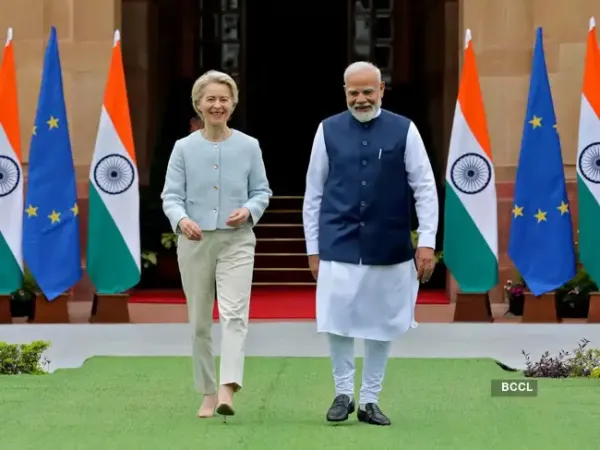
India’s 77th Republic Day celebrations on January 26, 2026, are set to carry strong diplomatic significance as European Commission President Ursula von der Leyen and European Council President António Costa will attend the parade as chief guests at Kartavya Path, New Delhi.
This marks the first time that top European Union leadership has been invited together for India’s Republic Day, signalling a major shift in New Delhi’s engagement with Brussels.
A First in Republic Day History
The 2026 invitation is historic for more than one reason. While India has hosted several global leaders over the decades, this is the first occasion when the European Union’s top political leadership will attend as a collective representation of the EU.
The move reflects India’s growing recognition of the EU as a single strategic partner, rather than a group of individual countries.
It also comes at a crucial time, with trade talks between India and the European Union gaining momentum.
Why This Invitation Matters for India–EU Relations
The presence of Ursula von der Leyen and António Costa is being seen as a strong diplomatic signal ahead of ongoing trade negotiations.
Earlier this week at the World Economic Forum in Davos, von der Leyen described the upcoming India–EU trade pact as “the mother of all deals”, hinting at a potentially historic Free Trade Agreement (FTA) between the two sides.
The timing of the Republic Day invitation suggests:
Who Are the EU Leaders Attending Republic Day 2026?
Ursula von der Leyen
She is the President of the European Commission, the EU’s executive arm. Her role includes shaping EU policy, overseeing trade negotiations, and representing the bloc globally on economic and strategic matters.
António Costa
As the President of the European Council, Costa chairs EU summits and represents the collective interests of EU member states. His presence highlights political unity within the bloc.
Republic Day Chief Guests: A Long-Standing Diplomatic Tradition
Since 1950, India has invited a foreign head of state or government as the chief guest for Republic Day celebrations. The choice has always reflected India’s foreign policy priorities.
From leaders of the Non-Aligned Movement during the Cold War to strategic partners in recent years, Republic Day invitations have often mirrored India’s evolving global position.
Notably:
Inputs from agencies
This marks the first time that top European Union leadership has been invited together for India’s Republic Day, signalling a major shift in New Delhi’s engagement with Brussels.
A First in Republic Day History
The 2026 invitation is historic for more than one reason. While India has hosted several global leaders over the decades, this is the first occasion when the European Union’s top political leadership will attend as a collective representation of the EU.The move reflects India’s growing recognition of the EU as a single strategic partner, rather than a group of individual countries.
It also comes at a crucial time, with trade talks between India and the European Union gaining momentum.
Why This Invitation Matters for India–EU Relations
The presence of Ursula von der Leyen and António Costa is being seen as a strong diplomatic signal ahead of ongoing trade negotiations.Earlier this week at the World Economic Forum in Davos, von der Leyen described the upcoming India–EU trade pact as “the mother of all deals”, hinting at a potentially historic Free Trade Agreement (FTA) between the two sides.
The timing of the Republic Day invitation suggests:
- Strengthening economic and strategic ties
- Renewed momentum in India–EU trade talks
- Growing cooperation on technology, climate, defence and supply chains
- Europe’s interest in India as a long-term strategic partner
Who Are the EU Leaders Attending Republic Day 2026?
Ursula von der LeyenShe is the President of the European Commission, the EU’s executive arm. Her role includes shaping EU policy, overseeing trade negotiations, and representing the bloc globally on economic and strategic matters.
António Costa
As the President of the European Council, Costa chairs EU summits and represents the collective interests of EU member states. His presence highlights political unity within the bloc.
Republic Day Chief Guests: A Long-Standing Diplomatic Tradition
Since 1950, India has invited a foreign head of state or government as the chief guest for Republic Day celebrations. The choice has always reflected India’s foreign policy priorities.From leaders of the Non-Aligned Movement during the Cold War to strategic partners in recent years, Republic Day invitations have often mirrored India’s evolving global position.
Notably:
- France has been invited multiple times, most recently in 2024
- The US was represented by Barack Obama in 2015
- ASEAN leaders were invited collectively in 2018
- Egypt’s President attended in 2023
List of Chief Guests at India’s Republic Day Parade (1950–2026)
| Year | Chief Guest(s) | Country / Entity |
| 1950 | President Sukarno | Indonesia |
| 1951 | King Tribhuvan Bir Bikram Shah | Nepal |
| 1952 | No invitation | — |
| 1953 | No invitation | — |
| 1954 | King Jigme Dorji Wangchuck | Bhutan |
| 1955 | Governor-General Malik Ghulam Muhammad | Pakistan |
| 1956 | R. A. Butler; Kotaro Tanaka | United Kingdom; Japan |
| 1957 | Marshal Georgy Zhukov | Soviet Union |
| 1958 | Marshal Ye Jianying | China |
| 1959 | Duke of Edinburgh (Prince Philip) | United Kingdom |
| 1960 | President Kliment Voroshilov | USSR |
| 1961 | Queen Elizabeth II | United Kingdom |
| 1962 | PM Viggo Kampmann | Denmark |
| 1963 | King Norodom Sihanouk | Cambodia |
| 1964 | Lord Louis Mountbatten | United Kingdom |
| 1965 | Rana Abdul Hamid | Pakistan |
| 1966 | No invitation | — |
| 1967 | King Mohammed Zahir Shah | Afghanistan |
| 1968 | PM Alexei Kosygin; President Tito | USSR; Yugoslavia |
| 1969 | PM Todor Zhivkov | Bulgaria |
| 1970 | King Baudouin | Belgium |
| 1971 | President Julius Nyerere | Tanzania |
| 1972 | PM Seewoosagur Ramgoolam | Mauritius |
| 1973 | President Mobutu Sese Seko | Zaire |
| 1974 | Tito; Sirimavo Bandaranaike | Yugoslavia; Sri Lanka |
| 1975 | President Kenneth Kaunda | Zambia |
| 1976 | PM Jacques Chirac | France |
| 1977 | Edward Gierek | Poland |
| 1978 | President Patrick Hillery | Ireland |
| 1979 | PM Malcolm Fraser | Australia |
| 1980 | President Valéry Giscard d’Estaing | France |
| 1981 | President José López Portillo | Mexico |
| 1982 | King Juan Carlos I | Spain |
| 1983 | President Shehu Shagari | Nigeria |
| 1984 | King Jigme Singye Wangchuck | Bhutan |
| 1985 | President Raúl Alfonsín | Argentina |
| 1986 | PM Andreas Papandreou | Greece |
| 1987 | President Alan García | Peru |
| 1988 | President Junius Jayewardene | Sri Lanka |
| 1989 | Nguyen Van Linh | Vietnam |
| 1990 | PM Anerood Jugnauth | Mauritius |
| 1991 | President Maumoon Abdul Gayoom | Maldives |
| 1992 | President Mário Soares | Portugal |
| 1993 | PM John Major | United Kingdom |
| 1994 | PM Goh Chok Tong | Singapore |
| 1995 | President Nelson Mandela | South Africa |
| 1996 | President Fernando Henrique Cardoso | Brazil |
| 1997 | PM Basdeo Panday | Trinidad and Tobago |
| 1998 | President Jacques Chirac | France |
| 1999 | King Birendra | Nepal |
| 2000 | President Olusegun Obasanjo | Nigeria |
| 2001 | President Abdelaziz Bouteflika | Algeria |
| 2002 | President Cassam Uteem | Mauritius |
| 2003 | President Mohammad Khatami | Iran |
| 2004 | President Lula da Silva | Brazil |
| 2005 | King Jigme Singye Wangchuck | Bhutan |
| 2006 | King Abdullah bin Abdulaziz | Saudi Arabia |
| 2007 | President Vladimir Putin | Russia |
| 2008 | President Nicolas Sarkozy | France |
| 2009 | President Nursultan Nazarbayev | Kazakhstan |
| 2010 | President Lee Myung-bak | South Korea |
| 2011 | President Susilo Bambang Yudhoyono | Indonesia |
| 2012 | PM Yingluck Shinawatra | Thailand |
| 2013 | King Jigme Khesar Namgyel Wangchuck | Bhutan |
| 2014 | PM Shinzo Abe | Japan |
| 2015 | President Barack Obama | United States |
| 2016 | President François Hollande | France |
| 2017 | Crown Prince Mohammed bin Zayed | UAE |
| 2018 | ASEAN Leaders | ASEAN Nations |
| 2019 | President Cyril Ramaphosa | South Africa |
| 2020 | President Jair Bolsonaro | Brazil |
| 2021 | PM Boris Johnson (cancelled) | United Kingdom |
| 2022 | No chief guest | — |
| 2023 | President Abdel Fattah el-Sisi | Egypt |
| 2024 | President Emmanuel Macron | France |
| 2025 | President Prabowo Subianto | Indonesia |
| 2026 | Ursula von der Leyen; António Costa | European Union |
Inputs from agencies