
Listen to this article in summarized format
Loading...
××
Subscribe to

Unlock AI Briefing and Premium Content
Subscribe NowWhat's Included
- Exclusive Stories
- Daily ePaper Access
- Smart Market Tools
- Curated Investment Ideas
- Ad-lite Experience
Subscription

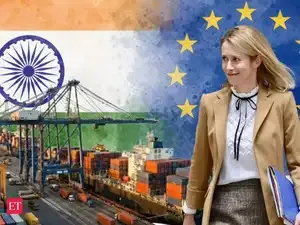
Kaja Kallas, Vice-President of the European Union, arrived in New Delhi on Saturday, marking her first official visit to India. The visit comes as India and the European Union prepare for a series of high-level engagements that could culminate in the announcement of a long-negotiated free trade agreement.
Welcoming her arrival, Ministry of External Affairs spokesperson Randhir Jaiswal said the timing of the visit reflected growing momentum in bilateral ties.
In a post on X, Jaiswal said: “A warm welcome to EU HRVP @kajakallas on her first official visit to India as the EU High Representative/Vice-President. The visit comes at an opportune moment to further strengthen the India-EU Strategic Partnership, building on the momentum of regular high-level engagements.”
Also Read: India's billion-dollar trade deal may be the real show this Republic Day
The free trade agreement is expected to be one of the centrepieces of the 16th India-EU Summit, scheduled to take place in New Delhi. At the summit, both sides are also set to adopt a new EU-India comprehensive strategic agenda, signalling a broader reset of relations beyond trade alone.
Also Read: Mother of all trade deals is loading: What it means for India
Commerce and Industry Minister Piyush Goyal has earlier described the proposed agreement as the “mother of all deals”, pointing to both its scale and its strategic importance. With a combined market of close to two billion people, the pact would link two of the world’s largest democratic economies at a time when global trade is becoming more fragmented.
A report by the Global Trade Research Initiative said the agreement would be India’s biggest and most complex trade deal so far, covering goods, services and trade rules across the European Union’s 27-member customs union.
Also Read: EU’s new GSP rules to impact only 2.66% of India’s exports: Govt
The renewed push to close the deal is closely linked to changes in the global trading environment. High tariffs imposed by the United States have disrupted established trade routes, with some Indian exports facing duties of up to 50 per cent. Trade watchers say this has added urgency for the EU to deepen economic ties with partners such as India, particularly as Washington has taken a more aggressive stance towards European exports.
The expected announcement next week would mark a shift in a relationship that has often struggled to convert political warmth into measurable economic outcomes. While tariff cuts and market access will attract attention, officials on both sides see the agreement as part of a larger strategic recalibration.
“Europe is ready to deliver on a powerful new agenda with India. Today, the EU agreed to move forward with the signature of a new Security and Defence Partnership. It will expand our cooperation in areas such as maritime security, counterterrorism, and cyber defence. I look forward to signing it next week during the EU-India Summit in New Delhi,” she said.
Also Read: Guns, tech and trust: EU's defence reset is India’s big moment
The agreement will mark a shift in how both sides approach defence cooperation. What was once largely a buyer-seller relationship, dominated by a small group of European suppliers, is now expected to evolve into a more structured industrial partnership with long-term implications.
India already has substantial defence trade links with Europe. France, Germany, Spain and Italy have been among India’s key suppliers of advanced weapons, platforms and subsystems. At the same time, Indian defence exports to European countries, particularly ammunition and explosives, have risen sharply over the past two years as European nations work to replenish stockpiles depleted by geopolitical tensions and ongoing military assistance commitments.
EU leaders will attend the Republic Day celebrations as chief guests. President of the European Council Antonio Costa and President of the European Commission Ursula von der Leyen will be on a state visit to India from January 25 to 27 at the invitation of Prime Minister Narendra Modi.
During the visit, Costa and von der Leyen will co-chair the 16th India-EU Summit on January 27. They are scheduled to meet President Droupadi Murmu and hold restricted as well as delegation-level talks with Prime Minister Modi. An India-EU Business Forum is also expected to be held on the sidelines of the summit.
India and the European Union have been strategic partners since 2004. The previous summit was held virtually on July 15, 2020. Officials see the participation of EU leaders as chief guests at the 77th Republic Day celebrations, along with the summit, as a step towards deepening cooperation in areas of shared economic and strategic interest.
Earlier, von der Leyen said the European Union was close to finalising the free trade agreement with India, a deal that some have called “the mother of all deals”. Speaking at the World Economic Forum in Davos, she spoke about Europe’s broader effort to expand trade and international cooperation.
“There is still work to do. But we are on the cusp of a historic trade agreement. Some call it the mother of all deals. One that would create a market of 2 billion people, accounting for almost a quarter of global GDP,” she said.
Von der Leyen said she would travel to India next weekend to take forward work on the proposed agreement. She added that strengthening economic ties and deepening cooperation with India remained a priority, while placing the deal within Europe’s wider global trade strategy, which keeps the bloc open to partners worldwide.
(With ANI inputs)
Welcoming her arrival, Ministry of External Affairs spokesperson Randhir Jaiswal said the timing of the visit reflected growing momentum in bilateral ties.
In a post on X, Jaiswal said: “A warm welcome to EU HRVP @kajakallas on her first official visit to India as the EU High Representative/Vice-President. The visit comes at an opportune moment to further strengthen the India-EU Strategic Partnership, building on the momentum of regular high-level engagements.”
Also Read: India's billion-dollar trade deal may be the real show this Republic Day
India, EU trade talks near conclusion after years of negotiations
India and the European Union are expected to announce the conclusion of their free trade agreement negotiations on Tuesday, after years of slow and often difficult talks. The pact is likely to lower tariffs on European automobiles and wine while giving Indian exporters wider access to the EU market for electronics, textiles and chemicals, according to reports.The free trade agreement is expected to be one of the centrepieces of the 16th India-EU Summit, scheduled to take place in New Delhi. At the summit, both sides are also set to adopt a new EU-India comprehensive strategic agenda, signalling a broader reset of relations beyond trade alone.
Also Read: Mother of all trade deals is loading: What it means for India
Commerce and Industry Minister Piyush Goyal has earlier described the proposed agreement as the “mother of all deals”, pointing to both its scale and its strategic importance. With a combined market of close to two billion people, the pact would link two of the world’s largest democratic economies at a time when global trade is becoming more fragmented.
A report by the Global Trade Research Initiative said the agreement would be India’s biggest and most complex trade deal so far, covering goods, services and trade rules across the European Union’s 27-member customs union.
Europe seeks new partners as global trade shifts
The European Union remains one of the world’s richest consumer markets, with around 450 million people and an economy estimated between €18 trillion and €22 trillion. However, Indian exporters have faced challenges in the bloc since the withdrawal of Generalised System of Preferences benefits in 2023.Also Read: EU’s new GSP rules to impact only 2.66% of India’s exports: Govt
The renewed push to close the deal is closely linked to changes in the global trading environment. High tariffs imposed by the United States have disrupted established trade routes, with some Indian exports facing duties of up to 50 per cent. Trade watchers say this has added urgency for the EU to deepen economic ties with partners such as India, particularly as Washington has taken a more aggressive stance towards European exports.
The expected announcement next week would mark a shift in a relationship that has often struggled to convert political warmth into measurable economic outcomes. While tariff cuts and market access will attract attention, officials on both sides see the agreement as part of a larger strategic recalibration.
Defence partnership may reshape India-EU strategic ties
Running alongside the trade negotiations is a security and defence partnership that EU officials see as equally significant. Speaking in the European Parliament earlier this week, Kallas confirmed that the European Union had agreed to proceed with the signing of a new Security and Defence Partnership with India.“Europe is ready to deliver on a powerful new agenda with India. Today, the EU agreed to move forward with the signature of a new Security and Defence Partnership. It will expand our cooperation in areas such as maritime security, counterterrorism, and cyber defence. I look forward to signing it next week during the EU-India Summit in New Delhi,” she said.
Also Read: Guns, tech and trust: EU's defence reset is India’s big moment
The agreement will mark a shift in how both sides approach defence cooperation. What was once largely a buyer-seller relationship, dominated by a small group of European suppliers, is now expected to evolve into a more structured industrial partnership with long-term implications.
India already has substantial defence trade links with Europe. France, Germany, Spain and Italy have been among India’s key suppliers of advanced weapons, platforms and subsystems. At the same time, Indian defence exports to European countries, particularly ammunition and explosives, have risen sharply over the past two years as European nations work to replenish stockpiles depleted by geopolitical tensions and ongoing military assistance commitments.
EU leaders converge on Republic Day amid symbolic gestures
The broader political significance of the relationship will be visible during India’s Republic Day celebrations. A small military contingent from the European Union will take part in the parade on January 26, marking the first time an EU contingent has participated. The Economic Times reported this on January 20, citing unnamed sources.EU leaders will attend the Republic Day celebrations as chief guests. President of the European Council Antonio Costa and President of the European Commission Ursula von der Leyen will be on a state visit to India from January 25 to 27 at the invitation of Prime Minister Narendra Modi.
During the visit, Costa and von der Leyen will co-chair the 16th India-EU Summit on January 27. They are scheduled to meet President Droupadi Murmu and hold restricted as well as delegation-level talks with Prime Minister Modi. An India-EU Business Forum is also expected to be held on the sidelines of the summit.
India and the European Union have been strategic partners since 2004. The previous summit was held virtually on July 15, 2020. Officials see the participation of EU leaders as chief guests at the 77th Republic Day celebrations, along with the summit, as a step towards deepening cooperation in areas of shared economic and strategic interest.
Earlier, von der Leyen said the European Union was close to finalising the free trade agreement with India, a deal that some have called “the mother of all deals”. Speaking at the World Economic Forum in Davos, she spoke about Europe’s broader effort to expand trade and international cooperation.
“There is still work to do. But we are on the cusp of a historic trade agreement. Some call it the mother of all deals. One that would create a market of 2 billion people, accounting for almost a quarter of global GDP,” she said.
Von der Leyen said she would travel to India next weekend to take forward work on the proposed agreement. She added that strengthening economic ties and deepening cooperation with India remained a priority, while placing the deal within Europe’s wider global trade strategy, which keeps the bloc open to partners worldwide.
(With ANI inputs)