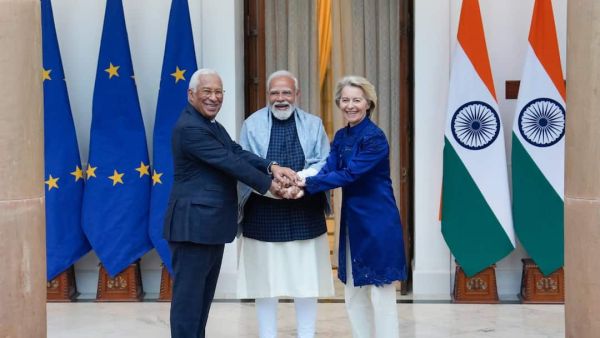
New Delhi: The following are the highlights of the India-European Union free trade agreement, closure of negotiations for which was announced on Tuesday.
The pact is likely to be implemented next year.
* India, the 4th largest economy, and the European Union, the 2nd largest economy, comprising 25 per cent of Global GDP, account for one third of global trade.
* Over 99 per cent of Indian exports gain preferential entry into the EU, unlocking massive growth potential.
* Open new opportunities for MSMEs and create jobs for women, artisans, youth and professionals.
* USD 33 bn of exports in labour-intensive sectors like textiles, leather, marine products, gems and jewellery set to gain immensely from preferential access under the FTA.
* To bring down tariffs up to 10 per cent on almost USD 33 bn of exports to zero duty on the first day of the implementation of the pact
* On automobiles, a calibrated and carefully crafted quota-based liberalisation package
* Will not only allow EU auto makers to introduce their models in India in higher price bands but also open possibilities for Make in India and exports from India in future.
* Indian consumers to benefit from high-tech products and greater competition
* The reciprocal market access in the EU will also open up opportunities for India-made automobiles
* India has prudently safeguarded sensitive sectors, including dairy, cereals, poultry, soymeal, certain fruits and vegetables, balancing export growth with domestic priorities
*FTA provides measures to tackle non-tariff barriers through strengthened regulatory cooperation, greater transparency, and streamlined customs, Sanitary and Phytosanitary (SPS) procedures, and Technical Barriers to Trade disciplines
* Future-ready mobility framework expands global opportunities for skilled, semi-skilled Indian professionals
* Through CBAM (carbon border adjustment mechanism) provisions, commitments have been secured, including a forward-looking most-favoured nation (MFN) assurance extending flexibilities
* Certainty of market access, non-discriminatory treatment, focus on digitally delivered services, and ease of mobility will provide a boost to India's services exports
* India to get access to the EU's 144 sub-sectors like IT/ITeS, Professional Services, and Education Services
* The EU will get access to 102 sub-sectors offered by India
* It will bring in high-tech services and investment into India from the EU, resulting in a mutually beneficial arrangement.
* FTA provides a facilitative and predictable framework for business mobility covering short-term, temporary and business travel in both directions
* The EU and India are providing mobility commitments to each other for Intra-Corporate Transferees (ICT) and Business Visitors, along with entry and working rights for dependents and family members of ICTs.
* The EU has also offered commitments in 37 sectors/sub-sectors for Contractual Service Suppliers (CSS) and 17 sectors/sub-sectors for Independent Professionals (IP).
* India also secured a framework to constructively engage on Social Security Agreements over a five-year horizon.
* India secures access for practitioners of Indian Traditional Medicine to work under home title in EU nations where traditional medical practices are not regulated
*FTA promotes cooperation to advance innovation and secure cross-border electronic payments
*EU becomes India's 22nd FTA partner.
(Disclaimer: This report has been published as part of the auto-generated syndicate wire feed. Apart from the headline, no editing has been done in the copy by ABP Live.)
-
The four Arsenal players who missed training as Mikel Arteta dealt fresh triple injury worry

-
Referee drops out of Premier League action after Man City and Pep Guardiola complaints

-
'I texted Tottenham transfer chief and told him to sign Omar Marmoush - this is how he reacted'

-
Vaibhav Suryavanshi smashed a blistering half-century, hitting 22 fours and 11 sixes as India posted 352 runs in the World Cup.

-
Martin Lewis gives £10,000 ISA advice and highlights 'over 60s rule'