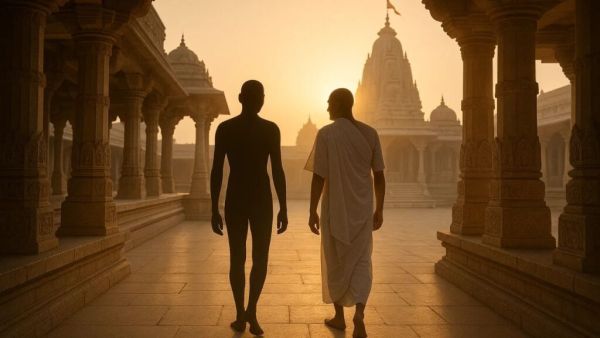
Jainism in India is divided into two major sects. The sects of Jainism include the names Shvetambara and Digambara. Both the sects are based on the principles of non-violence, truth and salvation but there is a deep difference in their conduct, dress and religious beliefs. While Shvetambara saints wear white clothes, Digambara saints perform penance by remaining completely naked. Both have different views regarding worship, idol installation and women’s salvation.
According to historians, the division of these two sects took place about two thousand years ago when the Jain sage went to South India under the leadership of Bhadrabahu and the followers of Sthulbhadra remained in Magadha. Due to climate, social conditions and spiritual practices, differences between the two groups deepened with time and two separate traditions developed.
What is the main difference between Digambara and Shwetambar?
uniform
- Shwetambar Muni wears white clothes.
- Digambara monks live naked i.e. without clothes, the monks of this sect abandon their clothes and perform penance.
women’s perspective of salvation
- In the Shwetambara sect, women are considered worthy of salvation.
- At the same time, in the present situation in the Digambara sect, women are not considered worthy of salvation. In this sect, a man is considered eligible for salvation only after birth.
religious texts
- Shwetambaras are believed to have 12 organs and 12 appendages, which they have compiled.
- According to the Digambaras, the original Agama texts got destroyed with time, so they later considered the texts like ‘Pravachanasara’, ‘Samayasara’, ‘Tatvarthasutra’ etc. as important.
idol makeup
- In the Shvetambara sect, the idols of Tarthankaras are adorned with clothes and jewellery.
- At the same time, in the Digambara sect, the idols do not have clothes, jewelery or even hair-nails etc. The nude image is considered prominent in this sect.
life illustration of lord mahavir
- Shwetambaras believe that Lord Mahavir was born in the womb of Kumarika Trishala and he took up sannyasa wearing clothes.
- Digambaras believe that Mahavir took sannyasa naked and meditated without clothes throughout his life.
conduct of monks and nuns
- Shwetambar Sadhus keep Rajoharan (broom) and Kamandalu (water vessel) with them.
- Digambara Sadhus carry only peacock feather broom (Pichhi) and Kamandalu and take food with their hands on the ground.
geographical spread
- The Shwetambara sect is mainly spread in Gujarat, Rajasthan and Western India.
- Digambara sect is mainly found in Madhya Pradesh, Maharashtra, South India and Bundelkhand.
Similarities of Shwetambara and Digambara sects
- Both sects accept the basic Jain principles like Triratna (Sangat – Knowledge – Character), non-violence, truth, aparigraha etc.
- Both worship Tirthankaras, although the styles are different.
- The goal of both is soul-purification, freedom from the bondage of karma and attainment of salvation.
-
Use of raw milk to brighten skin in winter

-
Women are flaunting lab-grown bling as natural gem prices crumble

-
Acharya Pramod Krishnam spoke on the new rules of UGC, said- ‘There is a conspiracy to divide the country in the name of caste-religion’
-
Dutch designer Ronald van der Kemp furious as Angelababy wears haute couture in livestream sales

-
Javeria Abbasi faces criticism for doing a bold photoshoot with her husband