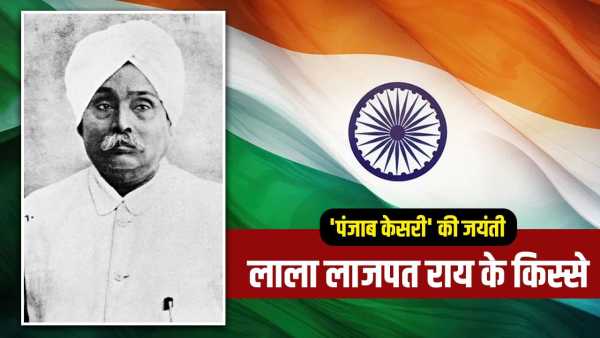
Lala Lajpat Rai was the representative face of extreme nationalism and his name is preserved in history as “Punjab Kesari”.
The destination was the same but the comrades of the struggle had different opinions regarding the path to reach it. The revolutionary stream of the freedom struggle had no confidence in getting rid of the British slavery without taking up arms. But there was a conflict between the followers of the non-violent path of struggle and the soft path. In the late nineteenth century and early twentieth century, this ideological conflict emerged dividing into two clear streams, the moderate party and the extreme party. The extremist group believed in extreme nationalism. The trinity of its leadership was recognized as “Lal-Bal-Pal”.
This triumvirate of Lala Lajpat Rai, Bal Gangadhar Tilak and Bipin Chandra Pal played a historic role in agitating the people against slavery and the British. On the occasion of the birth anniversary of Lala Lajpat Rai, read some stories related to the ideological conflict in the Congress which was battling the British.
dialogue not conflict
In the two decades after the establishment of the Indian National Congress in 1885, the then leadership of the Congress believed in the fairness and generosity of the British rather than in direct confrontation. Liberal leaders like Dadabhai Naoroji, Gopal Krishna Gokhale, Firozshah Mehta were confident of some concessions for the people of India through requests and petitions from the British government.
The effort was to make the government move forward in the constitutional direction. They were also hoping for gradual self-rule. Instead of a direct challenge to the British power, the leaders of the liberal stream were in favor of continuous dialogue with the British government. His thinking was that the path of conflict would hinder dialogue. In the heat of conflict, decisions in public interest will be halted and repression will increase.
Lala Lajpat Rai used to say that the British are exploiters, one should not expect any concession from them without fighting.
no freedom without struggle
Lala Lajpat Rai, Bal Gangadhar Tilak and Vipin Chandra Pal did not expect any generosity or morality from the British. He considered the efforts of moderate thinking leaders to achieve something for the public through requests and petitions as futile. He was in favor of complete independence and bluntly said that independence cannot be given as a gift. It has to be achieved. One has to struggle to achieve this. To make the struggle effective, the public will have to be made aware, fighting and organized. He clearly said that the British were exploiters and no concession should be expected from them without a fight.
Trinity of Lal-Bal-Pal
Lala Lajpat Rai had clearly said that a nation that does not stand up for its own liberation is not the ruler of its plight, it is itself responsible for its plight. The background of the famous slogan of Tilak “Swaraj is our birthright” was actually prepared by the triumvirate of Lal-Bal-Pal. At that time, when the moderate faction of the Congress was avoiding direct confrontation with the British, the extremist faction wanted to move forward openly on the path of struggle.
He said that one should not wait for anyone's blessings to attain Swaraj. This conflict of ideologies came to the fore in the Surat session of Congress in 1907. Congress formally divided into two factions. Lala Lajpat Rai, Tilak and Pal were accused of radicalizing the Congress. On the other hand, extremist leaders alleged that Congress was becoming isolated from the people.
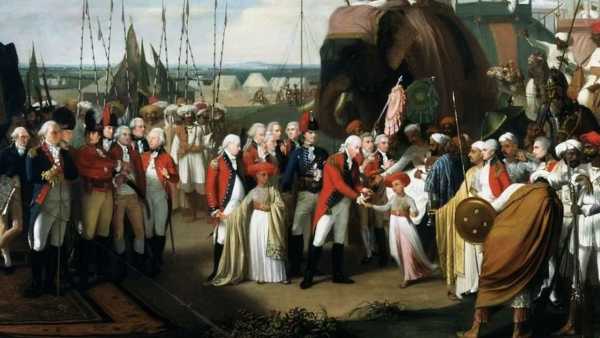
British Empire.
Mere meetings and resolutions cannot bring freedom
After this split of Congress, Lala Lajpat Rai openly attacked the rival camp. Said that the Congress whose concern is limited only to meetings and resolutions cannot represent the soul of the country. The division of Congress weakened the organization. This situation was beneficial for the British. Intensified the cycle of repression. But this ideological conflict and division also yielded meaningful results, which intensified the freedom movement in the coming days.
Swadeshi movement gained momentum. Nationalist thinking expanded. Boycott movements intensified. The public came to the center of the movement for the first time and under pressure the moderates had to openly come into the path of struggle. It can be said that the ground for people-based politics of the Gandhi era was prepared by Lal-Bal-Pal. The mantras of the freedom struggle like non-cooperation, civil disobedience and Quit India Movement were the products of extreme nationalism.
multidimensional personality
This conflict between the moderate and extreme factions of Congress was not the result of any ego or weakness. This was a natural process of democratic thinking and ideological differences. On the other hand, the moderate party gave language and platform to the movement, while on the other hand, the extremist party fueled the struggle.
Lala Lajpat Rai was the representative face of extreme nationalism and his name is safe in history as Punjab Kesari. Had versatile talent and multidimensional personality. He converted extreme nationalist thinking into practice through struggle. On the one hand, he was fighting the British and on the other hand, through Arya Samaj, his struggle against the evils and evil practices of the Hindu society continued. Without education, the society will not wake up and move forward, for this he started a series of DAV colleges.
Struggle – coordination of creation
He had an amazing coordination of struggle and creation. He was not just a political leader. He was also a writer, journalist, social reformer and educationist. His struggle was not only for political freedom. He wanted to free the country from mental slavery. For this, he considered national education based on Indian culture and values necessary. He made concrete efforts in this direction. His emphasis was on establishing indigenous industries and adopting their products for economic self-reliance.
After the partition movement of 1905, Lala ji played an important role in giving an all-India form to the Swadeshi movement. He had said that political freedom is incomplete unless economic and intellectual freedom is achieved. With this thinking in mind, he promoted national educational institutions and indigenous industries. Not only within the country but also abroad he made efforts to create public opinion for India's independence.
In 1907, the British government exiled him to Mandalay (Burma) without trial. During his exile, he deeply understood the structure of colonial rule. There he sharpened his thoughts through writing. It was from here that his thinking became more intense. Between 1914 and 1919, he went to America and founded the Indian Home Rule League of America. He presented India's position to the world through American society and the press. His book The United States of America: A Hindus Impression is not just a travelogue, but a critical review of the West from the Indian point of view – which elevates him above an ordinary leader. He strongly criticized the British rule in his book Unhappy India. The book England's Debt to India gives a factual account of economic exploitation. Another of his books, The Story of My Deportation, is a living document of colonial oppression. These books show that he was not just an emotional but also an intellectual nationalist.
nail in the coffin
The revolutionaries considered this injustice done to this great leader of the freedom struggle as an insult to the nation and vowed to take revenge. Sardar Bhagat Singh, Azad and his comrades fulfilled their oath by killing police officer Saunders. Lala Lajpat Rai, the symbol of extreme nationalism, instilled the spirit of struggle in the freedom movement and especially in the youth. He played an unequaled role in shaping the India of the future not only through movements but also through various positive efforts like social reform and propagation of education. His life teaches that mere change of power is not enough for independence, but social and moral reconstruction is also necessary. The country always remembers her as Punjab Kesari.
-
How to make idli batter at home: Simple guide for soft and fluffy idlis

-
Budget 2026: Will Home Loan Interest Tax Relief Rise to ₹5 Lakh? Big Hope for Homebuyers

-
What Are the 6 Spiritual Truths Only Banaras Can Teach You About Life?
-
5 Signs Hanuman Ji Is Removing Fear and Anxiety From Your Life

-
Building Your Baby's Vision in the Womb: Science, Nutrition, and Safe Pregnancy Habits