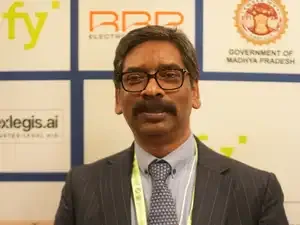
At the World Economic Forum this year, Jharkhand’s leadership presented a recalibrated vision for the state’s future, one that moves toward other sectors and new-age financing models. Across two high-level engagements at ET House in Davos, Chief Minister Hemant Soren and Finance Secretary Prashant Kumar outlined how the state is repositioning itself in global investment conversations.
Speaking at ET House, Chief Minister Hemant Soren said that while Jharkhand’s economic trajectory has been anchored in its mineral endowment, the future calls for diversification, value addition, and future-facing industries.
“A new generation has come up, and its expectations are different,” Soren said in his fireside address. “There is a clear call to go beyond mineral extraction and consider opportunities in processing, manufacturing, and services.”
Soren highlighted the policy space created after the Sustainable Harnessing and Advancement of Nuclear Energy for Transforming India (SHANTI) Act, 2025, noting that it opened new possibilities for Jharkhand in nuclear energy. The Centre already mines uranium in the state, he said, and the new legislative framework allows Jharkhand to evaluate opportunities aligned with India’s evolving critical minerals and energy strategy.
Micro, small, and medium enterprises (MSMEs) constitute another pillar of Jharkhand’s next growth. Soren described them as agile engines of development that can deliver quicker turnaround times and faster employment generation compared to large capital-intensive projects. “Small and medium industries move fast. They start operations quickly and generate jobs almost immediately,” he stated, emphasising that the state is increasingly comfortable enabling such enterprises.
Beyond industry, Soren outlined a broader development canvas. Jharkhand is working to unlock its tourism potential through circuits linking religious destinations such as Deoghar, while also exploring partnerships in sports infrastructure. Calling Jharkhand a “green state with a strong sporting legacy,” he pointed to icons such as former Indian cricket captain MS Dhoni and the state’s contribution to the national women’s hockey team. He added that Jharkhand has the potential to develop large, globally benchmarked sports academies.
Women-led growth is another priority. Soren said the government is assessing focused programmes for women entrepreneurs, building on strong participation in welfare and livelihood schemes. Defending direct benefit transfers against criticism, he said the state’s approach is rooted in long-term empowerment. Initiatives such as the Maiya Samman Yojana and the Guruji Student Credit Card, which provides education loans of up to ₹15 lakh at concessional rates, are aimed at giving people the capacity to stand on their own feet, he said.
Complementing the Chief Minister’s vision, Jharkhand Finance Secretary Prashant Kumar, speaking at a separate panel at ET House, laid out the mechanisms through which the state plans to fund this next phase of growth.
Kumar acknowledged that traditional models of infrastructure financing, largely dependent on budgetary grants and bank lending, are under strain. “Fiscal space is limited, while development needs remain high,” he stated, adding that Jharkhand has begun actively exploring blended finance structures and public-private partnerships to mobilise capital for infrastructure creation.
The state is also increasingly framing contracts where upfront risks are borne by the government while operational risks are transferred to private players. Kumar cited the example of the solar energy sector, where land and water are provided free of cost, along with a 25-year power purchase guarantee. “Once these risks are covered, investments begin to fall into place,” he underlined. Additionally, Jharkhand is drafting a new policy on industrial parks and boosting investments in transportation and logistics hubs.
The panel’s private sector voices underscored the importance of policy certainty. Mohammad Athar, Partner and Leader, Capital Projects and Infrastructure Development, PwC India, said private capital is willing to invest when there is clarity on demand and regulation. He highlighted land policy frameworks, including long-term fixed rental models, as a key lever for unlocking investment.
Saurabh Tripathi, Leader of the Global Financial Institutions Practice at BCG, stressed that infrastructure projects inherently carry policy risk. Certainty around land acquisition, taxation, and regulatory continuity over long planning horizons, he said, is critical to attracting capital. Foreign investors, in particular, seek ways to de-risk “existential risks” that can derail projects in emerging markets.
Tripathi also emphasised that frameworks alone are not enough. “Once you create the right environment, investors do not automatically arrive,” he pointed out. “States need to actively market themselves and identify the right investors.”
Taken together, Jharkhand’s Davos engagements reflected a state aligning vision with execution. By pairing sectoral diversification and MSME-led growth with smarter financing models, risk-sharing frameworks, and proactive global outreach, Jharkhand is positioning itself not just as a mineral-rich state, but as one shaping its next chapter of economic development.
Speaking at ET House, Chief Minister Hemant Soren said that while Jharkhand’s economic trajectory has been anchored in its mineral endowment, the future calls for diversification, value addition, and future-facing industries.
“A new generation has come up, and its expectations are different,” Soren said in his fireside address. “There is a clear call to go beyond mineral extraction and consider opportunities in processing, manufacturing, and services.”
Soren highlighted the policy space created after the Sustainable Harnessing and Advancement of Nuclear Energy for Transforming India (SHANTI) Act, 2025, noting that it opened new possibilities for Jharkhand in nuclear energy. The Centre already mines uranium in the state, he said, and the new legislative framework allows Jharkhand to evaluate opportunities aligned with India’s evolving critical minerals and energy strategy.
Micro, small, and medium enterprises (MSMEs) constitute another pillar of Jharkhand’s next growth. Soren described them as agile engines of development that can deliver quicker turnaround times and faster employment generation compared to large capital-intensive projects. “Small and medium industries move fast. They start operations quickly and generate jobs almost immediately,” he stated, emphasising that the state is increasingly comfortable enabling such enterprises.
Beyond industry, Soren outlined a broader development canvas. Jharkhand is working to unlock its tourism potential through circuits linking religious destinations such as Deoghar, while also exploring partnerships in sports infrastructure. Calling Jharkhand a “green state with a strong sporting legacy,” he pointed to icons such as former Indian cricket captain MS Dhoni and the state’s contribution to the national women’s hockey team. He added that Jharkhand has the potential to develop large, globally benchmarked sports academies.
Women-led growth is another priority. Soren said the government is assessing focused programmes for women entrepreneurs, building on strong participation in welfare and livelihood schemes. Defending direct benefit transfers against criticism, he said the state’s approach is rooted in long-term empowerment. Initiatives such as the Maiya Samman Yojana and the Guruji Student Credit Card, which provides education loans of up to ₹15 lakh at concessional rates, are aimed at giving people the capacity to stand on their own feet, he said.
Complementing the Chief Minister’s vision, Jharkhand Finance Secretary Prashant Kumar, speaking at a separate panel at ET House, laid out the mechanisms through which the state plans to fund this next phase of growth.
Kumar acknowledged that traditional models of infrastructure financing, largely dependent on budgetary grants and bank lending, are under strain. “Fiscal space is limited, while development needs remain high,” he stated, adding that Jharkhand has begun actively exploring blended finance structures and public-private partnerships to mobilise capital for infrastructure creation.
The state is also increasingly framing contracts where upfront risks are borne by the government while operational risks are transferred to private players. Kumar cited the example of the solar energy sector, where land and water are provided free of cost, along with a 25-year power purchase guarantee. “Once these risks are covered, investments begin to fall into place,” he underlined. Additionally, Jharkhand is drafting a new policy on industrial parks and boosting investments in transportation and logistics hubs.
The panel’s private sector voices underscored the importance of policy certainty. Mohammad Athar, Partner and Leader, Capital Projects and Infrastructure Development, PwC India, said private capital is willing to invest when there is clarity on demand and regulation. He highlighted land policy frameworks, including long-term fixed rental models, as a key lever for unlocking investment.
Saurabh Tripathi, Leader of the Global Financial Institutions Practice at BCG, stressed that infrastructure projects inherently carry policy risk. Certainty around land acquisition, taxation, and regulatory continuity over long planning horizons, he said, is critical to attracting capital. Foreign investors, in particular, seek ways to de-risk “existential risks” that can derail projects in emerging markets.
Tripathi also emphasised that frameworks alone are not enough. “Once you create the right environment, investors do not automatically arrive,” he pointed out. “States need to actively market themselves and identify the right investors.”
Taken together, Jharkhand’s Davos engagements reflected a state aligning vision with execution. By pairing sectoral diversification and MSME-led growth with smarter financing models, risk-sharing frameworks, and proactive global outreach, Jharkhand is positioning itself not just as a mineral-rich state, but as one shaping its next chapter of economic development.
(This article is generated and published by ET Spotlight team. You can get in touch with them on etspotlight@timesinternet.in)