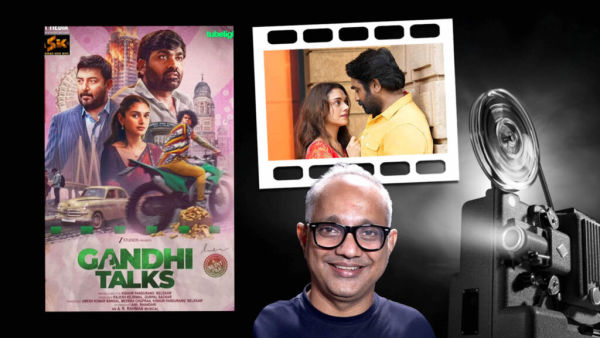
The din around Dhurandhar is yet to die down at the box office. Amid the massive clamour for ‘mass’ films, Indian cinema takes a quieter turn this weekend as a silent film arrives in theatres with little fanfare. Nearly four decades after the delightful Kamal Haasan-Amala Akkineni movie Pushpaka Vimana (The Flower Chariot), Gandhi Talks marks a return to wordless storytelling, this time as a dark comedy, starring Vijay Sethupathi, Arvind Swamy and Aditi Rao Hydari.
For good measure, there is a twist: Gandhi Talks is billed as an AR Rahman musical. Interestingly, its songs are already making noise online. Inquilab Ziddia peppy dance track sung by Shreya Ghoshal (with its Tamil version Rummy Rummy rendered by Khatija Rahman), is gaining traction across platforms. Another winning track is Sunhari Kirnepicturised on Arvind Swamy’s character as he grapples with despair following the collapse of his business empire, and sung by Arijit Singh, a long-time Rahman collaborator.
The award-winning music composer, Rahman recently rattled the Mumbai film industry with his remark that “Bollywood is communal,” triggering widespread unease. While some people expressed sympathy with his view, others felt the criticism was unfair, particularly given that Rahman, who stormed Hindi cinema in the 1990s with his non-conformist, techno-inflected sound, was once treated almost like a demi-god by the industry. But Kishor Pandurang Belekar, director of Gandhi Talksrecounts a very different experience of working with Rahman.
Also read: Back to square one for Jana Nayagan; experts slam hasty court move as CBFC wins appeal
In a chat with The Federal, Belekar shares, “There are many stories about him but my experience has been completely different. Rahman worked passionately on my film and even changed the background score thrice. He kept changing it till the last moment to make it better. This is because there’s no dialogue in the film and you can only hear Rahman’s music. You end up seeing the musical colours in the film,” says Belekar, who did not interfere with the composer’s work at all. In an interview, Rahman even praised Belekar for giving him so much creative freedom to compose music for the film, which meant more to him than a Rs 100 crore fee.
The music used in the silent film ranges from Indian and Western classical music to opera and a cappella too, says Belekar. “I conceived the film, but the film’s sanskar (character) has been given by Rahman, and the actors, who brought the silent film to life,” says Mumbai-based Belekar, a Marathi film director with a theatre background. This pan-Indian film, made on a budget of Rs 30-40 crore, is all set to screen in 900 theatres across India on January 30 and will release in five languages: Hindi, Tamil, Telugu, Malayalam, and Marathi.
A silent film
So, why did he choose to make a silent film? Belekar, who grew up in a Bombay slum circled by constant babble, says that in a world addicted to noise, Gandhi Talks is a rebellious move to remind Indian cinema about its roots.
“Indian cinema itself started with a silent film. Didn’t the film industry begin with the silent film Raja Harishchandra (1913)?” he asks, adding that it seems befitting to celebrate 100 years of Indian cinema with this silent film. In fact, Gandhi Talkswhich centres around the world’s unseemly obsession with money today, begins by paying tribute to the legendary Dadasaheb Phalke.
Aditi Rao Hydari and Vijay Sethupathi in a still from Gandhi Talks.
Belekar adds that while violence, power and money create a lot of noise, truth is quiet. “My characters in the film are honest as they battle against their circumstances. There is a war going on inside them. Because of this, the businessman (Arvind Swamy), who faces bankruptcy, and the unemployed person (Vijay Sethupathi) don’t seem to have any agency and lack a voice.”
On the challenges
Since Gandhi Talks is a film without dialogues (at the most there are just foley sounds), the film’s songs are either heard on a radio or as a background score. The film’s protagonists on which the songs are filmed do not lip sync the songs, and the music plays on in the background. The ‘Zara Zara’ number, shot on Sethupathi and Hydari on Marine Drive in Mumbai, reminds you of a song in a Basu Chatterjee film.
It is a risk to switch off a critical device like dialogue in cinema, Belekar admits. But his passion to experiment on celluloid, inspired by films like Pushpaka Vimana (1987) and Tom Hanks’s 2000 survival drama Cast Away (in which the character is stuck in an island with no one to talk to), the director set out to pursue an impossible dream to make a silent film.
Also read: Dhurandhar becomes first Hindi film to earn Rs 1,000 crore in India
“The audiences have changed since the time of Pushpaka Vimana, so the risks are high. But I was fascinated by the idea. I’ve seen this in theatre; if you take an offbeat subject and present it in a very simple way to people, they will watch it,” he says earnestly. But he faced multiple challenges in his 25-year journey to make the film. It took him that long, he says.
To begin with, it took him 15 long years to write a workable screenplay for a silent film. In a world dominated by mobile phones, for example, how do you have people on the film screen with mobile phones and not talking? he asks.
Getting actors on board
Getting actors on board was another big hurdle. No A-list actor in Bollywood wanted to touch a silent film and I don’t blame them, he reveals. But he had faith in his script and refused to give up. “If Dadasaheb Palke and Singeetam Srinivasa Rao sir could make it, then why couldn’t I?” he asks rhetorically.
Kishor Pandurang Belekar (centre) with Vijay Sethupathi and Arvind Swamy on the sets of Gandhi Talks.
Ironically, both his lead actors are from south India. It was not deliberate. It just happened that way, he says, pointing out that he approached Vijay Sethupathi since he knew the south Indian actor always picked experimental kind of roles.
“I narrated the story to Vijay over the phone from Mumbai and he agreed. He is a fantastic actor, and he had great faith in me. Importantly, he loved the idea of silent cinema. I picked Arvind Swamy since he looked flamboyant, and is a wonderful actor who emotes with his eyes,” he says.
Bagging AR Rahman
It’s another story how he got AR Rahman on board. “It was lyricist Raqeeb Alam, the songwriter for the Hindi dubbed version of Pushpa: The Rose, who connected me to Rahman sir. I sent him my screenplay and a Zoom meeting was arranged. Rahman heard me narrate my story frame by frame. After one hour, he told me, he was doing this film. ‘I love the screenplay and you can count me in,’ he said,” recounts Belekar. However, he recalls asking Rahman shamefacedly, if he could use his name to get a producer since he did not have the money to sign him. And the music composer magnanimously agreed.
Also read: Why the backlash against AR Rahman is unfair and an act of cultural illiteracy
“Once I had Rahman, I quickly got funding, producer, a studio, and everything else fell into place and my film is also releasing in theatres now,” says Belekar. Gandhi Talkshowever, has nothing much to do with Gandhi or his philosophy. “The only Gandhian thing in the film is how people run behind the Gandhi on the rupee note,” says Belekar wryly. However, despite its focus on the unsatiable greed for money in our world today, this dark comedy ends on a note of hope, assures Belekar.
“We only need to look back at our history, at our great leaders and icons like Savitribhai Phule, BR Ambedkar, who gave us the Constitution, Gandhiji, and even Shivaji, all of them can give us wings to stand up and fight for our rights. That’s the message in my film,” he reveals. The director points out that it is not good for the film industry if it took 40 years to make another silent film. He says, “We need all kinds of films to be made. We also need a mass film like Dhurandhar for the industry to run, and we need small experimental cinema as well. Both need to be supported.”
-
India-EU trade deal shows how countries are adapting to American protectionism
-
Arsenal travel preparations for Leeds United trip interrupted as flight decision made

-
Arsenal transfer latest: Deal agreed with 'Messi-like' star as Arteta addresses missed moves

-
Google overhauls Search with Gemini 3: What is changing

-
UK construction company plunges into administration with 300 jobs lost - £17m debt