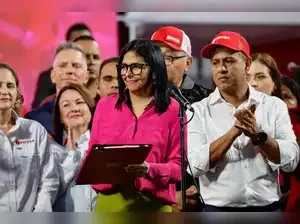
Lawmakers approved in a final vote on Thursday a sweeping reform of Venezuela's main oil law after sweetening a proposal by interim President Delcy Rodriguez to lower taxes, expand the oil ministry's decision power, grant autonomy for private producers and make possible asset transfers and outsourcings.
The changes are expected to encourage increases in oil and gas production and foreign investment following a $100 billion reconstruction plan for the industry proposed by U.S. President Donald Trump this month after the U.S. military captured Venezuelan President Nicolas Maduro.
The fast-tracked reform to the backbone of the country's oil industry follows 20 years of strict nationalization and expropriation of assets previously owned by foreign companies including U.S. oil majors Exxon Mobil and ConocoPhillips, which have not been fully compensated after years of arbitrations and lawsuits.
"We have achieved the unanimous approval of a hydrocarbons law reform that will make hiring domestic and foreign companies to extract resources from the world's largest oil reserve more competitive," said National Assembly President Jorge Rodriguez.
As promised by U.S. officials, Trump's administration eased sanctions on the Venezuelan energy industry related to its oil exports through a general license shortly after the reform approval.
The proposal was submitted, discussed and approved in less than two weeks. Trump said he would control Venezuela's oil revenue indefinitely following a flagship $2 billion supply deal between Caracas and Washington.
Many potential oil investors viewed the reform as "good enough" to encourage initial investment to recover the OPEC country's depleted industry, while former Venezuelan officials have called it unconstitutional.
The new law will allow private producers to operate projects under new oil contracts or in joint ventures, even if they are the minority stakeholders. They are gaining long-sought autonomy to commercialize output and cash proceeds out of state company PDVSA's control.
The reform also formalizes an oil production sharing model first introduced by Maduro and negotiated with little-known energy firms in recent years. Politicians and experts have warned about the secrecy of those deals and the potential for corruption due to loose regulation.
Changes to the text added in recent days prepared the ground for reducing the income tax for energy projects and removed a series of extra taxes. But a new 'hydrocarbon tax' yet to be regulated in separate legislation was introduced, casting doubts about Caracas' intention of really lowering the government's take, among the highest in Latin America.
Proposals made at the last minute by opposition lawmakers to grant transparency, limit the ministry's powers and maintain the National Assembly approval power for oil contracts were rejected.
The legislature's energy committee received some 120 proposals to modify the law, said lawmaker Orlando Camacho, who is allied with the government.
Washington did not recognize the legitimacy of the election of Venezuela's National Assembly. The U.S. also rejected other voting processes in the country that had little participation and a lack of international observation.
MORE FLEXIBILITY
The possibility of transferring oil assets currently owned and operated by state oil firm PDVSA, and to outsource the operation of oilfields under the new contract model was added recently to the reform.
Those production-sharing contracts are expected to be signed as the government makes an evaluation over the next six months of dozens of PDVSA-controlled oil and gas joint ventures, the model that has dominated the industry since the previous hydrocarbons law was approved in 2001.
The National Assembly lost its previous approval authority over contracts, with the oil ministry - currently also controlled by Rodriguez - taking over almost all power to sign contracts and greenlight any term changes.
The changes are expected to encourage increases in oil and gas production and foreign investment following a $100 billion reconstruction plan for the industry proposed by U.S. President Donald Trump this month after the U.S. military captured Venezuelan President Nicolas Maduro.
The fast-tracked reform to the backbone of the country's oil industry follows 20 years of strict nationalization and expropriation of assets previously owned by foreign companies including U.S. oil majors Exxon Mobil and ConocoPhillips, which have not been fully compensated after years of arbitrations and lawsuits.
"We have achieved the unanimous approval of a hydrocarbons law reform that will make hiring domestic and foreign companies to extract resources from the world's largest oil reserve more competitive," said National Assembly President Jorge Rodriguez.
As promised by U.S. officials, Trump's administration eased sanctions on the Venezuelan energy industry related to its oil exports through a general license shortly after the reform approval.
The proposal was submitted, discussed and approved in less than two weeks. Trump said he would control Venezuela's oil revenue indefinitely following a flagship $2 billion supply deal between Caracas and Washington.
Many potential oil investors viewed the reform as "good enough" to encourage initial investment to recover the OPEC country's depleted industry, while former Venezuelan officials have called it unconstitutional.
The new law will allow private producers to operate projects under new oil contracts or in joint ventures, even if they are the minority stakeholders. They are gaining long-sought autonomy to commercialize output and cash proceeds out of state company PDVSA's control.
The reform also formalizes an oil production sharing model first introduced by Maduro and negotiated with little-known energy firms in recent years. Politicians and experts have warned about the secrecy of those deals and the potential for corruption due to loose regulation.
Changes to the text added in recent days prepared the ground for reducing the income tax for energy projects and removed a series of extra taxes. But a new 'hydrocarbon tax' yet to be regulated in separate legislation was introduced, casting doubts about Caracas' intention of really lowering the government's take, among the highest in Latin America.
Proposals made at the last minute by opposition lawmakers to grant transparency, limit the ministry's powers and maintain the National Assembly approval power for oil contracts were rejected.
The legislature's energy committee received some 120 proposals to modify the law, said lawmaker Orlando Camacho, who is allied with the government.
Washington did not recognize the legitimacy of the election of Venezuela's National Assembly. The U.S. also rejected other voting processes in the country that had little participation and a lack of international observation.
MORE FLEXIBILITY
The possibility of transferring oil assets currently owned and operated by state oil firm PDVSA, and to outsource the operation of oilfields under the new contract model was added recently to the reform.
Those production-sharing contracts are expected to be signed as the government makes an evaluation over the next six months of dozens of PDVSA-controlled oil and gas joint ventures, the model that has dominated the industry since the previous hydrocarbons law was approved in 2001.
The National Assembly lost its previous approval authority over contracts, with the oil ministry - currently also controlled by Rodriguez - taking over almost all power to sign contracts and greenlight any term changes.