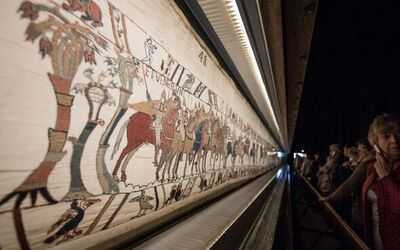
The French are not handing over the Bayeux Tapestry to the UK as planned because of Britain's potholes. The ancient piece of art, which is an embroidery depicting the Battle of Hastings, is supposed to be transported to the British Museum in London while the museum in Normandy undergoes renovations. However, conservationists have said potholes could lead to damage to the artefact. They have filed documents that call on judges to cancel the deal to protect the artwork.
They said that "vibrations and shocks" could lead to damage to the "extremely fragile" piece of historic art. Meanwhile, experts said that potholes in both Britain and France could tear apart the embroidered cloth, which is around 1,000 years old.
Campaigners are contesting Emmanuel Macron's authority in the Conseil d'État, France's highest court, The Telegraph reports. Court documents claim that the French President made a legal "error of judgment" by agreeing to send the tapestry to London. However, the Treasury had signed off on an £800m insurance package to cover the risks.
The British Museum and the French state have also agreed on a maximum level of vibration that the tapestry would be permitted to withstand during the journey. But experts say even the smallest potholes could cause severe damage to the tapestry.
A French heritage group, Sites and Monuments, launched the legal challenge. "If [the roads] are in poor condition, that is obviously not a good thing," said Julien Lacaze, the group's president.
"The risks are those associated with handling the tapestry and the vibrations during a long journey. They must be limited to the bare minimum."
Concerns have been previously raised by French conservationists. A deal was in talks in 2018 when Theresa May was Prime Minister. Court documents question why consistent warnings have been brushed aside in the lead-up to this deal.
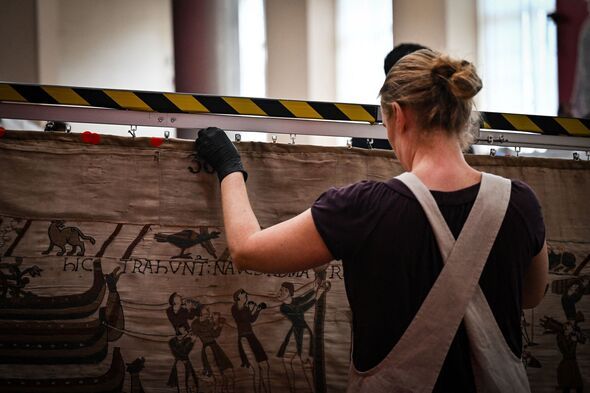
Meanwhile, the regional directorate of cultural affairs last year shared a video online explaining that the artwork was "too fragile to be moved over a long distance". The documents also include a study of the condition of the tapestry from 2022, which lays out the risks of transporting it to Britain.
It revealed that examples of potential shock sources include "breaks in the load, a defect on a road (sudden change in level, hole in the surface, etc.)".
The report reads: " There is no active vibration-damping system that can eliminate all vibration during the handling and transport of the tapestry. In this context, all long-distance transport - beyond three hours - is strongly discouraged."
Last year, the British government and the British Museum promised that the tapestry would only suffer vibrations of "less than two millimetres per second" on its journey to the UK. A Belgian expert on vibration mitigation in the museum sector, Dr Kerstin Kracht, said: "Adhering to the limit will certainly not cause any damage. The only question is whether it is technically possible to comply with this limit."
She said that it's a more likely scenario that vibrations would come close to 45 millimetres per second. Additionally, bumps and potholes would cause further spikes.
She explained: "There are a lot of bumps in the UK. I learnt this during my studies with the British Museum. Believe me, the bumps in Belgium are just as bad, if not worse.
"The fundamental principle of any solution strategy regarding vibration reduction is the avoidance of vibrations. So yes, the smoother a road surface, the better. Every movement of an object carries a risk. This risk will never be completely eliminated."
Last year, Nicholas Cullinan, the director of the British Museum, told The Telegraph that "more fragile things travel all the time", and jobs like this is what the museum does "day in, day out".
-
Why is Chhath Puja celebrated, what is the religious significance and history?

-
Why you should not listen to sad songs

-
What is the capacity of NASA’s most powerful supercomputer?

-
Virat Kohli’s Instagram account reactivated after being deactivated?

-
Vivo V70 series launching soon in India, with premium features